
Managing a team has never been simple, but the expectations placed on managers have shifted dramatically over the past few years. The blend of remote work, AI-assisted workflows, and a workforce that increasingly values autonomy has rewritten what good leadership actually looks like. If you’re still leading the way you did five years ago, you’re likely leaving both performance and morale on the table.
What makes a good manager in 2026 isn’t about being the smartest person in the room or logging the longest hours. It’s about creating the conditions where your team can do their best work — consistently, clearly, and without burning out. That requires a specific mix of skills, habits, and systems that many managers overlook.
This article breaks down the traits and practices that define effective managers right now, with practical steps you can start applying to your own team this week.
Why the Manager’s Role Has Changed
The traditional command-and-control model of management is losing ground fast. Gallup’s ongoing research on the future of work consistently shows that employees who feel their manager genuinely listens to them are significantly more engaged — and engaged teams are more productive, less absent, and far less likely to quit.
At the same time, AI tools are absorbing more routine work, which means your team has more cognitive bandwidth for complex, judgment-heavy tasks. That shifts the manager’s job from task assigner to strategic enabler. You’re no longer just checking boxes — you’re helping people think better, collaborate more effectively, and grow faster.
Core Traits That Define a Good Manager in 2026
1. Clarity Over Busyness
One of the biggest complaints team members have about their managers is vagueness. Unclear priorities, shifting goalposts, and ambiguous feedback create anxiety and waste time. Good managers in 2026 are obsessively clear — about goals, expectations, and what success actually looks like.
This doesn’t mean micromanaging. It means setting up enough structure that your team can make smart decisions independently, without needing to loop you in for every small call. Think of it as building a decision-making framework, not a checklist.
2. Psychological Safety as a Non-Negotiable
Harvard Business Review describes psychological safety as the belief that one won’t be punished or humiliated for speaking up with ideas, questions, concerns, or mistakes. Teams with high psychological safety take more initiative, flag problems earlier, and collaborate more honestly.
As a manager, you set the tone. When you admit you don’t have all the answers, ask for your team’s input before presenting your own view, and respond to mistakes with curiosity rather than blame — you build a culture where people actually bring their best thinking to work.
3. Mastery of Async Communication
Whether your team is fully remote, hybrid, or spread across time zones, async communication is now a core management skill — not just a nice-to-have. Good managers in 2026 know how to communicate context-rich updates that don’t require a follow-up meeting to decode.
This is where having the right tools matters. Many teams still rely on WhatsApp threads or long email chains, which scatter information and make it nearly impossible to track decisions or find context later. Tools like async-first platforms built for team collaboration make a meaningful difference here. Morningmate, for instance, is a work management tool that centralizes team updates, tasks, and file sharing in one place — its feed-style interface means everyone can catch up on what happened without sitting through another sync call.
4. Coaching Mindset Over Directive Leadership
The best managers today act more like coaches than bosses. Instead of handing down answers, they ask better questions. Instead of solving problems for their team, they create space for the team to solve problems themselves — and build capability in the process.
Practically, this looks like shifting your 1-on-1s from status updates to development conversations. Ask your team members what obstacles they’re running into, what kind of support would actually help, and where they want to grow. Then act on what you hear.
5. Visibility Without Micromanagement
McKinsey research on managerial effectiveness highlights that one of the key differentiators of high-performing managers is their ability to stay informed without becoming a bottleneck. You need to know what’s happening across your team — not to control it, but to remove blockers and allocate resources intelligently.
This is a real challenge for managers who are still running their teams out of email inboxes or group chats. When work is scattered, you end up either over-checking in (which feels like surveillance) or being completely in the dark. Morningmate helps solve this by giving managers a single view of tasks, progress, and team activity — so you can stay informed without pinging your team every hour asking for updates.
Practical Habits Good Managers Build in 2026
Traits are one thing — daily habits are what actually move the needle. Here are the routines that separate good managers from average ones.
- Weekly team check-ins with a clear agenda — not just a status round-robin, but a focused conversation around priorities, blockers, and decisions that need to be made together.
- Documented decisions — when your team makes a call, write down what was decided, why, and who owns the follow-through. This prevents the same conversation from happening three times.
- Regular 1-on-1s — at least bi-weekly, focused on the person — not just their tasks. Ask about energy levels, development goals, and what’s getting in their way.
- Clear ownership on every task — ambiguous ownership is where work goes to die. Every piece of work should have one clear owner and a due date. Tools like Morningmate make task assignment and tracking simple, even for teams that aren’t particularly tech-savvy.
- Feedback loops, not annual reviews — build lightweight feedback into your regular rhythms. A quick “that went well because X” or “next time, try Y” in the moment is worth more than a detailed annual performance conversation.
What Good Management Looks Like Across Different Team Types
Remote Teams
For remote managers, the biggest risk is invisible disconnection — team members who feel isolated, unsure of priorities, or hesitant to raise concerns because there’s no natural water-cooler moment to do so. The good manager here invests heavily in written communication, creates deliberate moments for connection, and builds systems that make work visible without requiring everyone to be online at the same time.
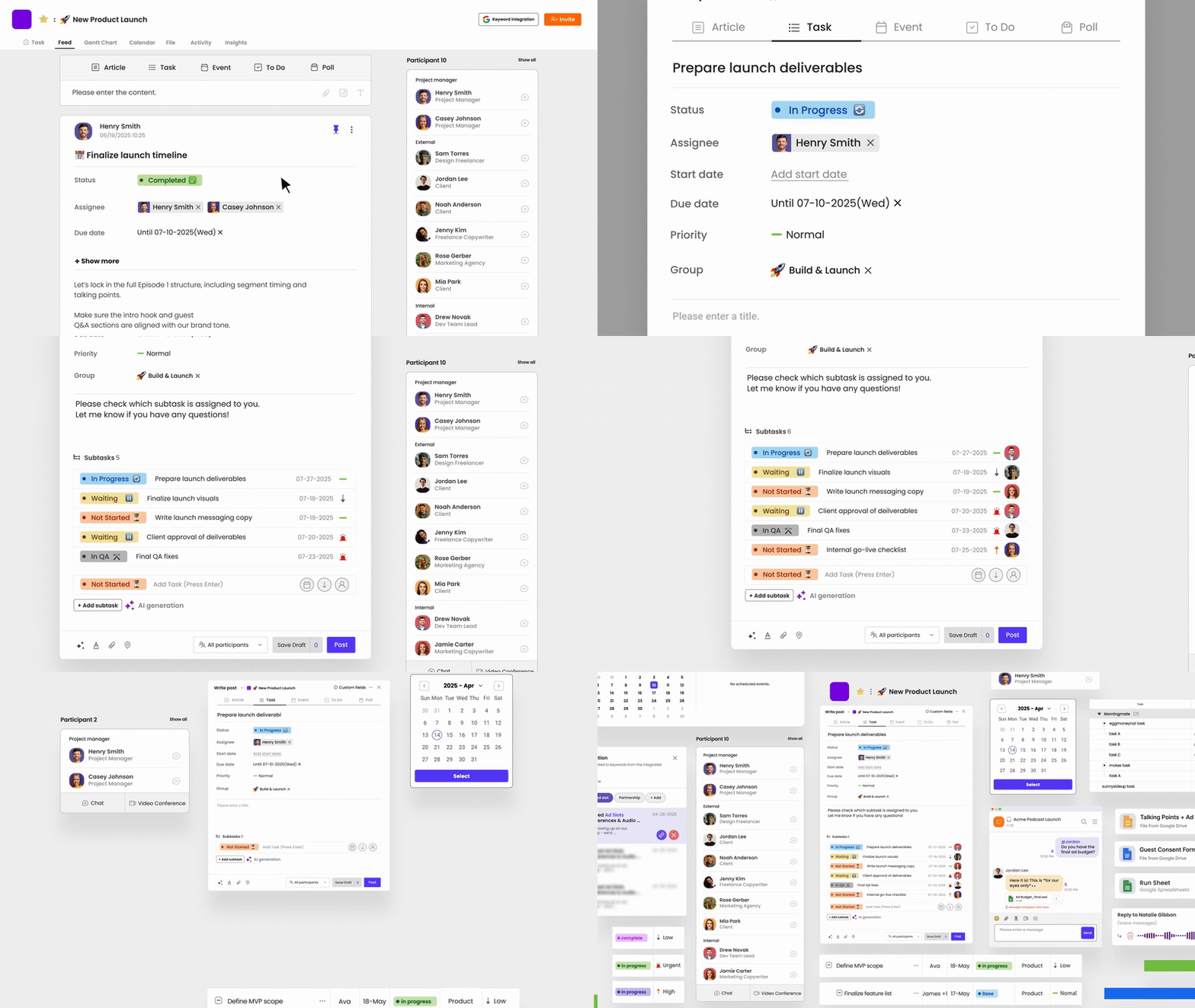
If your team still runs on a mix of email and WhatsApp, it’s worth exploring tools designed specifically for remote team management — ones that keep conversations, tasks, and files in context rather than scattered across multiple apps.
Hybrid Teams
Hybrid management comes with a specific trap: proximity bias. People in the office tend to get more face time, more informal feedback, and more visibility — which can quietly disadvantage remote team members, even when no one intends it. Good hybrid managers actively counteract this by standardizing how work is communicated and reviewed, regardless of where someone is sitting.
Growing Companies
If your company is scaling, the management challenge shifts. What worked when you had ten people usually breaks somewhere around thirty or forty. Processes that lived in people’s heads need to be documented. Communication that happened informally needs structure. A tool like Morningmate — built to be simple enough that non-technical teams actually adopt it — can help growing companies create that shared system without adding unnecessary complexity.
A Simple Self-Assessment for Managers
Honest self-reflection is one of the most underrated management habits. Run through these questions at the end of each month and notice where you’re drifting.
- Does my team know what the top three priorities are this week — without asking me?
- When someone on my team makes a mistake, is their first instinct to tell me — or to hide it?
- Can I tell, right now, what each person on my team is working on and where they’re stuck?
- In my last five conversations with team members, how often did I ask a question vs. give an answer?
- If I were on my team, would I find it easy to do great work — or would I find it confusing and exhausting?
There are no trick questions here. The answers just tell you where to focus next.
The Bottom Line on What Makes a Good Manager in 2026
Good management in 2026 isn’t about having all the answers or being available around the clock. It’s about building clarity, trust, and systems that help your team do their best work — even when you’re not in the room. The managers who get this right will build teams that are faster, more resilient, and genuinely motivated to do great work.
Start with one thing: pick the habit or trait from this article that feels most absent from your current approach and commit to working on it for the next thirty days. Small, consistent changes in how you manage compound into something meaningful over time.