When your team was five people, communication was easy. You sat near each other, or hopped on a quick call, and everyone stayed in the loop. But somewhere between hiring your tenth and thirtieth employee, things start slipping. Messages get buried in email threads. Updates live in personal WhatsApp chats. Someone hears about a decision three days after it was made. Sound familiar?
This is the moment when an intentional internal communication strategy stops being a nice-to-have and becomes something your team genuinely cannot grow without. Without it, you are not just dealing with minor inefficiencies — you are actively losing alignment, trust, and momentum every single week.
The good news is that fixing this does not require a massive overhaul or an enterprise software budget. What it requires is a clear, practical framework that fits how your team actually works. This guide walks you through exactly that.
Why Internal Communication Breaks Down as Teams Grow
Growth introduces complexity. More people means more opinions, more time zones, more departments — and more opportunities for information to get lost in transit. What worked when everyone shared a Slack channel or a single group chat simply does not scale.
Gallup research consistently shows that employees who feel they are not kept informed are significantly less engaged at work. Low engagement is not just a morale problem — it directly affects productivity, retention, and the quality of decisions being made at every level of your company.
The root causes usually fall into a few predictable patterns:
- Information is scattered across too many tools — email, personal messenger apps, spreadsheets, and verbal conversations
- There is no consistent rhythm or cadence for sharing updates
- Teams default to reactive communication rather than proactive transparency
- Leadership assumes information trickles down, but it rarely does
The Core Elements of a Strong Internal Communication Strategy
A real internal communication strategy is not just about picking a tool. It is about deciding what gets communicated, by whom, through which channel, and how often. Here is how to think through each layer.
1. Define Your Communication Channels — and Their Purpose
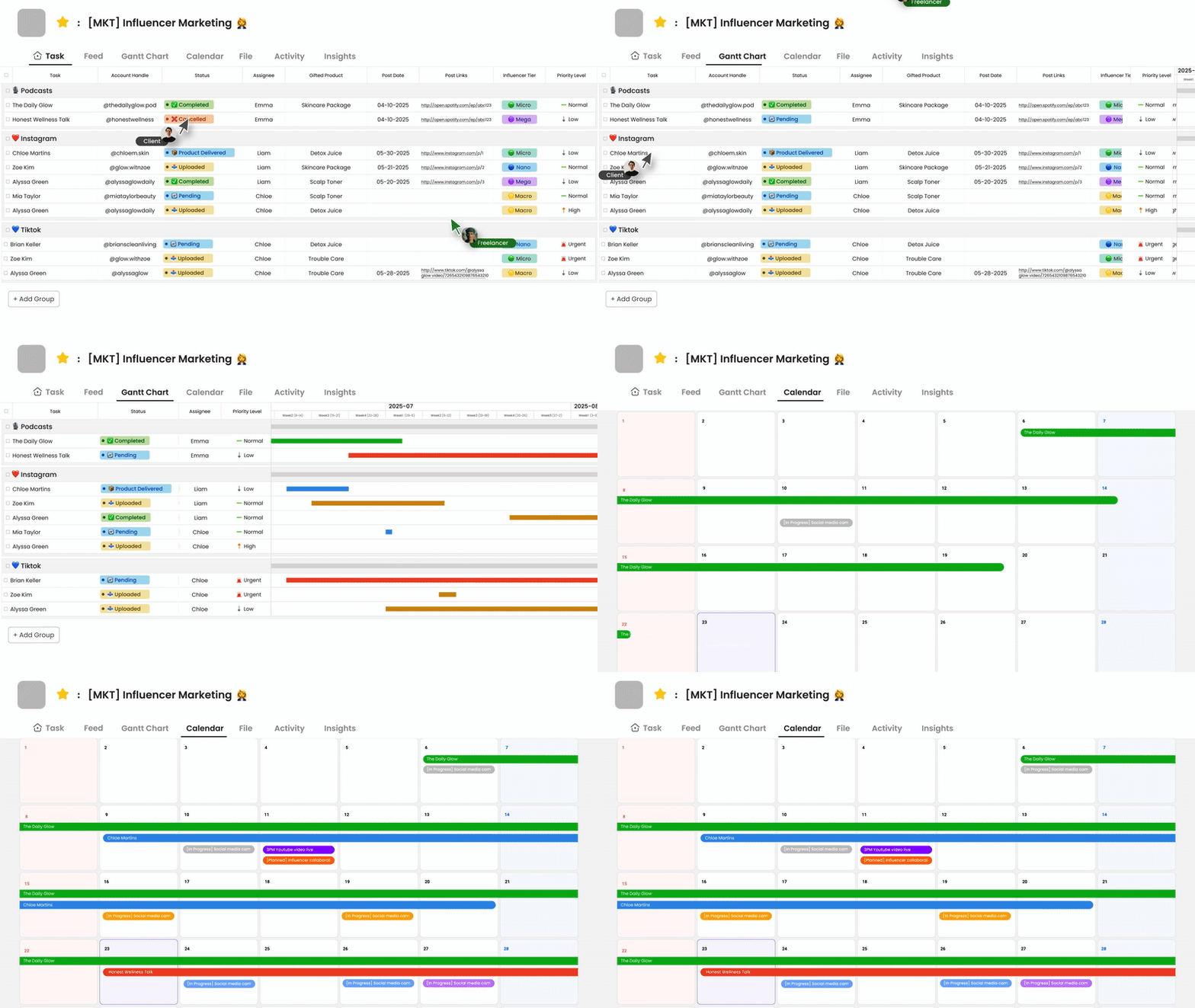
One of the fastest ways to create chaos is to let every type of message compete in the same space. Your first job is to assign clear purposes to each channel your team uses. Think of it as building lanes on a highway — each one handles a different type of traffic.
A simple starting framework looks like this:
- Real-time chat — for quick questions, informal check-ins, and time-sensitive nudges
- Task and project threads — for updates, feedback, and decisions tied to specific work items
- Company-wide announcements — for news, policy changes, and milestone updates that everyone needs to see
- Async updates — for team leads sharing progress, blockers, or weekly summaries without requiring a meeting
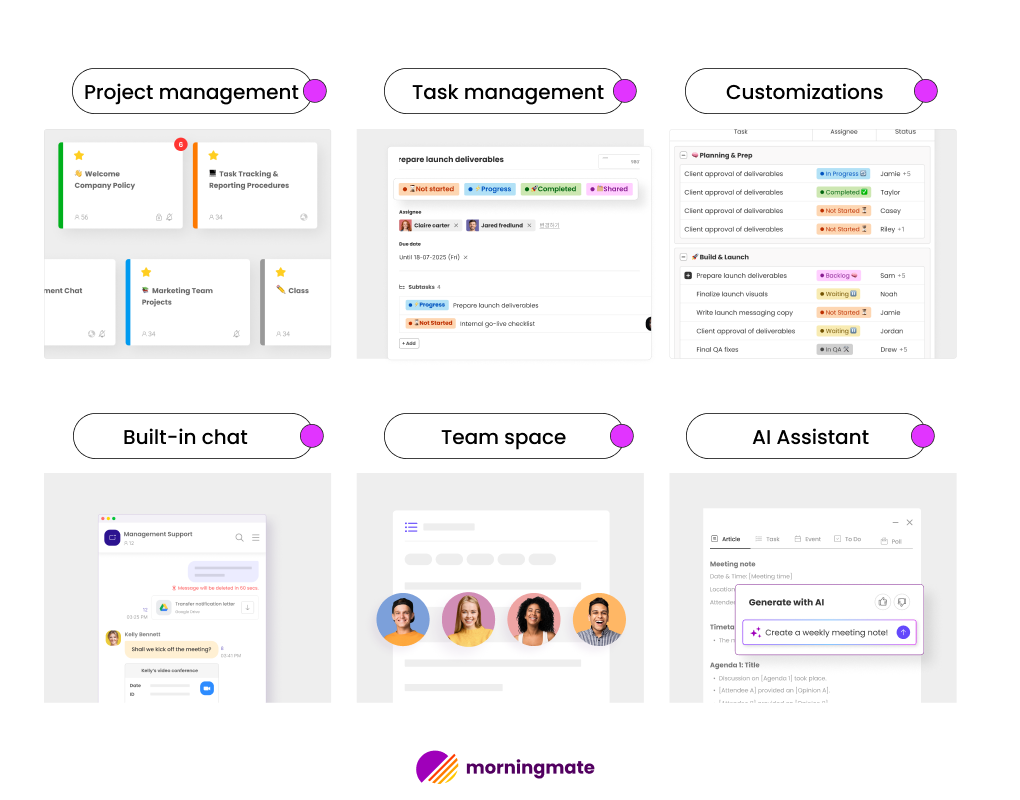
This is where many growing teams find tools like Morningmate genuinely useful. Morningmate is a lightweight work management tool that brings task management, a built-in team chat, and a social-media-style Feed view into one workspace. Instead of bouncing between a project tool and a messaging app, your team can handle structured work updates and real-time conversations in the same place — without the learning curve of complex platforms.
2. Establish a Communication Cadence
Frequency matters as much as format. A team that only hears from leadership during all-hands meetings every quarter is going to fill the silence with assumptions — and assumptions are expensive. Predictable rhythms create psychological safety and reduce the noise that comes from everyone chasing updates on their own.
Consider building a cadence like this into your internal communication strategy:
- Daily: Team-level async standups or brief status posts — no meeting required
- Weekly: Project or department updates shared in a central feed or thread
- Monthly: Leadership roundup covering company priorities, wins, and blockers
- Quarterly: All-hands or team-wide review with space for questions
Even simple async standups posted in a shared workspace can dramatically reduce the number of “just checking in” messages that eat up everyone’s day. This is especially valuable for remote and hybrid teams where spontaneous hallway conversations do not happen.
3. Separate Urgent from Non-Urgent Communication
When everything feels urgent, nothing is. Growing teams often suffer from notification overload — every message pings with the same weight, whether it is a critical client issue or someone asking where to find the Wi-Fi password.
Harvard Business Review has noted that excessive, poorly structured communication actually increases stress and reduces the quality of work output. Training your team to categorize and route messages appropriately is one of the highest-leverage communication habits you can build.
A practical rule: if it requires action in the next hour, use chat. If it requires context or a decision within a day or two, attach it to the relevant task or project. If it is informational, post it in a shared feed where people can read it on their own schedule.
Building Transparency Without Information Overload
There is a real tension in internal communication between sharing too little and sharing too much. Leaders who overcorrect toward radical transparency often end up flooding inboxes with noise. The goal is structured visibility — people can see what they need to see, and can easily find what they are looking for.
This is where the architecture of your tools matters. Morningmate’s Feed view, for example, works similarly to a social media timeline — team members can post updates, share files, and comment on work items in a structured stream. It gives leadership visibility across teams without requiring everyone to attend more meetings or wade through email chains. For operations leads and business owners who need a pulse on what is happening across departments, this kind of centralized, scrollable view is a practical alternative to status-report emails.
Create a Single Source of Truth
Every team needs one place where decisions, updates, and important files live. Not three places. Not “check the email I sent last Tuesday.” One place. When your team knows exactly where to look for information, you eliminate hours of search time and dramatically reduce the “did you see my message?” follow-ups.
This might be a shared project board, a pinned knowledge base, or a team feed. The format matters less than the consistency. Choose it, commit to it, and make sure leadership models the behavior by posting there first.
Give Context, Not Just Updates
One of the most underrated communication skills for managers is explaining the why behind decisions, not just the what. When your team understands the reasoning behind a direction change or a new priority, they can make better decisions independently — which is exactly what you need as you scale.
A useful format for async updates: what happened, what it means for the team, and what the next step is. Three sentences can replace a thirty-minute meeting if the context is clear.
Common Mistakes Growing Teams Make With Internal Communication
Even well-intentioned communication strategies fail when certain habits go unchecked. Watch for these patterns as your team scales:
- Using too many tools at once. When communication is split across email, WhatsApp, Slack, and project tools simultaneously, nothing is findable and everyone is exhausted. Consolidate where you can.
- Treating meetings as the default. Most status updates do not need a meeting. Build a culture of async-first communication, and reserve meetings for decisions and discussions that genuinely benefit from real-time interaction.
- Letting communication be leadership-only. Internal communication is not a top-down broadcast. Build in ways for team members to surface blockers, share wins, and ask questions in the open.
- Never reviewing what is working. Communication needs should be revisited as your team grows. What worked at fifteen people will not work at fifty. Check in quarterly and adjust.
A Practical Checklist for Rebuilding Your Internal Communication Strategy
If you are starting from scratch or doing a reset, here is a straightforward checklist to work through with your team:
- Audit your current tools — list every channel your team uses and what it is used for
- Identify gaps and overlaps — where is information getting duplicated or lost?
- Define channel purposes clearly and share them with the whole team
- Set a communication cadence at the team and company level
- Choose a single source of truth for decisions, updates, and files
- Create templates for recurring communications like weekly updates or project kickoffs
- Train managers to model async-first behavior
- Review and iterate quarterly
If your team currently relies on personal messenger apps or email threads for work communication, this is also a good moment to evaluate whether a dedicated workspace tool could simplify the transition. Morningmate, for instance, was specifically designed for teams who need structure without complexity — the interface mirrors what people already know from everyday messaging apps, which means adoption tends to be fast even for non-technical teams. You can explore how it supports team communication and task management in one place.
How to Get Team Buy-In on a New Communication Approach
The best strategy in the world does not work if your team does not follow it. Change management is half the battle when it comes to communication norms. Here is how to make the shift stick.
Start by involving your team leads in the design process. People support what they help build. If the new communication framework feels imposed from the top, expect passive resistance. If it is co-created, expect ownership.
Then, make the expected behaviors explicit. Write them down. Share them in onboarding. Post them in your team workspace. “We use chat for quick questions and the project feed for updates” is a norm that needs to be stated out loud before it becomes habit.
Finally, leaders need to go first. If the CEO still sends long email chains instead of posting in the shared workspace, the rest of the team will follow that signal, not the policy. Behavioral modeling from the top is the single fastest way to shift a team’s communication culture.
Building a solid internal communication strategy is not a one-time project — it is an ongoing discipline. But every hour you invest in getting this right pays back in fewer misalignments, faster decisions, and a team that actually trusts each other’s updates. That is the foundation every growing company needs.