Project Management

If you have ever watched a key team member leave — and walk out the door with everything they know about how things work — you already understand why documenting processes in a small business matters. Suddenly, no one knows which supplier to call, how invoices get approved, or what happens when a customer complains. The whole operation slows down while everyone scrambles to piece things back together.
The good news is that process documentation does not have to be a massive, painful project. Done right, it is simply the habit of writing down how work gets done — clearly enough that anyone on your team could pick it up and run with it. That kind of clarity is what separates businesses that scale smoothly from ones that feel chaotic no matter how hard everyone works.
This guide walks you through exactly how to document processes in a small business: where to start, what to include, and how to make sure your documentation actually gets used instead of gathering digital dust.
Why Process Documentation Is a Growth Lever, Not a Bureaucratic Chore
Many small business owners associate process documentation with large corporations and compliance departments. But research consistently shows that structured workflows improve performance at every company size. Harvard Business Review has found that well-defined processes reduce errors, speed up onboarding, and free teams to focus on higher-value work rather than reinventing the wheel every time a task comes up.
For a small business specifically, the stakes are even higher. You probably do not have large buffers of time or money to absorb repeated mistakes. When your team of 12 knows exactly how a process works, you stop losing hours to back-and-forth questions, inconsistent outputs, and rework.
The Hidden Cost of Undocumented Work
When processes live only in someone's head, your business becomes dependent on that person being available, in a good mood, and remembering every detail correctly. That is a fragile system. McKinsey research estimates that employees spend nearly 20 percent of their workweek searching for information or tracking down colleagues to get answers — time that documented processes would return to productive work.
Undocumented work also creates inconsistency. Two people doing the same job will do it differently, which means your customers get different experiences depending on who handles their request. Documentation creates a shared standard everyone can follow.
Where to Start: Choosing Which Processes to Document First
You do not need to document everything at once. Start with the processes that cause the most friction or carry the most risk if something goes wrong. A simple prioritization exercise can help you figure out where to begin.
Ask yourself these three questions about any process you are considering:
Does this process happen frequently enough that small inefficiencies add up?
Would a new hire struggle to do this correctly without guidance?
Would a mistake here directly impact a customer, a deadline, or revenue?
If you answer yes to any two of those, that process belongs near the top of your list. Most small businesses find that the highest-priority areas are client onboarding, invoicing and payment workflows, team communication protocols, and recurring operational tasks like weekly reporting or inventory checks.
Start With What Already Works
One of the fastest ways to build momentum is to document a process that is already running smoothly. Interview the person who does it best, watch them work if you can, and write down what you observe. This feels less abstract than trying to design an ideal process from scratch — and it gives your team a model to follow right away.
How to Document a Process: A Step-by-Step Approach
Good process documentation does not require special software or formal training. It requires clarity, consistency, and a commitment to keeping things simple enough that people will actually read and use what you write.
Step 1 — Name and Define the Process
Give the process a clear, descriptive name. "Client Onboarding" is better than "New Customer Stuff." Then write one or two sentences that define what the process covers, where it starts, and where it ends. This scope statement prevents confusion later about what is and is not included.
Step 2 — Identify the Owner and the Audience
Every documented process should have one owner — the person responsible for making sure it is followed and kept up to date. You should also note who the audience is: the role or roles that will actually use this document. Writing for a sales coordinator is different from writing for a warehouse supervisor.
Step 3 — List Every Step in Sequence
Break the process into numbered steps, written in plain language. Use action verbs and be specific. Instead of "Handle the customer inquiry," write "Reply to the customer's email within four business hours using the approved response template stored in the shared drive." Vague instructions produce vague results.
If a step involves a decision — for example, what to do if a payment is overdue versus on time — document both paths. A simple "if this, then that" format works well here.
Step 4 — Add Supporting Materials
Link to any templates, checklists, forms, or tools the person will need. If there is a video walkthrough, attach it. The goal is to make the document fully self-contained so the reader does not have to go hunting for anything to get started.
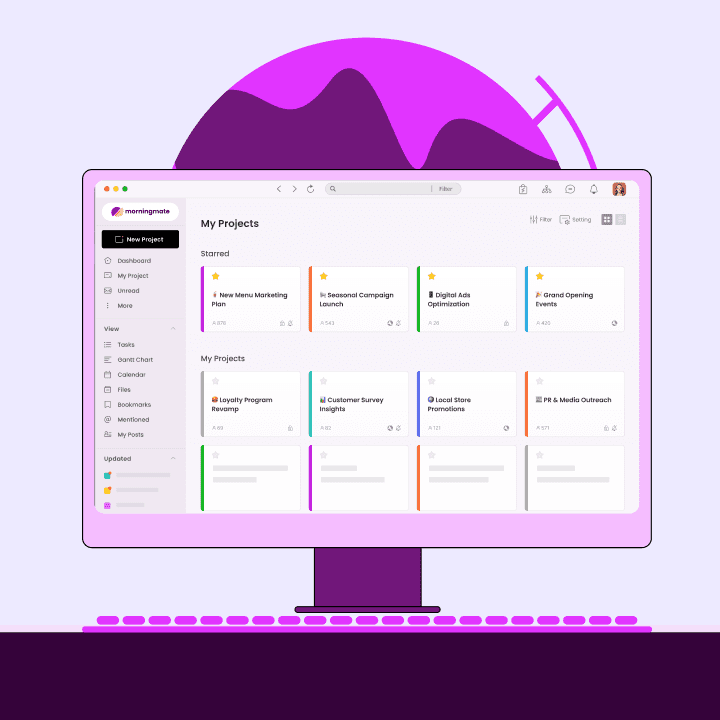
This is where a tool like Morningmate — a lightweight work management platform — becomes genuinely useful. You can store process documentation as posts in a project feed, attach the relevant files directly to that post, and assign related tasks to specific team members all in the same place. Nothing gets buried in an email thread or lost in a personal chat app.
Step 5 — Test It With Someone New
Before you call a process document finished, hand it to someone who does not already know the process and ask them to follow it without your help. Watch where they slow down, get confused, or make a wrong turn. Those are your gaps. Fix them before you roll the document out to the whole team.
Formats That Actually Get Used
The format you choose for your process documentation should match how your team works. A long written SOP (Standard Operating Procedure) is thorough, but it is not always what someone needs when they are in the middle of a task and just need a quick reminder of the next step.
Consider mixing formats depending on the complexity and frequency of the process:
Numbered step lists — best for linear, repeatable tasks like processing a return or setting up a new employee account
Checklists — ideal for quality control steps or pre-launch reviews where completion matters more than order
Flowcharts — useful when a process has multiple decision points and branches
Short screen-recorded videos — great for software-based processes where showing is faster than describing
One-page quick reference cards — for high-frequency tasks that experienced team members just need a reminder prompt for
The best documentation is the kind your team will actually open. If your current process docs are long Word documents that nobody reads, it is worth experimenting with shorter, more visual formats. You can always improve how your team communicates around processes once the core content is solid.
Keeping Documentation Alive: The Maintenance Problem
The most common failure mode for process documentation is not writing it — it is letting it go stale. A document that describes how things worked 18 months ago is not just useless. It is actively harmful because people trust it and follow incorrect steps.
Build maintenance into the system from the start. Two practical approaches that work well for small businesses:
Assign Version Control and Review Dates
Every process document should have a "last reviewed" date and a scheduled next review. For fast-moving areas like sales or customer support, review quarterly. For stable back-office processes, once or twice a year is usually enough. The process owner is responsible for triggering that review and updating the document when anything changes.
Make Updating Easy
If updating a document requires navigating three different systems or asking for edit permissions, it will not get done. Keep your documentation somewhere your team already works. Morningmate, for instance, allows teams to post updates, tag colleagues, and attach revised files directly within the workflow — so documentation stays connected to the actual work rather than sitting in a separate folder that no one remembers to check.
This kind of centralized knowledge management is one of the clearest advantages a small business can build as it grows.
Common Mistakes to Avoid When Documenting Business Processes
Even well-intentioned documentation efforts can fall flat. Watch out for these patterns:
Writing for yourself, not the reader. If you already know the process well, you will skip steps that feel obvious to you but are not obvious to someone new. Always write at the level of a competent but unfamiliar reader.
Making documents too long. If a process document runs more than two pages, consider whether it should be broken into smaller sub-processes. Long documents discourage reading.
Storing documentation where it cannot be found. A process guide buried in a shared drive subfolder from three years ago might as well not exist. Keep documentation somewhere searchable and accessible — ideally where your team already spends their working day.
Skipping the why. People follow processes more consistently when they understand the reason behind them. A single sentence explaining why a step matters dramatically improves compliance.
Treating documentation as a one-time project. Processes evolve. Documentation needs to evolve with them. Build in the maintenance habit from day one.
Getting Your Team On Board
Even the best process documentation fails if your team does not use it. Adoption is a culture question as much as a systems question. Gallup's workplace research consistently shows that employees engage more deeply when they feel their input shapes how work is done — which means the people who actually perform a process should help document it, not have documentation handed down to them.
Involve your team in the drafting process. Ask the person who does a task best to write the first draft, then have a colleague review it. When people contribute to the documentation, they feel ownership over it — and they are far more likely to both follow it and update it when something changes.
Make Documentation Part of How Work Gets Assigned
One practical way to embed documentation into your culture is to link it directly to task assignment. When you assign work to someone — whether through a project management tool or a team chat — attach the relevant process document to that assignment. Over time, the habit of checking the documentation before starting a task becomes automatic.
Teams using Morningmate can do this natively: tasks include descriptions, file attachments, and due dates, so the process guide, the assignment, and the deadline all live together in one place. There is no need to ping someone in a separate chat to ask where the instructions are. This is especially useful for remote and hybrid teams where people are not sitting close enough to tap a colleague on the shoulder.
A Simple Process Documentation Template to Get Started
If you want to start today, use this structure for your first process document. Keep it short and practical — you can always add detail later.
Process name — clear and descriptive
Process owner — the role responsible for this process
Audience — who will use this document
Purpose — one sentence on why this process exists
Trigger — what event or condition starts this process
Steps — numbered, written in plain language, with action verbs
Decision points — if/then branches clearly explained
Tools and templates — links to everything needed
Definition of done — how you know the process is complete
Last reviewed date — and the name of the reviewer
Print that out, stick it on your wall, and use it as a checklist every time you sit down to document a new process. You will be surprised how quickly a library of clear, usable documentation starts to build up.
Documenting processes in a small business is not about creating bureaucracy. It is about building a foundation that lets your team work confidently, your business grow without chaos, and your time as a leader shift away from firefighting and toward the work that actually moves things forward. Start with one process this week. Write it down clearly. Test it. Share it. Then do the next one.