
Cross-team collaboration sounds simple in theory. In practice, it’s where work goes to get stuck. Deadlines get missed because one team didn’t know another was blocked. Decisions get made in silos. Updates live in three different apps, and nobody’s quite sure which one is current.
If your teams are growing — or already stretched thin — the cost of poor cross-team collaboration shows up fast: duplicated work, slow delivery, and frustrated people. McKinsey research has found that employees spend a disproportionate amount of their working hours just trying to coordinate — not actually doing the work. That’s a systems problem, not a people problem.
The good news is that improving how your teams work together doesn’t require a massive overhaul. It requires the right structure, shared visibility, and tools that don’t create more friction than they solve. Here’s how to get there.
Why Cross-Team Collaboration Breaks Down
Before fixing the problem, it helps to understand what’s actually causing it. Most cross-team collaboration issues come down to a few recurring patterns.
Information Lives in Too Many Places
One team uses email. Another uses WhatsApp. Someone started a Slack channel last month. The result is that critical updates are scattered, and nobody has a complete picture of what’s happening. When teams can’t see each other’s work, they make decisions without full context — and that’s where things go sideways.
There’s No Clear Ownership Across Teams
Shared projects often fall into a gray zone where nobody knows who’s responsible for what. Without clear ownership, tasks stall at handoff points. Teams wait on each other without realizing they’re the ones holding things up.
Meetings Are Doing the Work That Systems Should Do
When teams lack a shared system for updates, they compensate with more meetings. Harvard Business Review has reported that executives spend an average of nearly 23 hours a week in meetings — much of it spent on status updates that a good system would make unnecessary. Meetings should be for decisions, not catch-ups.
How to Improve Cross-Team Collaboration: A Practical Framework
Improving cross-team collaboration isn’t about adding more check-ins. It’s about building a shared operating system — one where every team knows what others are working on, what’s blocked, and what needs input.
1. Create a Single Source of Truth for Work
The first step is consolidating where work lives. Every project, task, and update should exist in one place that any relevant team member can access. This doesn’t mean one giant board with everything on it — it means a connected workspace where teams can see their own work and get visibility into others’.
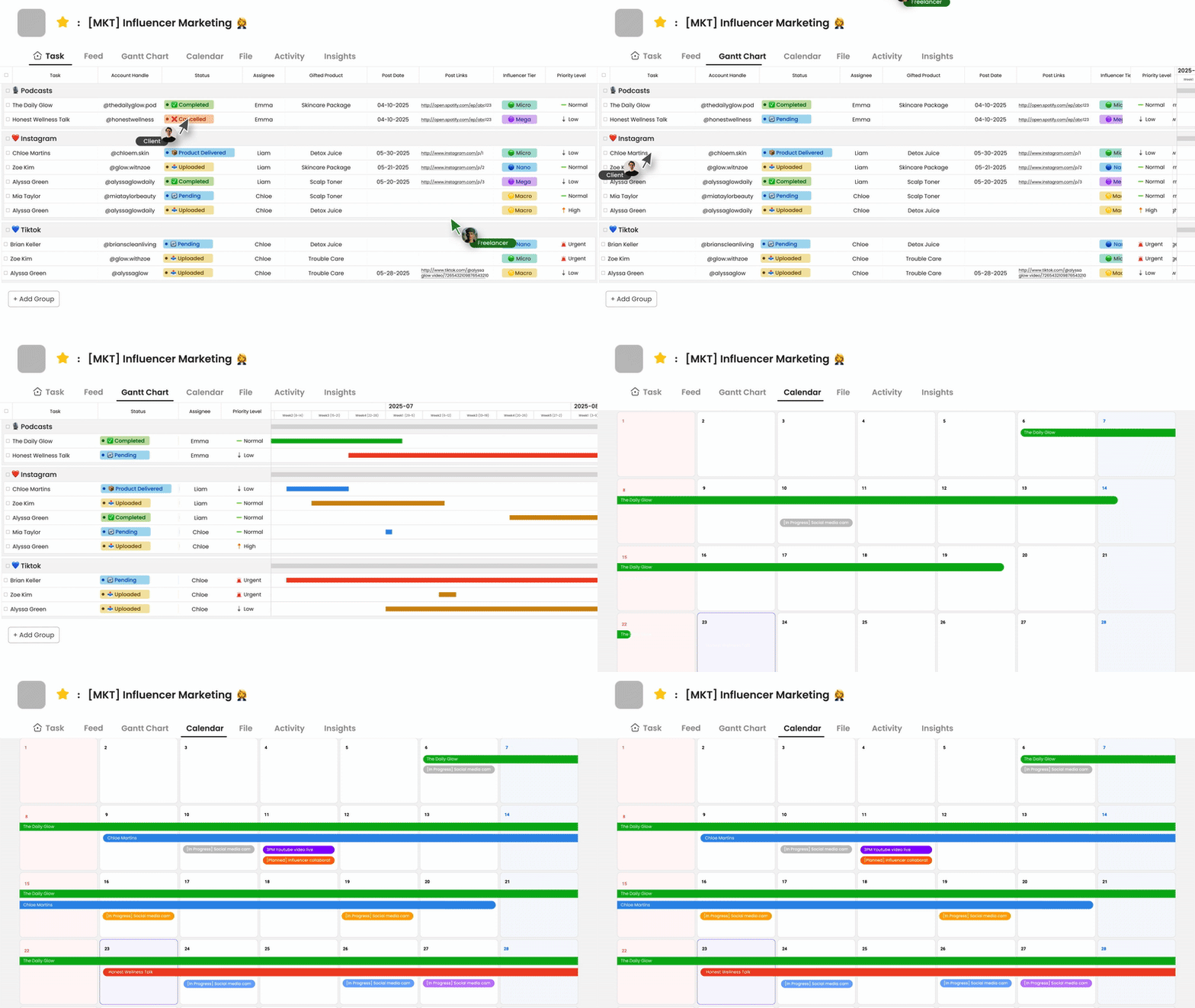
This is where tools matter. Morningmate, a lightweight work management platform used by over 550,000 teams, organizes work into a social-media-style Feed that makes it easy to post updates, share files, and keep project context in one place. Because the interface feels familiar — similar to the apps people already use daily — even non-technical teams adopt it quickly without a steep learning curve.
2. Define Roles and Handoffs Before Projects Start
At the start of any cross-team initiative, get specific about who owns what — and where one team’s responsibility ends and another’s begins. A simple RACI matrix (Responsible, Accountable, Consulted, Informed) can prevent a lot of downstream confusion.
Document these agreements somewhere your teams can reference, not just in a meeting that gets forgotten. Make the handoff points explicit: “When design delivers final assets, the dev team picks up within 48 hours.” Vague handoffs create vague accountability.
3. Shift Status Updates Out of Meetings and Into Async Tools
If your teams are syncing daily just to share what they’re working on, that’s a sign your tools aren’t doing their job. Async updates — posted to a shared workspace that anyone can check at any time — give teams visibility without requiring everyone to be available at the same moment.
This is especially critical for hybrid and remote teams. Gallup’s research on hybrid work shows that remote employees consistently report lower feelings of connection and visibility at work — a gap that async tools and shared workspaces can meaningfully close.
4. Build Communication Norms Across Teams
Different teams often have different communication habits. Marketing might respond to messages within the hour; engineering might batch their replies. Neither is wrong, but without shared norms, both teams end up frustrated.
Agree on a few basics across your organization:
- What channel is used for urgent vs. non-urgent messages?
- What’s the expected response time for cross-team requests?
- Where do decisions get documented after they’re made?
- What warrants a meeting vs. an async update?
Writing these norms down — even informally — makes a real difference. Teams stop guessing and start following a shared playbook.
5. Give Teams Visibility Without Overloading Them
Cross-team visibility doesn’t mean everyone needs to see everything. It means the right people can see the right things when they need to. Over-sharing creates noise; under-sharing creates blind spots. The goal is structured transparency.
With Morningmate’s task management and built-in chat, teams can organize work by project or department, share updates in context, and loop in other teams only when relevant — without flooding everyone’s feed with updates that don’t apply to them. The built-in chat works like a familiar messaging app, so teams can ask quick cross-team questions without switching to a separate tool.
Cross-Team Collaboration Checklist
Use this as a starting point when kicking off any cross-team project:
- Is there a shared workspace where all teams can track this project?
- Has each team’s role and ownership been clearly defined?
- Are handoff points documented with timelines?
- Do all teams know which tool to use for what type of communication?
- Are status updates async-first, with meetings reserved for decisions?
- Is there a point person responsible for cross-team coordination?
- Have you agreed on how blockers get escalated and resolved?
What Good Cross-Team Collaboration Actually Looks Like
Picture this: your ops team is rolling out a new process that affects both sales and customer support. Instead of a chain of emails and a handful of “quick calls,” they create a shared project in a central workspace. Each team has its own task list. Updates get posted as they happen. When a dependency comes up, the relevant people are tagged directly in context — not buried in a reply-all thread.
By the time the rollout happens, every team knows exactly what changed, why it changed, and what they’re responsible for. Nobody’s blindsided. That’s what structured cross-team collaboration makes possible — and it’s a lot more achievable than it sounds.
If your teams are still relying on email threads and personal messenger apps to coordinate across departments, it’s worth looking at a purpose-built alternative. Morningmate is designed for exactly this — giving growing teams a simple, organized workspace that replaces scattered communication with one shared system. You can explore how remote and hybrid teams use tools like this to stay aligned without the overhead of complex project management software.
Start Small, Then Scale
You don’t need to fix everything at once. Pick one cross-team workflow that’s currently painful — a recurring handoff, a shared project that keeps stalling, a communication loop that eats up meeting time — and apply these principles there first. Get it working, document what helped, then roll it out further.
The teams that collaborate well across departments aren’t doing anything magical. They’ve just built the habits and systems that make coordination the default — not the exception. That’s a standard any team can reach, regardless of size or industry.