Every week I have a version of the same conversation.
A business owner — usually running somewhere between 10 and 50 people — tells me they’ve been hearing a lot about AI and they’re wondering if they should be doing something about it. They’ve seen the headlines. They’ve watched a few demos. They’ve maybe tried ChatGPT a few times and found it interesting but weren’t sure what to do with it.
And then they ask: “Is this actually useful for a business like mine? Or is it all hype?”
It’s a fair question. And the honest answer is: both. Some of it is genuinely useful. Some of it is noise. The hard part is knowing which is which.
The Collaboration Evolution
To understand where AI fits, it helps to understand the trajectory.
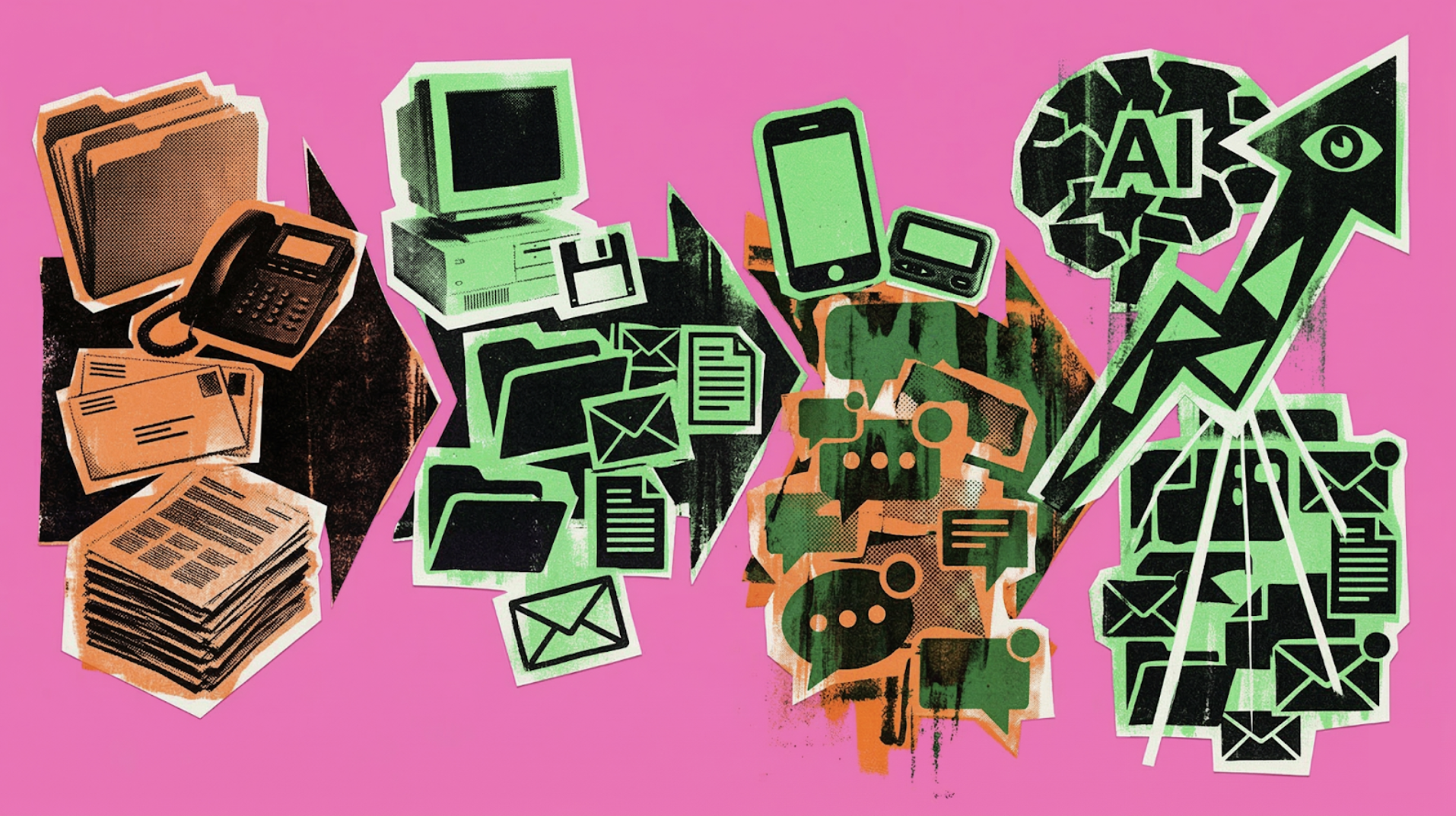
Think about how business communication has changed decade by decade. In the 90s, everything was physical. Then the PC moved things digital — files, emails, documents. Then mobile made communication instant and always-on — but also, for a lot of businesses, overwhelming and fragmented.
Now we’re in a new phase. AI tools are starting to sit on top of all that accumulated information and make it actually usable. The shift is from tools that store information to tools that understand it.
What’s Genuinely Useful Right Now
Let me be direct about the categories that are delivering real value for small businesses today.
| AI Capability | What It Actually Does | Realistic Time Saved | Readiness Requirement |
| Meeting transcription & summary | Turns a 45-min meeting into decisions + action items automatically | 2–3 hrs/week per team | Just needs to be turned on |
| Smart search across work history | Surfaces relevant past context in seconds | 1–2 hrs/week per person | Requires info to be in one system |
| First-draft generation | Produces solid first drafts of comms, SOPs, proposals | 30–60% of writing time | Works standalone |
| Automated status reports | Generates weekly summaries from task data — no one writes it manually | 1–2 hrs/week for managers | Requires consistent task tracking |
| AI-assisted onboarding answers | New hires ask questions, AI answers from stored SOPs | Variable | Requires documented SOPs |
Meeting transcription and summarization is the clearest win. Most small businesses don’t take consistent notes. Decisions made in meetings live in people’s memories, drift over time, and cause the confusion we talked about earlier. AI transcription tools now produce accurate summaries in under a minute. Decisions, action items, context — automatically, without anyone doing it manually.
Search across your own information is a real one too. If your team has been using a collaboration tool consistently, AI search can now surface relevant context in seconds. Instead of asking a colleague “what did we decide about the supplier terms?”, you ask the tool. This only works if the information was captured in the first place — which is why the structural foundation matters before the AI layer does.
First-draft generation is useful for certain roles. If someone on your team writes customer communications, proposals, or SOPs, AI can produce a solid first draft quickly. It won’t replace the judgment of someone who knows your customers. But cutting the blank-page problem in half is a genuine productivity gain.
Status summarization doesn’t get talked about enough. If work is tracked in a system, AI can generate a weekly summary of what moved, what’s stuck, what needs attention — without anyone writing that report. The report writes itself from the data.
What’s Still Mostly Noise
There’s a longer list of AI capabilities that are impressive in demos but haven’t translated into consistent value for most small businesses yet.
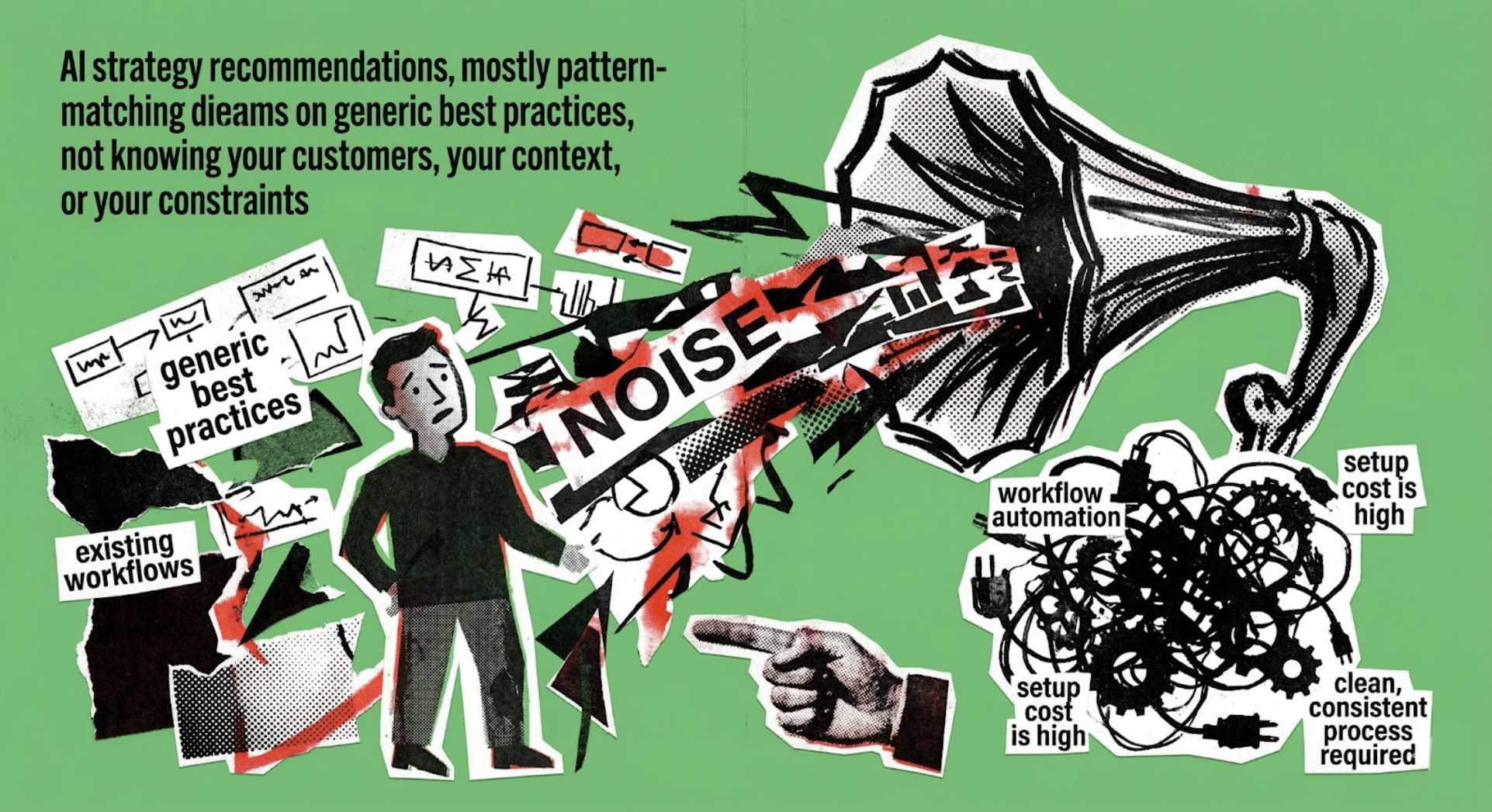
AI-generated strategy recommendations are the big one. Tools that claim to analyze your business and tell you what to do are mostly pattern-matching on generic best practices. They don’t know your customers, your context, or your constraints. They sound authoritative. Be skeptical.
Complex workflow automation is genuinely powerful, but the setup cost is high and it requires a clean, consistent process to automate in the first place. If you’re still running on WhatsApp and spreadsheets, automation tools will frustrate you before they help you.
The rule I’d suggest: if an AI tool requires you to build a new habit or a new process, it probably won’t stick unless the underlying need is urgent. The useful tools are the ones that slip into existing workflows and make them better.
The Real Value: Making Good Work Possible
There’s a framing I keep coming back to, because I think it captures what AI actually does when it works well.
“AI doesn’t do the work. It removes the friction that gets in the way of the work.”
Think about what gets in the way of good work in most small businesses. Information you can’t find. Context you have to rebuild every time. Repetitive tasks that drain energy. Updates that need to be manually compiled. Decisions made without the right information because nobody had time to pull it together.
AI, at its best, quietly removes those obstacles. The information surfaces when you need it. The summary is already written. The status is already updated. The first draft is already there.
What remains — the judgment, the relationships, the decisions that require real understanding of your business and your customers — that’s still entirely human. And it’s more valuable when it’s not buried under coordination overhead.

The Three Questions Worth Asking
When I talk to business owners about AI tools, three questions cut through the noise.
| Question to Ask | Green light if… | Red flag if… |
| Does this make existing work faster, or create new work to use it? | Faster — it fits into current flow | New habits required before any benefit |
| Does this require my information to be organized first? | No, or you’ve already done that | Yes, and your info is currently scattered |
| Would this still be useful in 6 months, not just now? | Solves a persistent problem | Solves a novelty problem |
The Compounding Effect
Here’s what I find genuinely exciting about where things are heading.
The businesses that are building good structural foundations now — one place where work lives, clear ownership, consistent status updates — are going to benefit disproportionately from AI tools over the next two to three years.
Because the AI capabilities that are coming will be much more powerful when your information is clean and accessible. The businesses that have been running on WhatsApp chaos will struggle to unlock that value. The ones that did the structural work first will find that AI stacks on top cleanly.
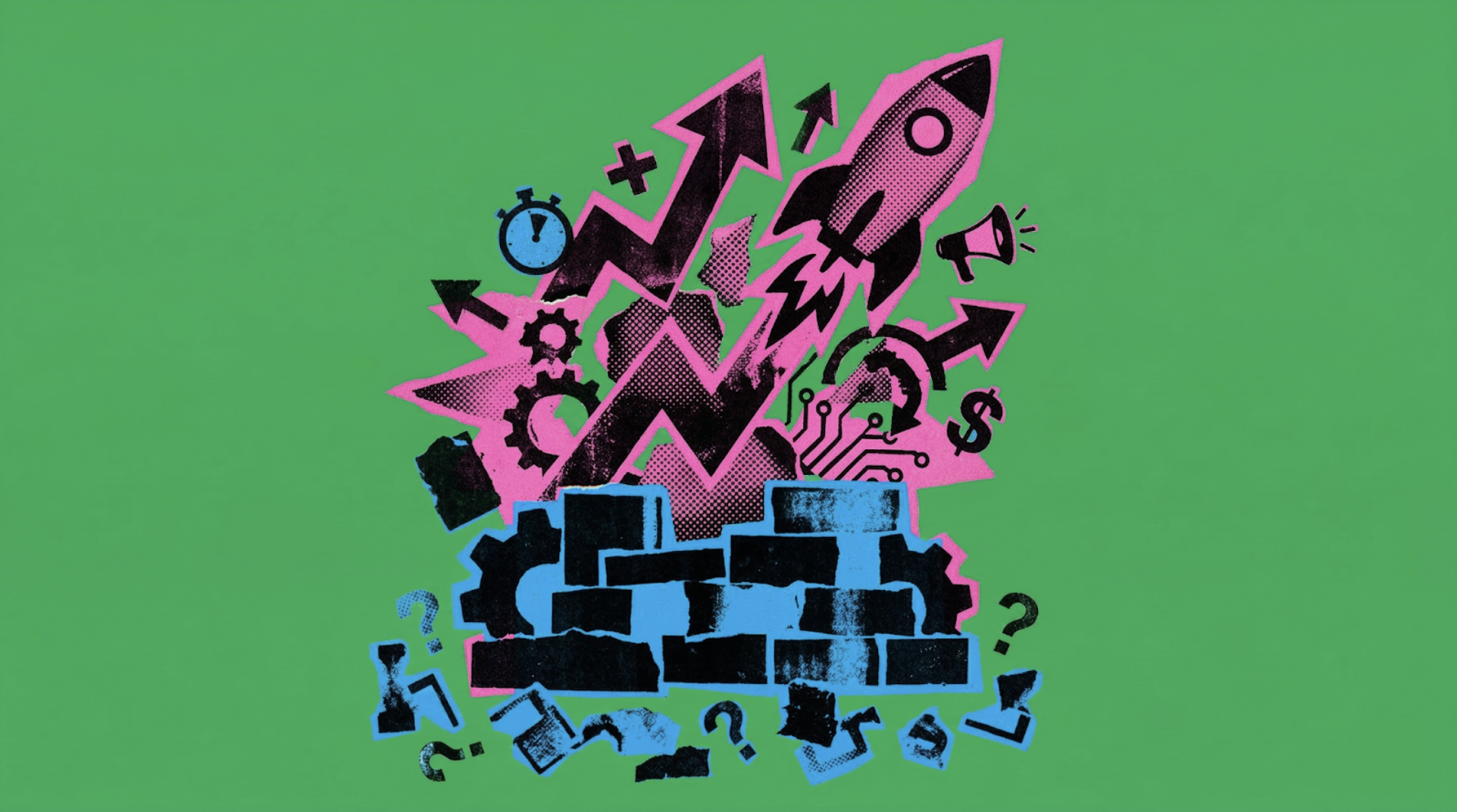
The foundation-building work is not complicated or expensive. It just requires a decision and some consistency.
The businesses I’ve seen get the most out of AI tools share one characteristic: they solved their information and alignment problems first. The AI came second. And when it did, it multiplied what was already working rather than trying to fix what was broken.
Up next → Article 5: Why Change Fails The surprisingly human reasons most tools never stick — and the simple things that actually work.
Morningmate is designed to be the structural foundation that makes AI useful — a single place where work lives, tracked consistently, visible to everyone who needs it. morningmate.com