

The announcement that went nowhere
Most software rollouts follow the same arc. A manager identifies a problem, evaluates tools, picks one, and sends an enthusiastic all-team message. For the first few days, a handful of people log in and poke around. Then, quietly, everyone drifts back to email and WhatsApp. The tool collects dust. The manager wonders what went wrong.
According to the Yooz 2025 Workplace Tech Resistance Report, 51% of employees say tech rollouts frequently create internal chaos. And a widely cited research finding puts the user adoption failure rate at 80% of companies that focus on technology instead of people.
The tool usually isn’t the problem. The rollout is.
Why adoption fails: the real reasons
Resistance to new software is predictable and well-documented. Understanding the actual causes is the first step to solving them.
People don’t understand why the change is happening
The manager sees the problem clearly — fragmented communication, missed deadlines, invisible work. The team doesn’t necessarily share that clarity. If the rollout message is ‘we’re switching to X,’ without a compelling explanation of what problem it solves, the team’s rational response is to stick with what they know.
Training is insufficient or one-off
Yooz found that 52% of employees receive only basic training, and 20% get almost no guidance at all. A single 30-minute onboarding session isn’t enough. People need to develop the habit of using the new tool before the old habit pulls them back.
The tool is introduced too broadly, too fast
Rolling out a new tool to an entire organization simultaneously is the most common rollout mistake. When everyone has to change at once, the transition feels disruptive, IT gets overwhelmed with questions, and there’s no internal champion to help colleagues who get stuck.
The old tools stay available
If WhatsApp is still the channel where the real conversations happen, the new work management tool will never become the default. People take the path of least resistance. Until the new tool is genuinely more convenient than the old one, or the old channel is explicitly phased out, adoption won’t stick.
A rollout playbook that actually works
This framework is built specifically for non-technical teams — the ones most likely to resist tools that feel unfamiliar or complicated.
Phase 1: Start with one team (weeks 1 to 4)
Pick a pilot team of three to six people who represent a real workflow — not the most tech-savvy people, but the ones most affected by the problem the tool solves. Run everything through the new tool for one month. Don’t make it optional for this group.
The goal isn’t to prove the tool works. It’s to create internal advocates who can say ‘yes, it’s actually useful’ to their colleagues.
Phase 2: Document what changed (week 4)
At the end of the pilot, have the team articulate what’s different. How long does it take to find the status of a task now versus before? How many ‘where are we on this?’ messages do they still send? Concrete before-and-after data is more persuasive than any product demo.
Phase 3: Let the pilot team lead the expansion (weeks 5 to 8)
Research on technology adoption shows that peer influence is one of the most powerful adoption drivers. Have the pilot team present to the next group, not as a top-down mandate, but as colleagues sharing what worked. This changes the dynamic from ‘the company is making us use this’ to ‘people like us find this useful.’
Phase 4: Make the old channel genuinely optional
Set a date when the team officially commits to using the new tool as the primary source of task ownership and project status. Don’t ban the old tools — but be explicit that work that lives only in WhatsApp or email isn’t visible to the team, and therefore doesn’t get tracked.
Phase 5: Reinforce, don’t assume
In the first three months, actively acknowledge when the tool is working. When a deadline gets caught early because it was visible in the system, say so. When a meeting gets cancelled because everyone could see the update, note it. People need to experience the value personally before the habit locks in.
One rule above all others
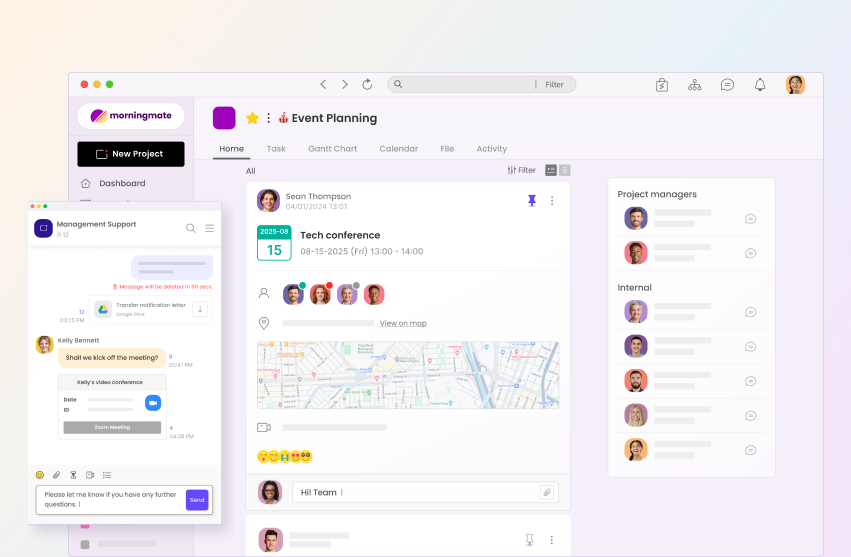
Choose a tool that is simple enough that non-technical team members can use it without training. If someone needs a tutorial to create a task or update a status, the tool is too complex for this use case. This is exactly what Morningmate was designed around — a work management tool with built-in chat that non-technical teams can pick up and use on day one, without an IT rollout or a week of onboarding. Simplicity is not a nice-to-have for non-tech teams — it is the primary adoption criterion.
The bottom line
Software adoption isn’t a technology problem. It’s a change management problem. The tool is the easy part. The hard part is giving your team a genuine reason to change their behavior, enough support to make the transition, and a clear moment when the old way stops being the default.
Get those three things right, and adoption follows.