How Scattered Communication and Missing SOPs Are Silently Killing Your Margins—And What to Do About It
A Story You Already Know Too Well
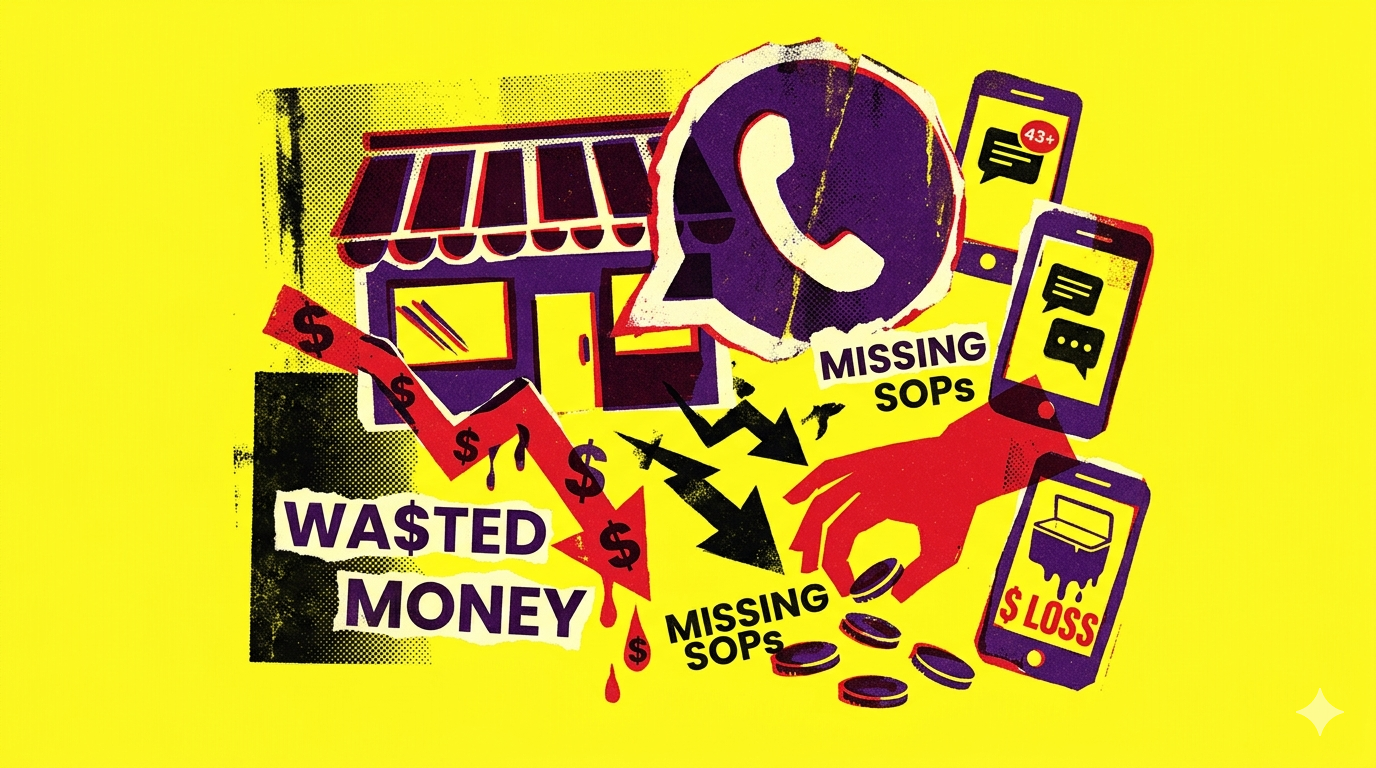
It is 11:47 PM on a Friday night. You are the CEO of a growing restaurant group with six locations. Your phone has 43 unread WhatsApp messages across 12 different group chats. Somewhere in one of those threads, a store manager reported that a walk-in cooler failed at the Soho location four hours ago. The message was buried under photos of a birthday cake for a staff member, a question about next week’s schedule, and a meme someone forwarded.
You did not see it until now. Hundreds of dollars worth of perishable inventory is gone. The morning team will arrive to an empty cooler and a menu they cannot fully execute. Your customers will notice. Your margins will bleed.
This is not a technology problem. It is not a people problem. It is a systems problem. And it is one that almost every F&B business in the world is suffering from right now—whether they realize it or not.
The Silent Killers: 5 Ways Disorganized Communication Destroys F&B Businesses
Before we talk about solutions, let us be honest about the problem. These are the five most common—and most expensive—operational breakdowns caused by scattered communication in food and beverage businesses. If even two of these sound familiar, your business is leaking money right now.
1. The WhatsApp Black Hole
| “Where did they send that?” Critical operational information—supplier price changes, health inspection updates, equipment failures, customer complaints—gets buried in the same WhatsApp group where someone shared a photo of their lunch. There is no search, no filing, no accountability. Information enters the chat and disappears into an endless scroll. |
The real cost is not the lost messages. It is the decisions that were never made because the right person never saw the right information at the right time. A vendor raises prices by 8% and sends a WhatsApp message to your procurement lead. That lead forwards it to a group chat. The CEO sees it three days later. By then, the old pricing has already rolled off and your food cost just jumped for the entire week.
2. The Inconsistency Tax
| “Every location does it differently.” Your Times Square location closes out the cash drawer at 9 PM. Your Soho location does it at 10:30 PM. Your newest location’s manager does not do it at all until the next morning. There is no standard operating procedure—or there is one, but it lives in a PDF that nobody has opened since training day. |
Without a standardized daily workflow that everyone follows, every location invents its own process. This means inconsistent customer experience, inconsistent financial reporting, and inconsistent quality. When something goes wrong, there is no system to trace where the breakdown happened.
3. The Knowledge Silo Problem
| “Only Sarah knows how to do that.” Your best store manager has a system that works perfectly—in her head. She knows exactly how to handle the Friday supplier delivery, when to prep for the weekend rush, and how to deal with the difficult vendor. But when she takes a vacation or leaves the company, all of that knowledge walks out the door with her. |
In F&B, institutional knowledge is one of your most valuable assets. But when it lives only in individual WhatsApp threads, personal notebooks, and verbal handoffs, it is also your most fragile asset. Every employee departure is a minor operational crisis.
4. The Customer Complaint Roulette
| “Wait, this is the third time they complained about the same thing?” A customer finds a foreign object in their food at one location. The store manager handles it on the spot, apologizes, and gives a discount. But the incident is only reported in a WhatsApp message to the area manager. No one logs it systematically. No one checks if the same issue has happened before. No one updates the quality control process. |
Two weeks later, the same thing happens at another location. Now it is a pattern, but nobody knows it is a pattern because there is no centralized system for tracking, categorizing, and resolving customer complaints. Every incident is treated as a one-off. The root cause is never addressed.
5. The Decision Paralysis Loop
| “I can never get a clear picture of what is happening.” As a CEO, you need real-time visibility into your operation. But your information comes from a patchwork of WhatsApp messages, weekly email reports (that are always late), spreadsheets that different managers format differently, and verbal updates during site visits. You spend more time gathering information than acting on it. |
The most dangerous version of this is when everything feels fine because nobody is reporting problems—not because there are no problems, but because there is no system that makes reporting easy, expected, and accountable.
The Root Cause: It Is Not Your Team. It Is Your Infrastructure.
Here is what most F&B leaders get wrong: they blame the people. “Why didn’t you tell me about the cooler?” “Why doesn’t anyone follow the closing procedure?” “Why do I have to ask three times for the daily report?”
The answer is almost always the same: because there is no system designed to make the right behavior the easy behavior.
Your team is not lazy or incompetent. They are operating inside a communication infrastructure that was never designed for running a multi-location F&B business. WhatsApp was built for personal conversations. Email was built for asynchronous correspondence. Neither was built for operational workflows that need to be executed consistently, tracked in real time, and reviewed by management.
The solution is not better people or more training. The solution is two things:
| 1️⃣ Unified Communication ChannelMove all operational communication—task assignments, status updates, announcements, file sharing, and discussions—into a single platform where information is organized by project, by location, and by topic. Not by whoever happened to send a message last. |
| 2️⃣ Standardized WorkflowsBuild repeatable templates for every recurring process—daily closings, inventory counts, customer complaint handling, new menu launches, staff onboarding—so that every location follows the same steps, every time, with built-in accountability and tracking. |
What This Looks Like in Practice: 3 Real Workflows That Transform F&B Operations
Theory is important, but let us get practical. Here are three specific workflows that demonstrate how a collaboration platform replaces scattered WhatsApp chaos with structured, trackable, and consistent operations.
Workflow 1: Standardized Daily Closing & Sales Reconciliation
Every F&B location must close out the day: reconcile POS sales data, count the cash drawer, log discounts and voids, scan receipts, and submit a daily report to HQ. This is the single most important daily process in any restaurant—and it is the one most commonly done inconsistently.
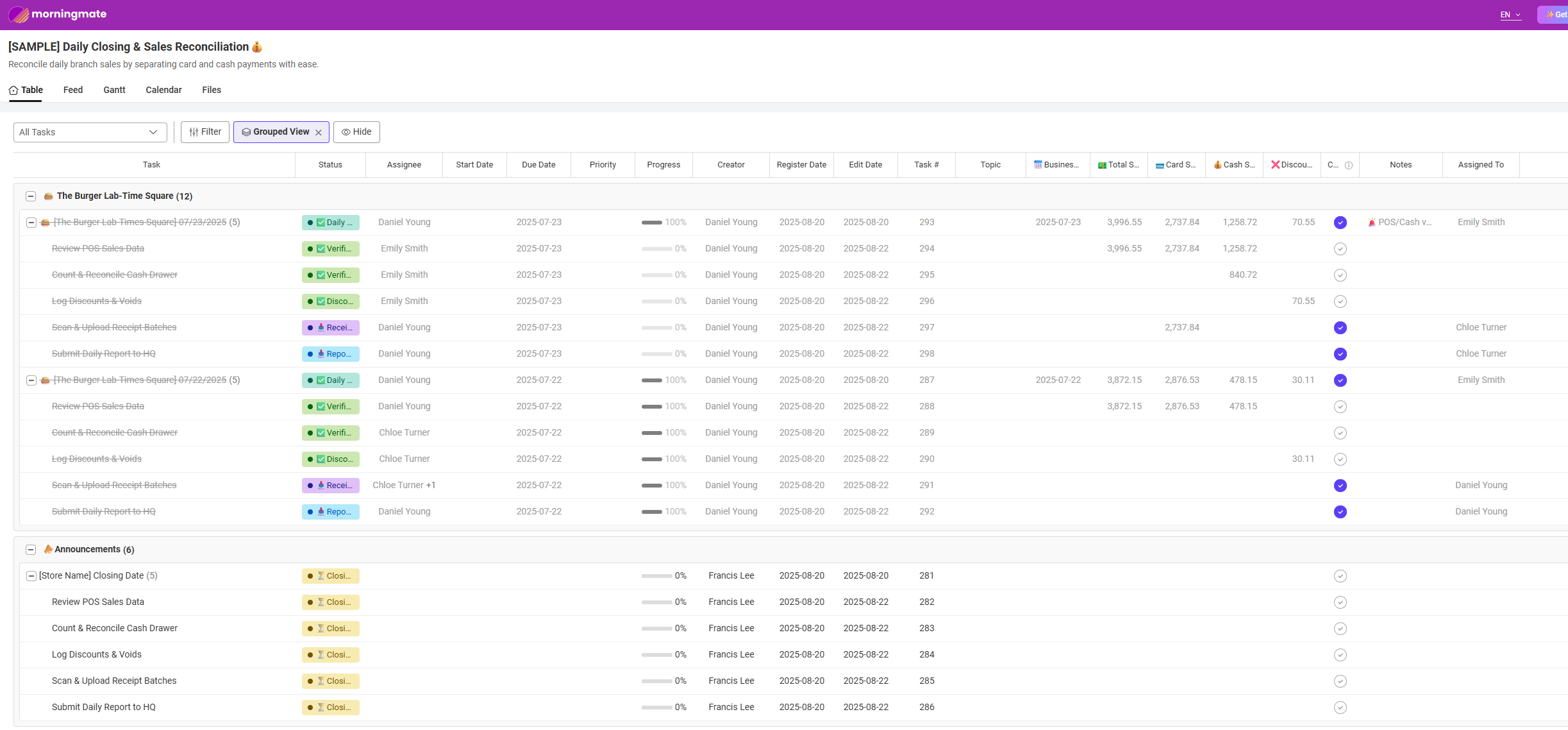
Morningmate — Daily Closing & Sales Reconciliation: Each location follows the same 5-step closing checklist with real-time progress tracking, assignees, and custom fields for sales data.
Before (WhatsApp era): The closing manager takes photos of the POS screen and cash count, sends them to a WhatsApp group, and hopes the area manager sees it. Numbers are entered into a shared Google Sheet the next day—sometimes. Discrepancies are discovered during the monthly accounting review, weeks after the fact.
After (Collaboration platform): Every location follows the same 5-step closing checklist, every night. Each step has an assignee, a due date, and a status. Sales figures are logged directly in custom fields—total sales, card sales, cash sales, and discount amounts are captured in real time. HQ can see which locations have completed their closing at any moment. If a step is missed, it is immediately visible.
As you can see in the screenshot above, The Burger Lab’s Times Square location has a structured daily closing workflow grouped by date. Each day’s closing includes five clear subtasks—from reviewing POS sales data to submitting the daily report to HQ. The status column shows exactly where each task stands: verified, in discussion, received, or reported. Custom columns capture the actual numbers: business day, total sales, card sales, cash sales, and discounts. Management can compare the July 23rd closing (100% complete) with the July 22nd closing at a glance.
The impact is not just operational—it is cultural. When every team member knows that their closing report is tracked and visible, the quality of work goes up. Accountability does not feel like surveillance; it feels like professionalism.
Workflow 2: Centralized Company Announcements & Policy Updates
How do you currently announce a new leave policy to all employees? A new food safety protocol? A change in operating hours? If the answer involves sending a message to multiple WhatsApp groups and hoping everyone reads it, you are setting yourself up for compliance failures.
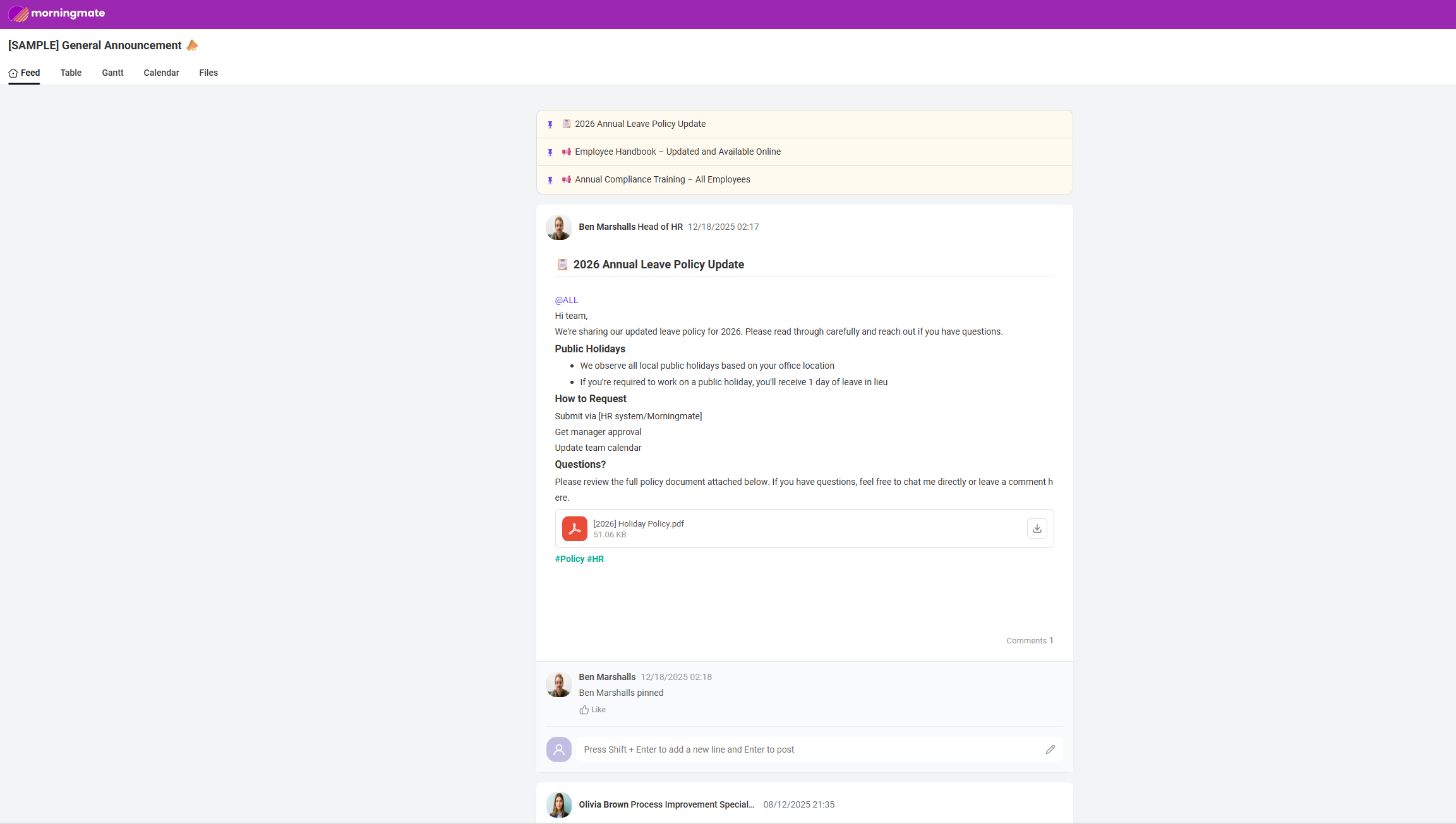
Morningmate — General Announcement Board: One structured announcement with full policy text, PDF attachment, tags, and threaded discussion. One source of truth for the entire organization.
Before (WhatsApp era): The HR manager sends a PDF to 6 different location group chats. Two managers forget to forward it to their teams. Three employees ask questions in separate DMs. Nobody knows who has read the policy. When an employee violates the policy two months later, the documentation trail is a mess.
After (Collaboration platform): One announcement, one channel, one source of truth. The policy is posted with the full document attached. Employee questions are answered in a threaded discussion visible to everyone—so the same question is not asked 15 times. Management can confirm that every location has acknowledged the update.
In the screenshot above, you can see how the Head of HR posts the “2026 Annual Leave Policy Update” with clear sections for public holidays, how to request leave, and a downloadable PDF of the full policy. The post is tagged with #Policy and #HR for easy searchability. All three pinned announcements—the leave policy, the updated employee handbook, and the annual compliance training—live in one organized feed. Six months from now, when a new employee needs to find the leave policy, they will find it in seconds—not buried in a WhatsApp thread from December.
For F&B businesses that operate across multiple locations and shifts, this is not a convenience feature—it is a compliance and liability necessity. When food safety regulations change or labor laws are updated, you need proof that every employee was informed.
Workflow 3: Voice of Customer Hub — Turning Complaints into Competitive Advantage
Customer complaints in the F&B industry are inevitable. What separates great restaurant groups from mediocre ones is not whether complaints happen—it is whether they have a system to capture, categorize, analyze, and resolve them consistently across all locations.
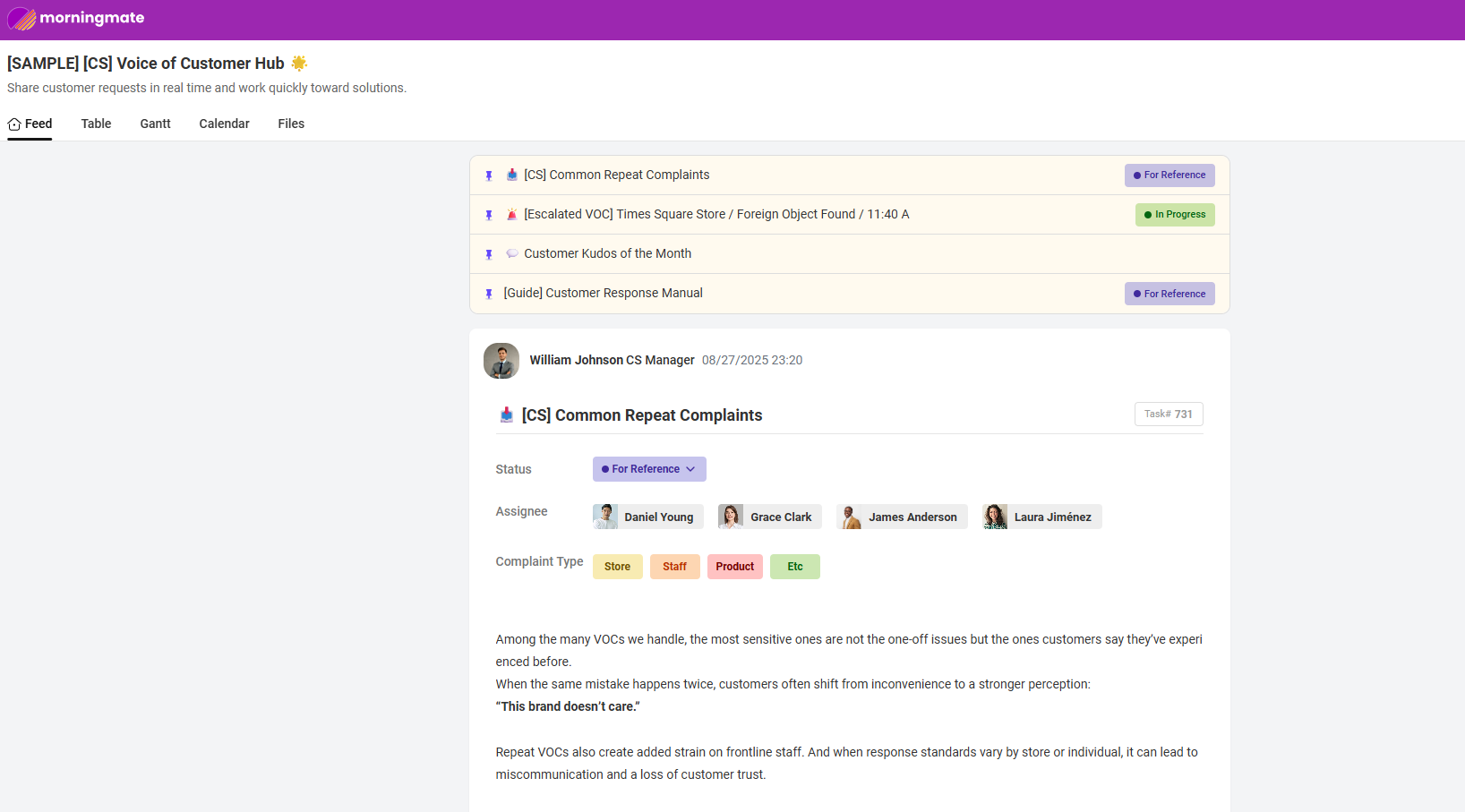
Morningmate — Voice of Customer Hub: Centralized complaint tracking with categorized types, standard response templates, subtask-based resolution tracking, and escalation management.
Before (WhatsApp era): A store manager handles a complaint on the spot and mentions it in a WhatsApp message. The area manager may or may not read it. No one categorizes it. No one tracks whether the same issue has happened before. Each store handles similar complaints differently, creating inconsistent customer experiences.
After (Collaboration platform): Every complaint is logged with a type tag (Store, Staff, Product, Delivery), an assignee, and a resolution status. When patterns emerge—like ‘the same complaint happening twice’—the system makes it visible. The team creates standardized response templates so every location handles the same complaint type in the same way. The result: faster resolution, consistent experience, and data that actually helps you improve.
Look at the screenshot above carefully. The CS Manager has identified the five most frequent complaint types from June through July and built standardized responses for each: delivery delays, missing or incorrect items, staff attitude issues, and mobile ordering errors. Notice the escalated item at the top of the feed—“Times Square Store / Foreign Object Found”—marked “In Progress” and given its own dedicated task for tracking. The post itself captures the core insight: “Among the many complaints we handle, the most sensitive ones are not the one-off issues but the ones customers say they have experienced before. When the same mistake happens twice, customers shift from inconvenience to a stronger perception: This brand does not care.”
That shift in perception is where you lose customers forever—and it is entirely preventable with the right system.
The Real Cost of Doing Nothing
Let us quantify what scattered communication actually costs a typical multi-location F&B business:
| Hidden Cost | Typical Impact | Annual Estimate (5 locations) |
| Missed supplier price alerts | 1–2% food cost overrun | $15,000–$30,000 |
| Inconsistent daily closing | Cash discrepancies + late reporting | $5,000–$12,000 |
| Untracked customer complaints | Repeat issues → lost customers | $20,000–$50,000 in lifetime value |
| Manager time on WhatsApp | 2–3 hours/day per manager | $25,000–$40,000 in labor |
| Knowledge loss from turnover | 3–4 week productivity dip per hire | $10,000–$20,000 |
| Total estimated annual loss | $75,000–$152,000 |
Now compare that to the cost of a collaboration platform like Morningmate: $199/month flat rate for up to 300 users on the Advanced plan. That is $2,388 per year. Even the most conservative estimate suggests a 30x return on investment.
The Good News: This Is the Easiest Problem to Fix
Here is what should give you hope as a leader: unlike food costs, which are subject to global commodity markets, or labor shortages, which are driven by macroeconomic forces, communication infrastructure is entirely within your control. You can fix it this week.
The transformation does not require a 12-month digital transformation initiative. It does not require an IT department. It does not require your kitchen staff to become technology experts. Modern collaboration platforms like Morningmate are designed specifically for teams where not everyone is tech-savvy—which is exactly the reality of the F&B industry.
Start with three steps:
| Step 1 Pick one workflow and standardize it.Start with your daily closing procedure. Build a repeatable template with clear steps, assignees, and deadlines. Run it for two weeks at one location. You will see the difference immediately. |
| Step 2 Move announcements off WhatsApp.Create a single channel for company-wide announcements. Every policy update, every operational change, every important notice goes here—with documentation attached. Your team will know exactly where to look. |
| Step 3 Build your Voice of Customer system.Create a project board for customer feedback. Categorize complaints by type. Track resolution. Within one quarter, you will have data that tells you exactly where your biggest service gaps are—and you can fix them before they cost you customers. |
The F&B businesses that will win in 2026 and beyond are not necessarily the ones with the best recipes or the most locations. They are the ones with the best systems. Systems that ensure every location operates at the same standard, every team member has the information they need, and every customer complaint becomes an opportunity to improve.
A Final Word to the CEO Reading This at Midnight
If you recognized yourself in the opening paragraph of this article—scrolling through WhatsApp at 11:47 PM, trying to piece together what happened across your locations today—know this: that feeling of drowning in fragmented information is not a reflection of your leadership. It is a reflection of an infrastructure that has not kept pace with your ambition.
You started this business because you are passionate about food, about hospitality, about creating experiences that bring people together. Somewhere along the way, the operational complexity grew faster than the systems to manage it. That is completely normal. It happens to every growing F&B business.
The gap between where you are and where you want to be is not talent, not capital, not market opportunity. It is operational clarity. The ability to see what is happening, when it is happening, across every location—and to know that your team is aligned, your processes are consistent, and your decisions are informed by real data, not scattered messages.
That gap is closable. Today.
Your restaurants deserve better systems. Your team deserves better tools. And you deserve to sleep through the night without checking WhatsApp.
Stop managing your business through WhatsApp.
See how Morningmate helps F&B teams build standardized workflows and unified communication.