Project Management

Effective task management does not break down when work gets hard — it breaks down when priorities shift and nobody tells the plan. One day your team is aligned on a product launch; the next, leadership pivots to a compliance deadline, and three people are still building slide decks for a campaign that has quietly been deprioritized. The work continues. The effort compounds. And by the time anyone notices, you have burned two weeks of capacity on the wrong thing.
This is one of the most expensive operational failures in a growing SMB — not because it happens dramatically, but because it happens quietly. Task management systems that were never updated still show the old priorities. Team members make local decisions based on stale information. Cross-functional handoffs stall because nobody knows what is still live. And you, the ops manager, end up chasing five different people to reconstruct a picture that should have been visible from a single dashboard.
Research from McKinsey consistently shows that misalignment on priorities is among the top contributors to wasted organizational effort — with knowledge workers spending a significant portion of their week on tasks that no longer serve the company's current goals. The problem is not ambition or effort. It is the gap between a decision made in a leadership meeting and an updated task workflow that the rest of the team can actually see and act on.
The Compounding Cost of a Plan Nobody Updated
When a priority changes but the task management system does not reflect it, the cost is not linear — it compounds. Each day that passes, more work gets completed on deprioritized items. More dependencies get built on top of assumptions that are no longer valid. More team members make decisions based on the last version of the plan they saw, not the current one.
Asana's Anatomy of Work Index found that workers switch between tasks an average of 25 times per day and spend over a third of their time on work about work — status updates, clarifying emails, and hunting for the right version of a document. A large portion of that friction is caused not by poor tools, but by plans that were never updated when direction changed.
For an ops manager, this shows up as: manual status chasing, cross-team confusion about handoff points, onboarding new hires into workflows that no longer match reality, and a persistent inability to answer the simple question — "what is the team actually working on right now?"
Operational Impact | When Plan Is Not Updated | When Plan Reflects Current Priorities |
|---|---|---|
Team focus | Split across old and new priorities | Unified on current objectives |
Status visibility | Manual chasing required | Real-time, self-serve |
Cross-team handoffs | Stall or duplicate | Sequential and documented |
Onboarding accuracy | New hires learn outdated workflows | New hires learn live processes |
Decision accountability | Lost in chat or email threads | Attached to tasks with clear owners |
The DRIFT Framework: A Model for Priority-Shift Failure
To diagnose why task management breaks down when priorities change, it helps to name the pattern. Call it the DRIFT problem: Decision made, Record not updated, Information siloed, Focus misaligned, Team catches up too late. Each letter describes a sequential failure that turns a legitimate business pivot into operational chaos.
DRIFT is not a technology problem. It is a process design problem. It happens in companies that use spreadsheets, companies that use enterprise PM software, and companies that rely on group chats. The common thread is the absence of a standardized protocol for propagating priority changes through the task coordination system fast enough for the team to redirect effort before too much work is wasted.
How Long Teams Continue Working on Deprioritized Tasks After a Priority Shift
1–2 days
Standardized task workflow
3–5 days
Chat-only coordination
7–14 days
Email-based coordination
Fig 1: Estimated duration of misaligned effort by coordination method (illustrative, based on industry patterns)
D — Decision Made: The Moment the Plan Becomes Outdated
The DRIFT cycle begins the moment a leadership decision changes the priority landscape — and that decision does not immediately reach the task management layer. In most SMBs, priority changes happen in Slack messages, verbal conversations, or leadership calls that get summarized in a follow-up email to some, but not all, stakeholders.
The ops fix here is a Priority Change Protocol: every decision that affects active task workflows must trigger a structured update. That means identifying which existing tasks are affected, who owns them, and what the new expected completion timeline is — before the meeting ends.
R — Record Not Updated: Where Task Management Systems Fail
The second failure point is the task tracking system itself. When a priority changes, someone needs to go into the system and update task statuses, reassign owners, and archive or reschedule items that are no longer active. Without a clear owner for this step, it simply does not happen.
The practical standard here is a dedicated "Plan Keeper" role — not a full-time job, but a named responsibility. Every active project should have one person accountable for keeping the task workflow current. In a growing SMB, this often sits with the ops manager or a team lead. The key is that it is explicit, not assumed.
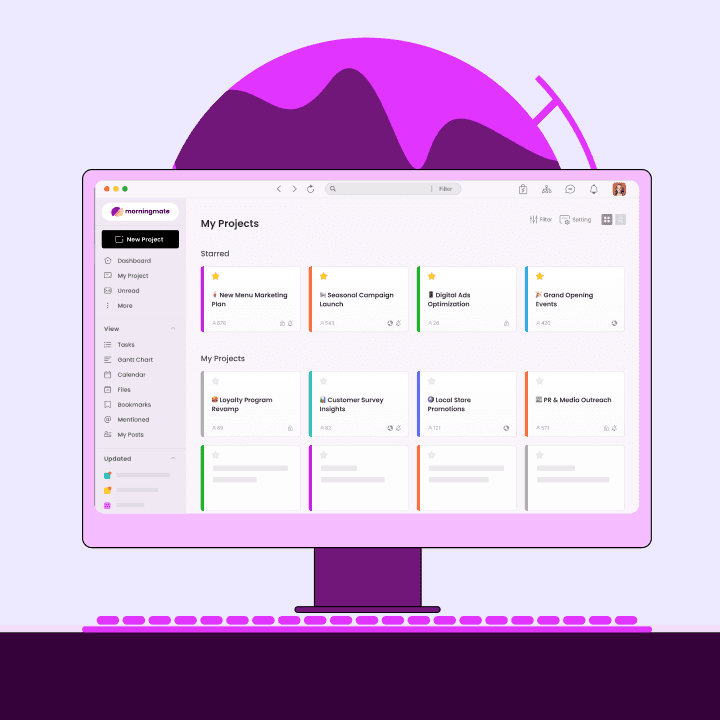
This is where a lightweight work management tool like Morningmate makes a structural difference. Rather than managing tasks across disconnected spreadsheets or email chains, you can update task statuses, reassign owners, and leave a comment trail that explains why a task changed — all in one place. The task tracking record stays live and accurate instead of drifting into irrelevance.
I — Information Siloed: When Only Some People Know the New Plan
Even when the plan gets updated in one place, the information often does not travel. The marketing lead knows the campaign has been pushed back. The designer does not. The developer building supporting assets finds out when the campaign goes live — without their work.
Information silos are a structural problem, not a communication attitude problem. The fix is a single workspace where task updates are visible to everyone with relevant access — not broadcast through a chat message that scrolls off the screen in four hours.
Harvard Business Review research on collaboration overload highlights that employees are increasingly overwhelmed by communication volume — but still miss critical updates. More messages is not the answer. A structured task coordination system where updates are attached to the work itself is.
F — Focus Misaligned: The Hidden Cost in Team Capacity
When information silos persist, team focus fractures. Some members correctly redirect to new priorities. Others continue on old tasks, assuming they would have been told to stop. The result is a team that appears busy — and genuinely is — but is not coordinated around the same outcome.
For an ops manager, this is the phase that produces the most visible symptoms: duplicated work, missed deadlines on the new priority, and the frustrating discovery that the team's combined effort did not add up to anything deployable. Task management at this point has effectively collapsed, even if every individual task shows a status of "in progress."
The standardization fix is a weekly Priority Pulse — a 15-minute structured review where the single source of task truth is opened, every active item is confirmed against current priorities, and anything out of alignment is flagged immediately. This is not a status meeting. It is a calibration checkpoint.
T — Team Catches Up Too Late: The Recovery Tax
The final stage of DRIFT is the recovery tax — the time and energy spent undoing misaligned work, realigning the team, and rebuilding momentum after the drift is discovered. Gallup's State of the Global Workplace report links unclear role expectations and poor communication directly to disengagement — and disengagement is always highest in the wake of poorly managed change.
The recovery tax is largely avoidable. But avoiding it requires process infrastructure that most growing SMBs have not yet built — standardized task workflows, named accountability at every handoff point, and a system that makes the current state of every project visible without a manager having to ask.
Applying DRIFT Prevention With Morningmate: A Worked Example
Here is what a standardized priority-shift response looks like in practice for a 35-person operations team using Morningmate as their task management hub.
Scenario: Leadership decides on a Tuesday afternoon to move the Q3 product feature launch forward by three weeks due to a competitive market development. At least four active workstreams — content, QA, design, and customer success enablement — are affected.
Step 1 — Decision logged as a task update: The ops manager opens Morningmate and updates the master project post for the product launch. The new deadline is set, a comment is added explaining the reason for the change, and the four affected sub-tasks are flagged for immediate reassignment review.
Step 2 — Owners notified in context: Because Morningmate's task management and built-in chat exist in the same workspace, each task owner receives a notification directly linked to the updated task — not a separate Slack message they will need to cross-reference. The context travels with the change.
Step 3 — Feed view surfaces the change team-wide: Morningmate's social-media-style Feed view means the updated project post surfaces for every team member with access to that workspace. Nobody has to ask "what changed?" — the change is visible and attributed.
Step 4 — Priority Pulse review on Thursday: Two days later, the 15-minute Priority Pulse confirms that all four workstreams have acknowledged the new timeline, updated their own task tracking entries, and identified any resource conflicts. One conflict is caught — the QA team has a scheduling overlap — and is resolved in the same session.
Result: The team redirects within 48 hours instead of two weeks. Zero duplicated effort. No status-chasing emails from the ops manager. The plan and the work are synchronized.
DRIFT Stage | Without a Standard Process | With DRIFT Prevention Protocol |
|---|---|---|
Decision | Shared verbally or in chat | Logged in task management system immediately |
Record update | Depends on who remembers | Owned by named Plan Keeper, same session |
Information reach | Partial — silos persist | Full team notified via workspace feed |
Focus realignment | 7–14 days of drift | Confirmed within 48 hours at Priority Pulse |
Recovery tax | High — rework, tension, lost trust | Minimal — conflicts caught early |
The Measurable Effect of Standardized Task Management on Redirect Speed
The business case for standardizing your task management process around priority changes is not just operational comfort — it is measurable capacity recovery. Teams with a structured task coordination process redirect effort significantly faster than those relying on informal communication. The gap between those two states is real working hours returned to productive output.
Team Redirect Speed After a Priority Shift (% of teams realigned within 48 hours)
21%
Email-based teams
44%
Chat-coordinated teams
78%
Standardized task tracking
Fig 2: Estimated redirect speed by coordination method (illustrative, based on operational benchmarks)
Implementation Checklist: Stopping DRIFT in Your Task Management System
If you recognize the DRIFT pattern in your team's current task workflow, the path forward is not to buy a more complex tool. It is to build the protocol that keeps your task management system synchronized with reality whenever priorities change. Here is what to implement in the next two weeks.
Assign a named Plan Keeper for every active project — one person accountable for keeping task tracking current when direction shifts.
Create a Priority Change Protocol — a three-step rule: (1) log the change in the task management system within the same business day, (2) update all affected task owners directly via the system, (3) archive or reschedule tasks that are no longer active.
Run a weekly Priority Pulse — a 15-minute review where the team's active task workflow is opened and every item is confirmed against current priorities. Not a status update. A calibration.
Consolidate task tracking to one workspace — if tasks live in spreadsheets, chat, and email simultaneously, the plan will always drift. Pick one system and enforce it. Tools like Morningmate, which combine task management with a built-in communication feed, reduce the distance between "update made" and "team informed."
Build an onboarding task template — new hires should inherit your current, live workflow from day one. If your task management records are stale, so is your onboarding.
Document why priorities changed — attach the reason to the task update, not just the outcome. Teams that understand context redirect faster and with less friction than those who receive instructions without explanation.
Audit your task workflow quarterly — remove completed, abandoned, and duplicate task records. A clean task management system is one your team will actually trust and use.
The goal of all of this is not bureaucracy. It is the opposite: a task management system that is so accurate and current that your team can self-serve their own alignment — and you spend your time leading operations instead of manually reconstructing the state of the plan from five different sources. That is what standardized task coordination looks like when it works. And it starts by treating every priority change not as a communication event, but as a task management event that requires an immediate, structured response.