Project Management

Good task management is the quiet infrastructure that holds a small team together — and when it starts to crack, the damage accumulates long before anyone names it. Work fragments across inboxes, personal notes, and half-remembered conversations. Two people duplicate the same research. A new hire spends their first week reverse-engineering processes that exist only in a senior colleague's head. None of these failures announce themselves with a loud alarm. They compound silently, draining the team of time and momentum that should be driving growth.
For operations managers in growing SMBs, this fragmentation is the central problem. You are not dealing with a single broken process — you are dealing with dozens of micro-gaps, each one small enough to dismiss individually, each one costly enough to matter in aggregate. Chasing status updates, rebuilding context after handoffs, re-explaining decisions that should already be documented: these tasks consume hours every week that your team cannot afford to lose.
The fix is not a new software subscription or a longer team meeting. It is a structured approach to how work is defined, handed off, tracked, and closed. This article walks through a practical model for doing exactly that — and shows you what standardized task coordination actually looks like in practice.
The Hidden Cost of Work That Lives Nowhere in Particular
Before building a solution, it helps to see the problem clearly. Fragmentation in task management does not usually mean tasks are forgotten entirely. It means they exist in ambiguous states: started but not tracked, assigned but not scoped, completed but not confirmed. Every task in that ambiguous state requires human overhead to maintain — someone has to remember it, chase it, or reconstruct its context.
Multiply that overhead by every active task on a twenty-person team and you get a meaningful slice of your operating capacity spent on coordination friction rather than productive work. The cost compounds further during onboarding, when new hires cannot access that institutional memory, and during cross-team handoffs, when context that lives in one person's head fails to travel with the work.
The table below maps where this friction typically shows up, and what it looks like before and after standardized task management is in place.
Friction Point | Without Standardized Task Management | With Standardized Task Management |
|---|---|---|
Status visibility | Manager asks each person individually | Status visible in the task itself, in real time |
Onboarding new hires | Process knowledge held by individuals, shared verbally | Documented workflows accessible from day one |
Cross-team handoffs | Context reset with each handoff; recipient starts from scratch | Full task history travels with the work |
Duplicate work | Two teams solve the same problem independently | Shared visibility prevents overlap before it starts |
Decision history | Buried in email threads or personal notes | Attached to the relevant task, searchable by anyone |
A Practical Model: The Four Layers of Task Integrity
Effective task management in a growing SMB rests on four distinct layers. Each layer addresses a specific failure mode. When all four are functioning, work stays whole — it does not fragment across people, tools, or time. When even one layer is missing, you get the compounding overhead described above.
The four layers are: definition, ownership, visibility, and closure. Think of them as the conditions a task must meet at every stage of its life to remain a reliable unit of work rather than a vague obligation floating somewhere in the team's collective memory.
Layer One: Task Definition That Leaves No Room for Interpretation
The first layer is the most frequently skipped. A task that says "update the supplier list" is not a task — it is a prompt. The person receiving it must still decide what "update" means, which list, by when, and what done looks like. That interpretive work is invisible labor, and it happens every time the task changes hands.
Strong task management discipline requires that every task include four elements before it is assigned: a clear deliverable, a deadline, the resources or access needed, and a definition of completion. This sounds obvious. In practice, most growing teams skip at least two of these elements for the majority of their tasks, then compensate by chasing status updates downstream.
Consider a practical example. An ops team is onboarding a new logistics partner. Instead of creating a task called "finalize logistics onboarding," a well-defined task reads: "Complete supplier onboarding checklist for Freight Co — all five steps confirmed, compliance docs uploaded to shared folder, status updated to Active in the vendor register. Due Friday." That task can be handed to any team member and executed without a briefing call.
Layer Two: Task Ownership That Is Named, Not Assumed
Shared responsibility is the operational equivalent of no responsibility. When a task belongs to "the team" or to "whoever has bandwidth," it belongs to no one. Ownership must be explicit: one named person is accountable for the outcome, even if several people contribute to it.
This becomes especially important during cross-team coordination. Picture a mid-sized product company running a quarterly customer communication campaign. Marketing produces the copy, design produces the assets, and operations manages distribution. If the task for final approval sits in a shared channel with no named owner, it stalls — because each team assumes one of the others is watching it.
Naming a single owner does not remove collaboration. It removes ambiguity about who is responsible for moving the work forward and raising a flag when it is blocked. Good task coordination assigns contributors and a reviewer too, but the owner is always one person.
Layer Three: Task Visibility That Does Not Require a Meeting to Maintain
If status requires a meeting, your task management system is not working. Status should be visible to any stakeholder at any moment without requiring the task owner to report it manually. This is where most growing teams hit the wall: they have tasks recorded somewhere, but the status of those tasks lives in someone's head or in a weekly sync.
Real visibility means that when the head of operations needs to know whether the vendor audit is complete, they can check directly — not send a message and wait. It also means that when a task is blocked, that blockage is surfaced in the task itself, not buried in a thread that the ops manager may or may not see.
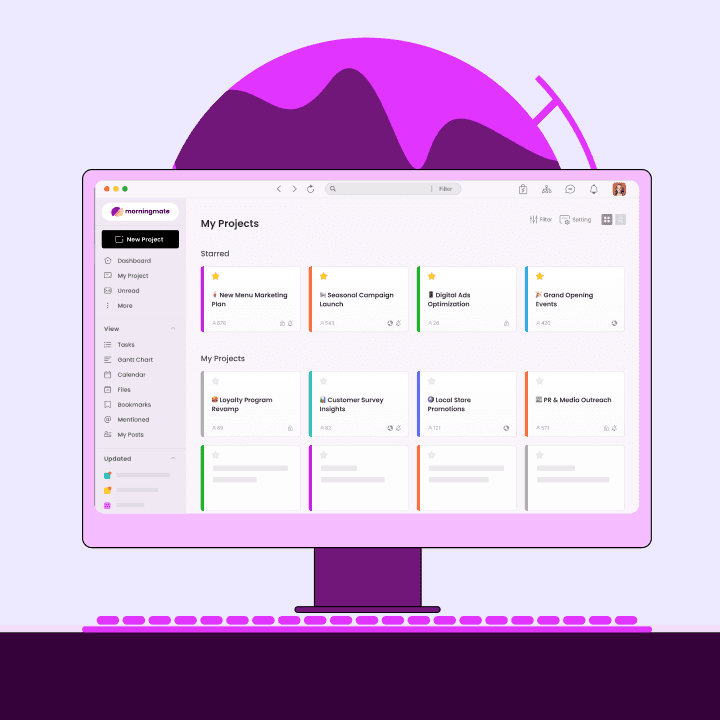
This is the layer where a tool like structured task management software earns its place. Morningmate, a lightweight work management platform used by over 550,000 teams, keeps task status, comments, and attachments in a single shared view. When an ops manager opens a project, they see the current state of every task without sending a single follow-up message. That visibility is what makes async coordination viable as a team scales.
Layer Four: Task Closure That Captures What Was Learned
Most task management approaches treat closure as a binary: done or not done. But for a growing ops team, closure is also a knowledge event. When a task is completed, there is usually something worth capturing — a decision that was made, a process that deviated from the template, a dependency that surfaced unexpectedly.
If that information is not attached to the task at closure, it dissolves. The next person to run a similar process has to rediscover it. This is how knowledge silos form: not from secrecy, but from the absence of a closure habit that captures institutional knowledge in a retrievable place.
A lightweight closure routine might be as simple as a final comment on the task: what changed from the original plan, what the next person should know, and whether the process template needs updating. Three sentences. Thirty seconds. Multiply that across a team over a year and you have built a searchable operational memory.
Applying the Model: A Standardized Vendor Onboarding Flow in Morningmate
Here is what the four-layer model looks like when it runs through a real operational process. The scenario: onboarding a new software vendor across procurement, IT, and finance in a forty-person company.
Step one — Definition. The ops manager creates a parent task in Morningmate titled "Vendor Onboarding: [Vendor Name]" with a checklist of sub-tasks: NDA signed, security review completed, payment terms confirmed, system access provisioned, contract filed. Each sub-task has a deadline and a definition of done written directly into the task description. No verbal briefing required.
Step two — Ownership. Each sub-task is assigned to a named individual — procurement owns the NDA, IT owns the security review, finance owns payment terms. The parent task is owned by the ops manager, who is accountable for the overall timeline but not for executing each step.
Step three — Visibility. As each sub-task moves through its stages, the status updates in Morningmate's shared project view. The ops manager can see at a glance that the NDA is signed, the security review is in progress, and payment terms are awaiting finance approval — without sending a single follow-up. If IT marks their sub-task as blocked pending a vendor document, that flag is visible immediately.
Step four — Closure. When the final sub-task is complete, the ops manager adds a closing comment to the parent task: the onboarding took eleven days instead of the planned eight because vendor security documentation arrived late; the process template should be updated to include a document request sent five days earlier than currently scheduled. That note lives inside the task, searchable by anyone who runs the next vendor onboarding.
Morningmate's AI Smart Search feature makes that closing note retrievable months later — a team member can ask in plain language "what slowed down the last vendor onboarding?" and get the answer back with the exact comment, the date it was written, and the task it came from. That is institutional memory that does not depend on any one person staying at the company.
Task Management Implementation Checklist
Use this checklist to assess where your current task management practice stands against the four-layer model, and to identify the highest-leverage changes to make first.
Layer | Action to standardize | Sign that it is working |
|---|---|---|
Definition | Write deliverable, deadline, resources needed, and done criteria into every task before assigning | New hires can execute tasks without a verbal briefing |
Ownership | Assign one named owner per task; add contributors and reviewer separately | Blocked tasks surface within hours, not days |
Visibility | Move all task status into a shared workspace — no status should live only in someone's head | Manager can answer "where does this stand?" without sending a message |
Closure | Require a closing comment on every completed task: what changed, what the next person needs to know | Process knowledge is searchable and does not leave when a team member does |
Template discipline | Build reusable task templates for recurring processes; update them at each closure | Recurring processes improve incrementally without a separate retrospective meeting |
Cross-team handoffs | Handoff is a task event, not a verbal conversation — the receiving owner is tagged in the task with full context attached | Handoff recipient asks fewer follow-up questions |
Effective task management is not about adding more process — it is about removing the invisible effort your team currently spends compensating for the lack of it. When task coordination is built on clear definition, named ownership, shared visibility, and disciplined closure, your team stops spending energy holding fragmented work together and starts spending it on the work itself. That shift is where real operational leverage lives, and it is available to any team willing to standardize before the next hire, the next campaign, or the next cross-team dependency makes the gaps impossible to ignore.