Project Management

Effective task management is the backbone of any well-run operation — and for many growing SMBs, it starts to collapse the moment the team hits double digits. Not because the work becomes harder, but because the systems managing that work never scaled. WhatsApp groups that worked fine at five people become noise factories at fifteen. Decisions get buried in threads. New hires have no idea what the standard process is. And you, the ops manager, spend more time chasing status than actually moving work forward.
This is not a communication problem. It is a task management infrastructure problem. And the longer it goes unaddressed, the more it compounds — in missed handoffs, duplicated effort, and onboarding time that stretches weeks longer than it should. Research published in Harvard Business Review found that employees spend as much as 28% of their workday managing email and messages unrelated to their core responsibilities. In a WhatsApp-as-ops-tool environment, that number only climbs.
What growing teams need is not just better chat — they need a structured approach to task coordination that survives headcount growth, team handoffs, and the inevitable chaos of a scaling business. Below is a framework built specifically for that challenge.
The Compounding Cost of Inconsistent Task Management
Before fixing anything, it helps to see the damage clearly. Inconsistent task management does not just slow your team down in the moment — it creates compounding drag across every function that touches the work. Consider what happens when there is no standard process for assigning, tracking, or closing tasks.
A request lands in WhatsApp. Someone says they will handle it. Two days later, it has scrolled out of view. No one followed up. The deadline passes. A client escalates. The ops manager — you — steps in, piecing together what happened from three different chat threads. That single failure costs roughly 30–60 minutes to untangle. Multiply that by ten incidents per week, across a team of twenty, and you are looking at hundreds of hours per year lost purely to task tracking failure.
McKinsey's research on the social economy estimated that improved communication and collaboration tools could raise productivity by 20–25% in knowledge-intensive work. Most teams leave that gain on the table by treating chat apps as their default task management system.
Operational Area | WhatsApp-Based Task Tracking | Standardized Task Management |
|---|---|---|
Task visibility | Buried in scrolling chat history | Centralized, always visible |
Accountability | Informal, easily ignored | Assigned, dated, tracked |
Onboarding new hires | Relies on verbal handoff, easily lost | Documented in task templates |
Cross-team coordination | Separate group chats, zero integration | Shared boards with clear ownership |
Status updates | Manual, repetitive chasing | Real-time, self-serve visibility |
Introducing the SCOPE Framework for Task Management
To move from WhatsApp chaos to operational clarity, ops teams need a model that addresses all the places task coordination breaks down. The SCOPE Framework — Standardize, Centralize, Own, Process, Evaluate — gives you five concrete pillars to build on. Each one targets a specific failure mode that emerges as teams grow beyond a handful of people.
This is not a theoretical model. Every component maps directly to a change you can make in how your team manages work day to day. Let's walk through each one.
S — Standardize Your Task Management Templates
The first failure point in informal task tracking is that every person handles tasks differently. One team member creates a detailed checklist. Another sends a single WhatsApp message. A third keeps everything in a personal note app. When these approaches collide during a handoff, information falls through the gaps.
Standardization means creating a task template that every function uses — with required fields like owner, due date, dependencies, and a definition of "done." For example, if your ops team handles vendor onboarding, the task template should include a step-by-step checklist: contract received, NDA signed, system access granted, introductory call booked. That checklist lives in your task management system, not someone's memory.
When this is in place, a new hire on day three can pick up a task and know exactly what it means to complete it correctly. That is the operational leverage standardization creates.
Time Spent Chasing Task Status Per Week (Hours per Manager)
8.5 hrs
WhatsApp-based ops
5.2 hrs
Email-based ops
1.4 hrs
Structured task mgmt
Fig 1: Estimated weekly hours spent on manual status chasing by ops managers (illustrative, based on industry benchmarks)
C — Centralize Where Task Coordination Lives
Fragmentation is the enemy of operational clarity. When tasks live across WhatsApp groups, email chains, spreadsheets, and sticky notes, no single person — including you — has a complete picture of what is happening. This is how things get missed, duplicated, or deprioritized without anyone realizing it.
Centralizing task management means choosing one place where all work is assigned, tracked, and closed — and enforcing that consistently across teams. That does not mean banning WhatsApp for social conversation. It means drawing a clear line: work coordination happens in the task system, not in chat.
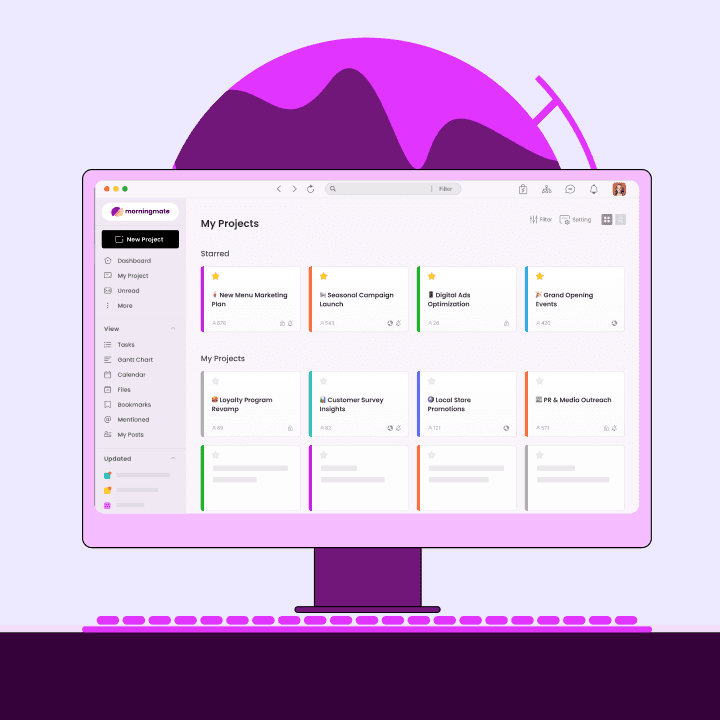
This is where tools like Morningmate solve a real structural problem. Morningmate is a lightweight work management platform that gives teams a dedicated space for task tracking and team coordination — without the complexity of enterprise tools like Jira. Its Feed view keeps work visible in a format teams already understand, reducing the learning curve that kills adoption in non-tech teams. Instead of chasing updates across five apps, you see everything in one place.
O — Own Every Task With Clear Accountability
In WhatsApp, tasks get acknowledged but rarely owned. "I'll handle it" in a group message is not the same as being assigned a task with your name, a due date, and a visible status. The difference matters enormously at scale.
Clear task ownership means every task has exactly one person responsible for its completion — not a team, not "whoever has time," but a named individual. When something slips, there is no ambiguity about where the conversation starts. And when a task is on track, the owner knows what is expected without needing a check-in nudge from management.
For ops teams coordinating across departments — say, finance, HR, and logistics — this is especially critical. A weekly vendor payment workflow might touch three people. If each step is a named task with a specific owner and due date, the handoff is automatic and auditable. Without that structure, you are back to manually chasing every link in the chain.
P — Process Every Recurring Workflow as a Repeatable Task Flow
Most ops teams do the same work over and over — onboarding employees, processing invoices, running weekly team syncs, managing supplier relationships. Yet in many SMBs, these recurring workflows live only in one person's head. When that person is out, the process stalls or gets done inconsistently.
The fix is to map every recurring process as a repeatable task workflow — a structured set of subtasks that can be launched as a template each time the process runs. Employee onboarding becomes a 14-step task checklist. Monthly reporting becomes a sequenced set of tasks assigned across finance and ops. Nothing is reinvented. Nothing is forgotten.
Asana's Anatomy of Work report found that workers spend nearly 60% of their time on "work about work" — status meetings, chasing updates, duplicating effort — rather than skilled work. Repeatable task workflows directly cut into that wasted time by eliminating the coordination overhead of figuring out what comes next.
E — Evaluate Task Management Health Regularly
A process you never review is a process that quietly deteriorates. The final component of the SCOPE framework is building a regular cadence to evaluate how your task management system is performing. Not just whether tasks are getting done, but whether the system itself is working.
This means looking at metrics like on-time task completion rate, average time tasks sit in "in progress" before closing, and which team members or functions are consistently behind. These signals tell you where your process has gaps — whether in ownership, resource allocation, or template quality.
A monthly thirty-minute review of task completion data across your key workflows is enough to catch drift before it becomes a systemic failure. The goal is not micromanagement — it is proactive ops management based on real data rather than gut feel and escalations.
Applying the SCOPE Framework: A Standardized Employee Onboarding Flow in Morningmate
Here is what the SCOPE framework looks like in practice. Take a common ops pain point: employee onboarding. In a WhatsApp-run environment, a new hire's first two weeks involves a flurry of messages, forgotten system access requests, and a manager who has to personally remind HR, IT, and finance to do their parts. It is exhausting and inconsistent.
With Morningmate and the SCOPE framework applied, the same process runs like this:
Standardize: A task template called "New Hire Onboarding" is created with twelve subtasks covering IT setup, HR paperwork, tool access, buddy assignment, and a thirty-day check-in. Every new hire triggers the same template.
Centralize: The template is launched inside Morningmate as a project. All tasks, files, and communications related to that hire live in one workspace — not scattered across WhatsApp, email, and Google Drive.
Own: Each subtask is assigned to a specific person — IT owns system access, HR owns paperwork, the hiring manager owns the thirty-day check-in. No ambiguity, no "I thought you were doing it."
Process: Because the template is reusable, the next onboarding takes five minutes to set up, not two hours. Morningmate's built-in chat also lets team members ask questions directly within the task context, so nothing important ends up lost in a separate WhatsApp thread.
Evaluate: At the end of each quarter, the ops manager reviews onboarding task completion rates. If the IT access subtask is consistently late, that is a signal to adjust the timeline or the process — before it affects the next cohort of hires.
The result is an onboarding process that runs without the ops manager being in the room for every step — which is exactly the goal of operational standardization.
Workflow Stage | WhatsApp / Manual Approach | SCOPE + Morningmate Approach |
|---|---|---|
Task creation | Verbal or WhatsApp message, no record | Template launched in seconds, fully documented |
Ownership assignment | Unclear, often assumed | Named, visible, non-negotiable |
Progress visibility | Manager must ask for updates manually | Real-time status visible to all stakeholders |
Handoff between teams | Message in group chat, easy to miss | Automated by task sequence and assignment |
Process repeatability | Rebuilt from scratch each time | One-click template reuse |
Post-process review | Anecdotal, based on who complains | Data-driven, completion rates tracked |
On-Time Task Completion Rate Before vs. After Standardized Task Management
41%
Before: Chat-based
63%
After: Basic task tool
87%
After: SCOPE + structured task mgmt
Fig 2: Estimated on-time completion improvement with standardized task management (illustrative, based on productivity research benchmarks)
Your Task Management Implementation Checklist
Implementing the SCOPE framework does not require a six-month transformation project. You can start this week. Here is a practical checklist for ops managers ready to standardize task management across their teams:
Audit your current task management reality. List every place tasks currently live — WhatsApp, email, spreadsheets, verbal agreements. This is your baseline.
Identify your three highest-frequency recurring workflows. Onboarding, vendor management, weekly reporting — pick the ones that create the most coordination pain.
Build a task template for each of those three workflows. Include required fields: task name, owner, due date, dependencies, and definition of done.
Choose one centralized task management tool and commit to it. Tools like Morningmate — which combines structured task tracking with a built-in chat that feels familiar to any WhatsApp user — reduce adoption resistance because the learning curve is minimal even for non-technical teams.
Assign explicit task owners for every active project. Go through your current open work and make sure every item has one named person responsible.
Set a monthly thirty-minute ops review. Look at task completion rates, identify bottlenecks, and update templates where the process has gaps.
Communicate the "why" to your team. People adopt systems faster when they understand the operational problem being solved — not just when they are told to use a new tool.
Solid task management is what separates ops teams that scale from ops teams that scramble. The SCOPE framework gives you a structured path from WhatsApp chaos to a system that works as hard as you do — one where you spend your time improving operations, not chasing them. The checklist above is your starting point. The first step is simply deciding that the current approach is no longer good enough.