Project Management

Good task management is the backbone of any productive small team — but there is a specific moment when even the best-run businesses quietly fall apart: when someone goes on holiday. Not a crisis, not a resignation, just a week off. And yet deadlines slip, clients wait longer than they should, and the owner ends up spending Sunday evening firefighting work that should have been handled on Thursday.
If that scenario sounds familiar, you are not running a bad business. You are running a business where productivity lives inside people rather than inside a system. When those people leave — even temporarily — the system leaves with them. That is a task management problem, and it is one of the most expensive problems a small team can have.
The good news: it is entirely fixable without hiring anyone new, buying five more tools, or building a bureaucracy that slows everyone down. Here is how to think about it, and what to actually do.
The Real Cost of Holiday-Driven Slowdowns
Most owners think of a team member's holiday as a temporary inconvenience. Work pauses for a week, then resumes. In reality, the disruption is longer and more expensive than that.
Consider what actually happens when someone steps away without a proper task handoff. Open tasks stall because no one else knows their status. Clients who expect a response by Friday get silence. The returning employee spends their first two days back catching up instead of moving forward. And the owner — who was supposed to be focusing on growth — gets pulled into operational gaps that nobody else can fill.
Where the Drain Really Happens
The cost is not just in the missed work. It is in the recovery time. A one-week holiday can create two to three weeks of disruption when task context is stored in someone's head rather than in a shared system. That is a significant tax on a 10-person team.
There is also a client trust cost. A small business's competitive advantage is often personal service and reliability. When a client gets a late delivery or a confused response because "that person is on holiday," the shine comes off fast.
Situation | When task context lives in the person | When task context lives in the system |
|---|---|---|
Team member goes on holiday | Work stalls; others cannot pick up where they left off | Anyone can see task status, notes, and next steps immediately |
Client asks for an update | Owner has to dig through messages or wait for return | Any team member can answer accurately in minutes |
Employee returns from leave | Two days lost catching up on what changed | Returns to a clear, current task list and gets back to work same day |
Owner's time | Pulled into daily firefighting to fill the gap | Free to focus on growth work as planned |
Why This Keeps Happening: The Root Cause
The root cause is not laziness or bad planning. It is that most small teams build their task management around people, not processes. One person owns a client relationship and holds all the context in their inbox. Another person is the only one who knows where a project stands because the "system" is a shared spreadsheet updated only when they remember to.
This works fine — until it does not. And holidays are the most predictable stress test of all, because unlike a resignation or illness, you know they are coming weeks in advance. If the system still breaks, it is a sign that task management is not actually being managed. It is being improvised.
The Handoff Problem Is Actually a Visibility Problem
When someone prepares to go on leave, they often write a handoff email or brief a colleague verbally. This feels thorough but it is a snapshot in time — it captures where things stood on Friday afternoon, not the ongoing reality of shifting priorities and new client requests. Good task management does not rely on handoffs. It relies on everyone always being able to see what is open, who owns what, and what the current status is — without asking.
That kind of real-time visibility is only possible when task tracking is a habit the whole team uses every day, not something that gets tidied up before someone leaves.
A Practical Fix: Build Task Management That Does Not Rely on Any One Person
The goal is not to build a complicated project management infrastructure. For a team of 5 to 50 people, the fix needs to be simple enough that it actually gets used. Here is a straightforward approach you can implement in a week.
Step 1: Move Tasks Out of Inboxes and Into a Shared Workspace
Every piece of work your team is responsible for should live somewhere visible to the whole team, not buried in someone's personal inbox or message thread. This is the single most important shift you can make. If a task is not visible, it does not exist to anyone else — and that means it stalls the moment the owner steps away.
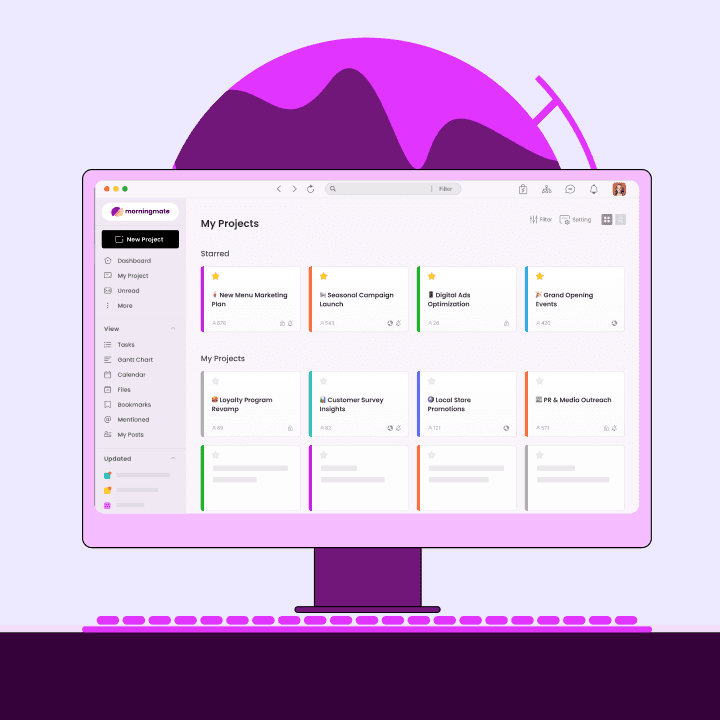
A tool like Morningmate gives your team a shared workspace where tasks, files, and updates all live in one place. Its feed-style interface feels familiar from day one — no lengthy onboarding required — so even non-technical team members actually use it, which is where most tool rollouts fail.
Step 2: Require Status Updates on Every Open Task
Every open task should have a current status attached: not started, in progress, blocked, waiting on approval, or done. That is it. This takes ten seconds to update and means that anyone — including the owner or a covering colleague — can scan the task board and know exactly where things stand without interrupting anyone.
Step 3: Assign a Backup Owner for Any Task That Will Be Active During a Holiday
Two weeks before any team member's leave, go through their open tasks together. For each active task, assign a backup owner. Not someone who will do all the work — just someone who is the point of contact if a decision needs to be made or a client needs a response. Document this inside the task itself, not in a separate email.
Step 4: Write Context Into the Task, Not Into the Person
Every task should include enough context for a colleague to pick it up cold. That means: what is the goal, what has been done so far, what the next step is, and where the relevant files live. This sounds like more work, but it takes five minutes per task and saves hours of confusion later. Think of it as writing a note to your future self — or to the colleague who will be covering.
Step 5: Do a Five-Minute Team Check-In the Week Before Any Holiday
Not a long meeting — just a quick walkthrough of what is active, who is covering what, and whether there are any tasks at risk of stalling. This makes holiday handoffs a team habit rather than a last-minute scramble.
How One Shared Hub Replaces the Chaos
The reason most small teams struggle with task management during holidays is not a process failure — it is a tool fragmentation failure. Tasks live in email, updates happen in chat, files are in a shared drive, and approvals come via text message. When the person who holds all those threads in their head goes on leave, the whole picture disappears.
Morningmate is built specifically to solve this. It combines task tracking, built-in team chat, and file management in a single lightweight workspace — so your team is not juggling five different apps to see what is happening on one project. Used by over 550,000 teams, it is designed to be simple enough for any team to adopt without a dedicated IT setup or weeks of training.
Putting Task Context Where Everyone Can Find It
One practical feature worth highlighting for holiday continuity: Morningmate's AI Smart Search lets any team member find task context, decisions, or files by asking in plain language — no guessing which folder something was saved in or scrolling through old messages. When someone is covering a colleague's work and needs to get up to speed fast, this removes a lot of the friction that usually causes delays.
The goal is not to build a surveillance system for your team. It is to make sure that the knowledge required to keep work moving is never locked inside a single person's head — or their inbox.
What needs to happen before a holiday | Fragmented tool setup | Shared workspace (Morningmate) |
|---|---|---|
Find all open tasks | Search across email, chat, spreadsheet, and notes | Open one project view — everything is there |
Assign backup owners | Send a handoff email that gets buried | Reassign directly in the task; backup owner notified instantly |
Share task context | Verbal briefing or long email thread | Notes and files attached to the task; searchable anytime |
Monitor during absence | Owner must chase updates manually | Task status visible at a glance without asking anyone |
Return from leave | Days spent reconstructing what happened | Open the task board; caught up within the hour |
The ROI Framing: What You Are Actually Buying
When you invest time in building solid task management habits, you are not just solving the holiday problem. You are building a business that can grow without adding headcount, because your existing team can carry more work without dropping balls. You are also building a business that is less dependent on you personally — which is what every owner says they want, but few actively design for.
Think about it this way: if a one-week holiday currently costs your business two to three weeks of full productivity, fixing that pays for itself in the first quarter. The steps above do not require a big software budget or a consultant. They require a shared workspace, a consistent habit, and about thirty minutes of setup before each team member goes on leave.
If your task management is currently held together by one person's memory and a thread of messages, the next holiday on the calendar is your deadline. Start with the basics — get tasks into a shared system, add status and context, assign a backup, and do a five-minute check-in before anyone leaves. You will not just survive the next holiday. You will barely notice it.