Project Management

Most service businesses run on relationships, reputation, and people — not software. Whether you run a cleaning company, a consulting firm, a logistics operation, or a marketing agency, the real work happens between people: calls, messages, handoffs, and follow-ups. But when none of that lives in one place, things fall through the cracks fast.
Without a back-office coordination system, your team ends up managing work through a patchwork of WhatsApp groups, email threads, sticky notes, and memory. Someone misses an update. A client request gets lost in a chat. A task no one claimed never gets done. Sound familiar?
The good news is that you do not need an enterprise-grade tool or a dedicated IT team to fix this. What you need is a clear understanding of where the coordination breaks down — and a smarter way to bring it together.
Why Service Businesses Struggle With Coordination
Service businesses are uniquely difficult to coordinate because the work is largely invisible. Unlike manufacturing or retail, there is no physical product moving through a pipeline. Instead, you have people, tasks, client expectations, and deadlines — all moving at once, with very little structure holding them together.
According to McKinsey research on organizational performance, poor coordination is one of the top hidden costs in service-oriented organizations. Teams spend enormous time simply figuring out who is doing what — time that could go directly into serving clients.
The problem compounds as teams grow. A two-person operation can survive on gut instinct and a shared inbox. A fifteen-person team cannot. Yet many businesses try to scale up without changing how they manage work — and they pay for it in errors, burnout, and lost clients.
The Most Common Coordination Gaps
Before you can fix a coordination problem, you need to name it. Most service businesses experience some version of the following breakdowns:
No single source of truth for task status. Someone asks "Where are we on this?" and no one has a clear answer.
Client requests that live only in personal inboxes. When the person who received the request is out, the task stalls.
Verbal handoffs with no paper trail. A manager tells a team member something important in passing — and it never gets acted on because it was never written down.
Duplicate work. Two people start the same task because nobody knew the other had already begun.
No visibility for leadership. Managers cannot see what is in progress, what is blocked, or what is overdue without manually checking in with each person.
Each of these is a symptom of the same underlying issue: work coordination is happening informally, in channels that were never designed for it.
What a Back-Office System Actually Does
A back-office coordination system does not have to be complicated. At its core, it does three things: it captures work, it assigns it clearly, and it makes the status visible to everyone who needs to know. That is it.
Many teams assume they need something like Jira or a full project management suite. But for most service businesses, that level of complexity creates more friction than it solves. The tool becomes something people avoid rather than use.
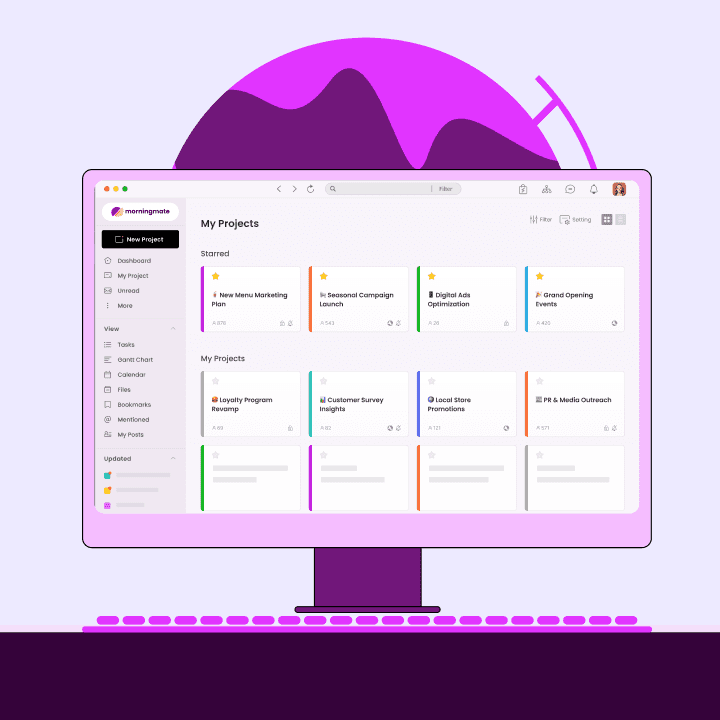
This is where a tool like Morningmate fits well. It is a lightweight work management platform built around task management and team communication — simple enough that non-technical teams can adopt it without training, but structured enough to bring real order to chaotic workflows. Teams across industries use it to replace scattered WhatsApp groups and email threads with one organized workspace.
How to Build Coordination Into Your Service Business
Getting organized does not require a big rollout or a consultant. You can start small and build from there. Here is a practical framework that works for most service businesses:
Step 1 — Audit Where Work Lives Right Now
Spend one week tracking every channel where work-related communication happens. Include WhatsApp, SMS, email, phone calls, and in-person conversations. Write down how many of those interactions resulted in a task that was never documented anywhere.
This audit is usually eye-opening. Most teams discover that the majority of their work starts in channels with no accountability built in.
Step 2 — Define What Needs to Be a Task
Not every message needs to become a task. But anything that requires action from a specific person by a specific date should be tracked. Create a simple rule for your team: if it needs to get done, it gets logged.
This habit alone eliminates a huge percentage of missed follow-ups and dropped requests. It shifts the team from relying on memory to relying on a system.
Step 3 — Pick One Tool and Commit to It
The biggest mistake teams make is using three tools at once and then having no single place to look. Pick one platform for task tracking and team communication, and make it the default — not an option.
Morningmate works well here because it combines a task manager with a built-in team chat in one interface. The chat looks and feels like WhatsApp, so the adoption curve is almost flat for non-technical staff. Teams do not need to learn a new way of communicating — they just move the conversation into a space where it is connected to the actual work.
Step 4 — Give Every Task an Owner and a Deadline
A task without an owner is just a wish. A task without a deadline is just a good intention. Require both for every item logged in your system, no exceptions.
This also changes how accountability works on your team. When ownership is explicit and visible, people are less likely to assume someone else will handle it.
Step 5 — Build a Weekly Visibility Habit
Even the best system falls apart without a regular rhythm. Set a weekly check-in — it can be fifteen minutes — where the team reviews what was completed, what is in progress, and what is blocked. This does not need to be a meeting. A simple async update in your work tool works just as well.
For managers and business owners, this weekly rhythm replaces the constant need to chase updates individually. You get visibility without micromanaging.
The Real Cost of Staying Unorganized
It is tempting to treat coordination problems as a minor inconvenience. They are not. Research published in Harvard Business Review found that employees lose significant time each week simply switching between apps and chasing down information — time that compounds into serious lost productivity over a quarter or a year.
For a service business, this lost time hits twice. First, your team is less productive. Second, your clients feel the effect — slower responses, more errors, and a service experience that feels disorganized even when the underlying work is solid.
Getting coordination right is not just an internal efficiency play. It directly shapes the quality of service your clients experience, and whether they come back.
Signs Your Team Is Ready to Level Up
If you are unsure whether now is the right time to put a system in place, look for these signals:
You or your managers spend more than an hour a week chasing status updates
Client complaints often come down to "we were not informed" or "this was not done"
New team members take weeks to understand how work actually flows
You cannot quickly answer "what is everyone working on right now" without making calls
The team is growing but output is not scaling proportionally
Any one of these is a signal. More than two, and the cost of staying unorganized is already higher than the effort it takes to fix it.
Starting Small Still Means Starting
You do not need to transform how your entire business operates overnight. The most successful teams start with one workflow — client onboarding, daily job assignments, internal requests — and get that one thing organized before expanding.
Morningmate is built for exactly this kind of incremental adoption. Its Feed view gives teams a social-media-style overview of what is happening across projects, so managers get real-time visibility without having to dig through folders or ask around. You can start with one team or one process, see the difference, and grow from there.
The goal is not perfection. The goal is to stop losing work to the gaps between tools, people, and conversations — and to build a team that can scale without the chaos catching up to it.