Project Management

Most weekly team reviews follow the same tired pattern: someone shares a status update, a few people nod along, and everyone leaves feeling like they just sat through a meeting that could have been an email. Nothing actually changes. Projects still slip. The same blockers come up week after week.
The problem isn't the meeting itself — it's the structure. A well-run weekly team review isn't just a check-in. It's a deliberate system for catching problems early, aligning your team on priorities, and making decisions that move work forward. When you get it right, it becomes one of the most valuable hours your team spends together.
This guide walks you through exactly how to set up a weekly team review that actually improves project outcomes — not just one that fills a calendar slot.
Why Most Weekly Reviews Don't Work
Before redesigning your review, it helps to understand what usually goes wrong. The most common failure isn't that teams skip the meeting — it's that the meeting lacks a clear purpose beyond "giving updates."
Research from Harvard Business Review found that 71% of senior managers considered most meetings unproductive and inefficient. That number likely hasn't improved much since — and weekly team reviews are often the worst offenders. They drift into status theater: everyone performs being busy, but no real decisions get made.
A few other patterns that derail weekly reviews:
No agenda shared in advance, so people come unprepared
The same vocal people dominate while others disengage
Action items from the previous week are never revisited
The review mixes tactical updates with strategic conversations, leaving both unresolved
There's no shared record of what was decided, so the same issues resurface next week
What a High-Impact Weekly Team Review Actually Looks Like
A great weekly review has three jobs: surface blockers before they become crises, align the team on what matters most this week, and close the loop on decisions from the previous week. Everything else is secondary.
Think of it less like a reporting session and more like a short coordination sprint. The goal is to leave the meeting with clear owners, clear next steps, and a shared understanding of where projects stand.
The Right Length and Frequency
For most teams of 5–20 people, 45 to 60 minutes once a week hits the sweet spot. Less than 45 minutes rarely leaves room to surface real issues. More than 60 minutes and attention drops sharply. If your team is larger or more complex, consider splitting into a team-level review and a cross-functional sync rather than extending the single meeting.
Frequency matters too. Weekly is almost always the right cadence for project-focused teams. Monthly reviews are too infrequent to catch drift early. Daily stand-ups serve a different purpose — they're tactical, not reflective.
Who Should Be in the Room
Invite everyone who owns a piece of active work — not just team leads. When individual contributors are excluded, the meeting becomes a game of telephone. You end up with secondhand updates and managers who aren't sure what's actually happening on the ground.
That said, keep the group tight. If you have more than 12 people in a weekly review, it's usually a sign you're running one meeting that should be two.
A Practical Agenda Framework for Your Weekly Team Review
Here's a simple, repeatable agenda structure you can adapt for your team. The key is to run every section in the same order every week until it becomes muscle memory.
1. Close the Loop on Last Week (10 minutes)
Start by reviewing the action items from your previous meeting. Not to shame anyone — but to establish that this meeting has real accountability. Ask: what was committed to, what got done, and what's still open? Anything still open either moves to this week's actions or gets deprioritized explicitly.
This single step separates productive weekly reviews from performative ones. It signals that commitments made in this room actually matter.
2. Project and Work Status — Red, Yellow, Green (15 minutes)
Go through active projects using a simple traffic light system. Green means on track. Yellow means at risk but recoverable. Red means blocked or off track and needs immediate attention. This format forces clarity and keeps status updates brief.
Each project owner gives a one or two sentence summary. The group only digs into yellows and reds — greens don't need discussion time. This alone can cut your review time by 20 minutes compared to open-ended updates.
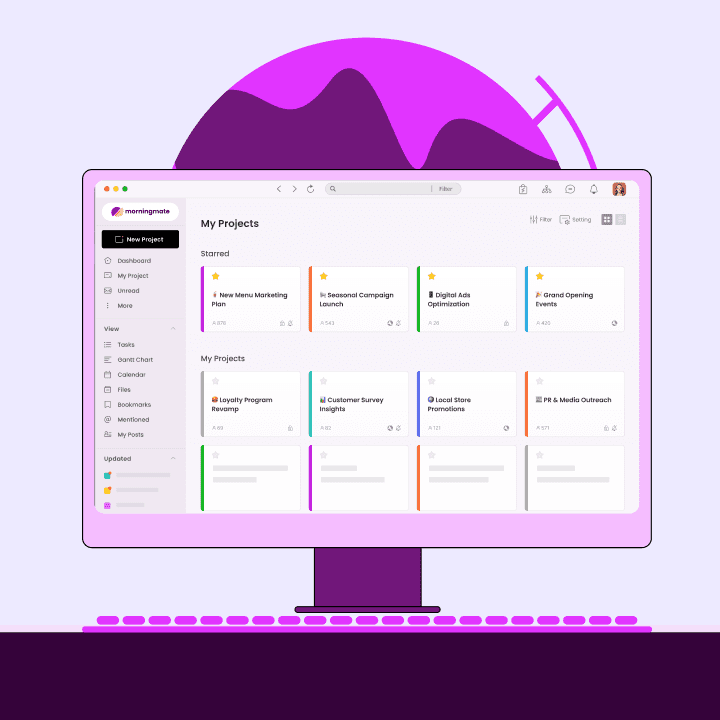
If your team uses a centralized task management tool, you can pull this view up live during the meeting rather than relying on verbal memory. Tools like Morningmate — a lightweight work management platform used by over 550,000 teams — let you see task statuses across projects in a shared feed view, so everyone is looking at the same picture without anyone needing to prep a slide deck.
3. Blockers and Dependencies (10 minutes)
This is the most valuable section of any weekly team review, and the most skipped. Give each person 60 seconds to name one thing that's slowing them down or that they need from someone else on the team.
Don't try to solve every blocker in the meeting. The goal is to surface them so the right people can connect after. Some blockers will resolve in 30 seconds once the right person hears about them. Others will need a separate conversation. Either way, naming them is the first step.
4. Priorities for This Week (10 minutes)
Ask each team member or project lead to name their top one or two priorities for the week ahead. This isn't a full task list — it's a shared signal of where attention is going. It also surfaces conflicts early. If two people are both counting on a third person's bandwidth this week, you want to know that now, not on Friday.
5. Decisions and Action Items (5–10 minutes)
Close by capturing every decision made and every action item assigned — with a name and a due date next to each one. No name, no due date means it won't happen. This record becomes the starting point for next week's "close the loop" section.
Assign one person to own the notes. Rotate this role if needed, but someone has to be responsible for the written record. Without it, the meeting's value evaporates within 24 hours.
Making the Review Work for Async and Hybrid Teams
If your team is distributed across time zones, a fully synchronous weekly review may not always be possible. Gallup's research on hybrid work consistently shows that async communication is now a core competency for most teams — not an edge case. Your weekly review structure needs to account for this.
One approach that works well for hybrid teams: ask everyone to submit a brief written update — project status, blockers, priorities — before the meeting. This pre-work compresses the synchronous time needed and means people in less favorable time zones can contribute meaningfully even if they can't attend live.
This is where a tool like Morningmate earns its place. Its built-in feed and async communication features let team members post structured updates before the meeting — think of it like a social-media-style stream where everyone can see what's happening across projects without needing to be online at the same time. The synchronous review then focuses on decisions and blockers, not catching up on status.
Recording and Sharing the Review
If some team members can't attend live, record the meeting and share it alongside the written notes. But don't let this become a crutch for poor documentation. The written record — decisions, action items, owners — should stand on its own. Video is supplementary.
Common Pitfalls to Avoid
Even with a good structure, weekly reviews can drift back into old habits. Watch for these warning signs:
The review becomes a reporting session. If people are just reading out task lists, cut the status section and move that to an async update. Use the live time for discussion only.
Action items disappear between meetings. Keep a running action log in a shared space — not buried in someone's personal notes or a one-off email. Morningmate's task management features let you convert action items from meetings directly into tracked tasks with assignees and deadlines, so nothing falls through the cracks.
The same topics come up every week without resolution. This usually means a decision is being avoided. Name it explicitly: "We've discussed this three weeks in a row. What's stopping us from deciding?"
The meeting runs long and feels unfocused. Assign a timekeeper. Give each section a hard time limit and stick to it. If a topic needs more than five minutes, schedule a separate working session.
How to Measure Whether Your Weekly Review Is Working
After six weeks of running a structured weekly review, you should start seeing measurable changes in how your projects move. McKinsey's work on organizational performance highlights that meeting effectiveness directly correlates with how clearly teams define and follow up on decisions — not just how often they meet.
Here are a few signals that your weekly team review is actually working:
Blockers are getting resolved faster — because they're being named earlier
Fewer surprises at the end of projects — because drift is caught weekly, not at delivery
Action items from previous meetings are consistently closed out
Team members come prepared and contribute actively, not just when called on
The meeting ends on time, with a clear list of next steps
If you're not seeing these after six weeks, revisit the structure. The most common fix is cutting the meeting down — either fewer people, shorter duration, or more async pre-work. A 30-minute review that's sharp and decisive will do more for your project outcomes than an hour-long one that meanders.
A Quick-Start Checklist for Your First Restructured Review
If you're ready to overhaul your weekly team review, here's a simple checklist to get your first session right:
Send the agenda at least 24 hours in advance with clear sections and time limits
Ask each person to submit one-line project statuses (red/yellow/green) before the meeting
Start by reviewing last week's action items — name, status, and outcome
Run through project statuses, focusing discussion only on yellows and reds
Give everyone a chance to name their top blocker for the week
Confirm top priorities for the week ahead
End with a written list of decisions made and actions assigned, with names and due dates
Share the notes within one hour of the meeting ending
The difference between a weekly review that improves project outcomes and one that just fills a time slot comes down to discipline and structure. The agenda above takes no special tools and no management training — just a willingness to run the meeting the same way every week until it becomes a genuine team habit. Start there, and the results will follow.