Project Management

At some point, most teams hit a wall. The group chat is overflowing, deadlines are missed because someone didn't see the update, and nobody quite knows who owns what. If that sounds familiar, you're not dealing with a people problem — you're dealing with a tools problem. Specifically, the absence of a proper project tool.
A project tool is more than a to-do list or a shared spreadsheet. It's the central nervous system of how your team works — where tasks live, where communication happens around those tasks, and where progress is visible to everyone who needs to see it. Without one, work gets fragmented across emails, personal messenger apps, and sticky notes on someone's monitor.
Choosing and actually using the right project tool can transform how your team operates day-to-day. But with so many options available, and with teams ranging from five-person startups to hundred-person operations, the decision isn't always straightforward. This guide breaks down what to look for, what to avoid, and how to make the switch without disrupting your team's flow.
Why Teams Keep Getting Project Management Wrong
The instinct is understandable: grab the tool everyone already uses. Email for updates. WhatsApp for quick questions. A shared Google Doc for project notes. It feels lightweight and low-friction — until it isn't.
The problem is that these tools weren't built for work coordination. They were built for personal communication. When you use them for project management, information scatters, context gets lost, and the loudest message thread wins — not the most important task.
Research from Harvard Business Review consistently shows that unclear processes and poor communication are among the top drivers of team inefficiency. When teams lack a structured system, managers spend a disproportionate amount of time chasing updates instead of doing strategic work. That's time your business can't afford to waste.
What a Good Project Tool Actually Does
Before you start comparing features, it helps to understand the core jobs a project tool needs to do for your team. These aren't nice-to-haves — they're the baseline.
Centralizes Work in One Place
Every task, update, file, and conversation about a project should live in one location. Not three tabs and a chat thread. When your team can open one tool and see everything relevant to their work, decision-making speeds up and nothing falls through the cracks.
Makes Ownership Crystal Clear
Accountability starts with clarity. A solid project tool assigns tasks to specific people with due dates attached. When everyone knows who owns what and when it's due, the follow-up emails stop and the work actually moves forward.
Gives Managers Real Visibility
Whether you're managing a remote team or leading operations across departments, you need a clear view of what's in progress, what's blocked, and what's done. A good project tool surfaces this information without requiring you to manually ask for it in a meeting.
Supports Communication in Context
Discussions about a task should happen near that task — not in a separate chat thread three days later. When communication is tied to specific work items, context is preserved and decisions are easier to track. This is where many older tools fall short, and why teams often end up running two systems side by side.
The Spectrum of Project Tools: Finding Your Fit
Not every project tool is built for the same kind of team. On one end of the spectrum, you have enterprise-grade platforms with complex workflows, detailed reporting, and steep learning curves. On the other end, you have basic task lists that lack the structure growing teams need.
Gartner's research on work management platforms highlights that adoption rates are one of the biggest barriers to ROI for project tools. Teams invest in sophisticated platforms only to find that employees revert to email within weeks because the tool feels too complex for everyday use.
The sweet spot for most growing teams is a project tool that's powerful enough to manage real work but simple enough that everyone — including non-technical team members — actually uses it. That balance matters more than any individual feature.
When Simple Isn't Enough
A shared spreadsheet or a basic checklist app might work when a team is tiny and everyone is in the same room. But as your team grows, projects multiply, and work becomes distributed, these approaches break down quickly. You need task dependencies, status tracking, and the ability to assign work across people — not just a running list.
When Complex Is Too Much
On the flip side, enterprise tools like Jira are powerful — but they're built for software development teams with dedicated project managers. If your team is running marketing campaigns, managing client projects, or coordinating operations across departments, you don't need a tool with sprints and story points. You need something that mirrors how your team actually thinks and talks about work.
This is exactly the gap that tools like modern work management platforms are designed to fill — structured enough to keep work organized, simple enough that onboarding takes hours, not weeks.
Key Features to Look for in a Project Tool
When evaluating options, run every tool through these criteria before committing your team to it.
Task assignment and due dates: Non-negotiable. Every task should have an owner and a deadline.
Status tracking: You should be able to see at a glance what's in progress, what's pending, and what's done — without running a meeting to find out.
File sharing and storage: Attachments, documents, and images should live alongside the tasks they belong to — not buried in an email thread.
Built-in communication: The ability to comment or message within the context of a task keeps discussions from scattering across external apps.
Simple onboarding: If your team needs a training course to use a tool, they won't use it. Prioritize interfaces that feel intuitive from day one.
Cross-team visibility: For managers and operations leads, being able to view work across multiple teams or projects from one dashboard is essential.
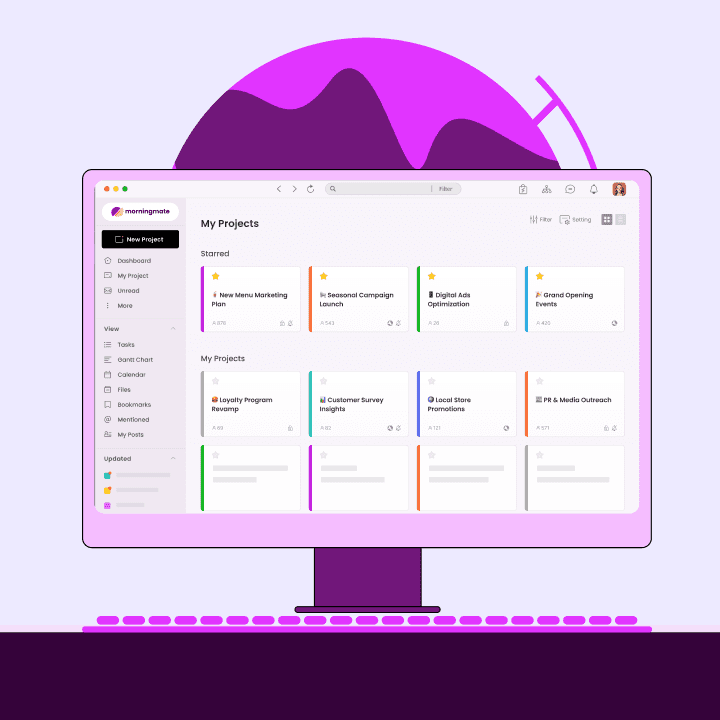
Morningmate, a work management tool used by over 550,000 teams worldwide, is built around exactly these priorities. Its feed-style interface — similar in feel to a social media timeline — makes it easy for team members to see project updates and tasks without a learning curve. Combined with a built-in chat that works like a familiar messaging app, it replaces the need for separate communication tools while keeping everything organized in one place.
How to Roll Out a Project Tool Without Losing Your Team
Choosing the right project tool is only half the battle. The other half is getting your team to actually adopt it. McKinsey research on organizational change has found that resistance to new tools often comes from unclear expectations, not the tools themselves. People need to understand why the change is happening and what it means for their daily work.
Here's a practical rollout approach that works for teams of most sizes:
Start with one team or one project. Don't migrate your entire company on day one. Pick a willing team or a new project and run it entirely through the new tool. Use that as your proof of concept.
Migrate existing work before launch. Set up the structure in advance — create the projects, add the tasks, bring in key files. Don't ask people to build the house while they're moving into it.
Set clear expectations about where work lives. If tasks go in the tool, make that the rule — not a suggestion. The tool only works if it becomes the single source of truth.
Designate a point person for questions. Have one person who knows the tool well enough to help teammates get unstuck without turning every small question into a meeting.
Review and iterate after 30 days. Check in with your team. What's working? What feels clunky? Most good project tools let you adjust workflows over time, so don't over-engineer your setup at the start.
Signs Your Current System Isn't Working
Sometimes teams aren't sure whether they need a new project tool or just better habits. Here are some clear signals that the tool — not the team — is the problem.
You spend more time looking for information than acting on it
Deadlines are missed because updates were buried in a chat or email
Team members duplicate work because they didn't know someone else was handling it
Managers can't answer "what's the status on this?" without asking multiple people
New hires take weeks to understand what's going on because context lives in people's heads
Work decisions are made in personal messaging apps and never documented anywhere
If three or more of these feel familiar, it's a clear sign your team has outgrown the informal systems you've been relying on. The good news is that switching to a proper project tool doesn't have to mean a painful, months-long migration.
Making the Most of Your Project Tool Once You're In
Once your team is up and running, the real value comes from consistency — not just setup. A project tool becomes genuinely powerful when it reflects how work actually flows in your organization.
Use it for recurring work, not just one-off projects. Build templates for common processes so your team isn't starting from scratch every time. Establish communication norms so everyone knows when to use the task comment versus the chat versus a quick call.
Morningmate, for example, supports both a project feed view and a built-in messaging interface, which means your team can coordinate work and communicate without ever leaving the platform. For operations leads managing multiple teams, this kind of unified visibility — seeing all active projects and team conversations in one dashboard — removes the constant context-switching that slows work down.
The goal isn't to have a perfectly optimized system from week one. It's to create a shared workspace where work is visible, accountability is clear, and your team spends less time managing the chaos and more time doing the actual work. That's what the right project tool makes possible — and once your team experiences it, going back to scattered emails and WhatsApp threads stops feeling like an option.