Project Management

Most teams reach a point where things start slipping through the cracks. Deadlines get missed, files are buried in email threads, and nobody is quite sure who owns what. The instinct is to find a tool that fixes everything — one place to chat, plan, assign, track, and report. But before you go searching for the perfect all-in-one solution, it helps to understand what you actually need and why two different categories of tools exist in the first place.
Project management tools and team collaboration tools are often treated as interchangeable. They are not. Confusing one for the other — or assuming you only need one — is one of the most common reasons teams end up frustrated with software that does not quite fit how they actually work.
This article breaks down the real difference between the two, what each one does well, where each one falls short on its own, and how to think about combining them in a way that actually supports your team rather than adding more complexity to your day.
What a Project Management Tool Actually Does
A project management tool is built around structure. Its primary job is to help you plan work, assign ownership, set deadlines, and track progress from start to finish. Think task lists, timelines, dependencies, milestones, and status updates. The entire experience is designed around the lifecycle of work — what needs to happen, in what order, and whether it is getting done.
This is incredibly useful when you are coordinating complex projects with multiple people, multiple moving parts, and a real need for accountability. Without this kind of structure, work tends to exist only in people's heads or in scattered notes, which is a recipe for delays and dropped balls.
Where Project Management Tools Shine
Project management tools are at their best when you need a clear, bird's-eye view of what is happening across a body of work. They answer the questions that managers lose sleep over: What is the current status of this deliverable? Who is blocked? Is this project on track to meet its deadline?
Assigning tasks with clear ownership and due dates
Tracking progress against milestones
Identifying bottlenecks before they become emergencies
Keeping work visible to everyone who needs to see it
Generating reports for leadership or clients
Where They Fall Short
Here is the honest limitation of most project management tools: they are not great at human conversation. They can tell you a task is overdue, but they cannot easily capture the quick back-and-forth that happens when a team member needs a fast answer, a decision needs to be made in the moment, or someone just needs to flag a blocker without creating a formal task for it.
Communication that lives outside the tool — in email, WhatsApp, or SMS — ends up disconnected from the actual work. Context gets lost. Decisions made in a chat thread never make it back to the task where they belong.
What a Team Collaboration Tool Actually Does
A team collaboration tool is built around communication and shared context. Its job is to make it easy for people to talk to each other, share files, ask questions, and stay aligned — without those conversations getting buried in inboxes or scattered across personal apps.
Where a project management tool says "here is what needs to get done," a collaboration tool says "here is where your team actually talks about the work." The best ones keep communication organized by topic, team, or project so that information is easy to find and easy to act on.
Where Collaboration Tools Shine
Collaboration tools reduce the friction of working together, especially when teams are remote or spread across time zones. Research from Harvard Business Review consistently shows that the quality of team communication directly affects productivity and morale — and that teams working asynchronously need especially reliable channels to stay connected and informed.
Fast, informal communication without the formality of email
Organized channels or threads so conversations do not get mixed together
File sharing and document storage in one accessible place
Keeping remote and hybrid team members in the loop
Building a shared knowledge base that new team members can access
Where They Fall Short
The weakness of a pure collaboration tool is the flip side of its strength: it is great at conversation but poor at structure. Messages pile up. Action items mentioned in chat often go untracked. Nobody owns follow-up. Without a way to convert conversations into tasks with deadlines and assigned owners, important things get said and then forgotten.
This is why teams that rely only on Slack, Microsoft Teams, or WhatsApp often still struggle with accountability. Communication flows freely, but actual work management remains invisible.
The Real Problem: Using Only One
Most teams default to one or the other. They either use a structured project management tool like Jira or Asana and conduct all actual conversation through WhatsApp — or they lean entirely on a chat app and try to manage work through pinned messages and reminders. Both approaches create gaps.
McKinsey research has found that employees spend a significant portion of their working week searching for information and communicating about work — time that could be dramatically reduced when communication and task management live in the same ecosystem. When the two are fragmented across different tools, teams pay a hidden productivity tax every single day.
The solution is not necessarily to find one tool that does everything at an enterprise level. For most teams — especially those under 100 people — the goal is to find a lightweight setup where task management and communication are connected, not competing.
Why You Need Both — And How They Work Together
When project management and collaboration work together, something useful happens: context stays attached to work. A comment on a task is visible to everyone who owns that task. A question asked in a project channel leads to a decision that gets captured where the work actually lives. Nobody needs to re-explain what was discussed in a meeting because the outcome is already linked to the relevant deliverable.
This is the setup that high-functioning teams have moved toward, and it is increasingly the expectation rather than the exception. Gallup's workplace research points to clarity of expectations and quality of communication as two of the strongest drivers of team engagement — both of which depend on having the right information in the right place at the right time.
A Practical Framework for Getting This Right
Rather than overhauling your entire stack at once, think about your team's two core needs: structured visibility into work, and easy communication around that work. Here is a simple way to evaluate whether your current setup is serving both.
Map where work is tracked. Can every team member see who owns what and what the current status is — without asking around?
Map where communication happens. Are conversations about work happening in the same place where work is managed, or in a separate app?
Identify the gaps. Are action items from conversations getting lost? Are tasks being managed in chat threads that were never designed for that?
Look for tools that bridge both. Ideally, your team should not need to switch between a project management tool and a separate communication app for day-to-day work.
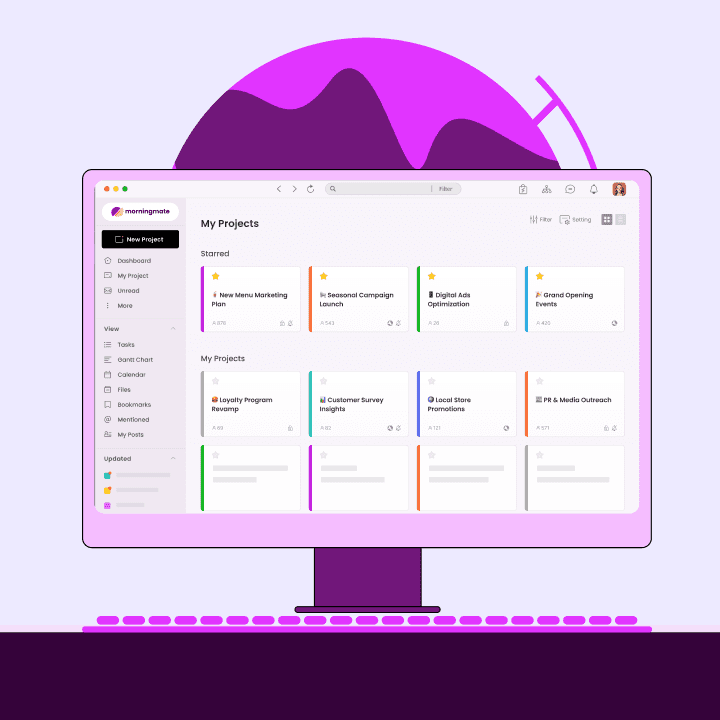
This is exactly the problem that tools like Morningmate are built to solve. Morningmate is a lightweight work management platform that combines task management with built-in team chat — so the conversation about the work and the work itself live in the same place. It is designed to replace the chaos of WhatsApp threads and email chains without forcing your team to learn a complex enterprise system.
When to Use Separate Tools vs. an Integrated Approach
For teams running enterprise-scale projects with complex dependencies and advanced reporting needs, using a dedicated project management tool alongside a communication platform can make sense — provided the two are integrated so that information flows between them.
For the majority of teams — small to mid-sized companies, hybrid and remote teams, operations teams, or any team that is currently managing work through personal messenger apps — an integrated approach is almost always simpler and more effective. Fewer tools means fewer places for information to get lost, fewer logins to manage, and less time spent re-syncing people who are already out of step.
Choosing the Right Setup for Your Team
Before evaluating any tool, it helps to be honest about where your team's current pain actually comes from. Use these questions to diagnose the real problem.
Do team members frequently ask "what is the status of this?" — even for work that is technically tracked somewhere?
Are you relying on WhatsApp or personal email to discuss work that should have a record attached to it?
Do decisions made in conversation fail to make it back to the task or project they relate to?
Does your team lose time every week searching for files, updates, or past conversations?
Do new team members struggle to get up to speed because context is spread across too many places?
If most of these ring true, the root issue is likely not the absence of a project management tool or a collaboration tool in isolation — it is the absence of a connected workspace where both things happen together.
Morningmate's Feed view is worth highlighting here. It surfaces updates from across your projects in a format that looks and feels like a social media feed — familiar, easy to scan, and designed for teams that do not want to spend twenty minutes navigating a dashboard just to see what is happening. Combined with its built-in chat, it gives teams the structure of task management alongside the speed of real conversation, without the learning curve that comes with complex platforms.
Getting Your Team Aligned on a New Setup
Even the right tool fails if the team does not adopt it consistently. This is one of the most underestimated challenges in any software rollout. People default to old habits — especially personal messenger apps — because they are convenient and already on everyone's phone.
The key is not to mandate adoption through policy but to make the new system the path of least resistance. That means setting up channels and projects before asking people to switch, migrating existing work into the new tool visibly so people can see it working, and making sure leadership models the behavior by using the tool themselves for updates and decisions.
A Simple Rollout Checklist
Define which types of communication belong where — for example, quick questions in chat, project updates on task cards, files attached directly to relevant tasks.
Set up the tool with your real projects before announcing the switch, so there is something to show immediately.
Run a short orientation — even fifteen minutes — so team members feel confident navigating the new system.
Agree on a trial period (two to four weeks is usually enough) before reviewing what is and is not working.
Nominate one person per team to answer questions and keep the tool organized during the transition.
Consistency matters more than perfection in the early weeks. A tool that is used imperfectly by everyone is far more valuable than a tool that is used perfectly by nobody. If your current setup has your team split between email, WhatsApp, and a task board nobody fully trusts, moving to one connected workspace — even if it takes adjustment — will pay off quickly.
Teams using Morningmate across a wide range of industries — from construction and logistics to consulting and retail — report that the familiarity of the interface is what makes adoption stick. When the chat feels like WhatsApp and the project feed feels like scrolling through updates, the learning curve almost disappears. For non-technical teams especially, that familiarity is not a small thing — it is often the difference between a tool that gets used and one that gets abandoned after a week.