Project Management

When someone searches for "membership management software," they're usually thinking about managing rosters, renewals, and dues for an association, gym, or nonprofit. But if you're a team manager or operations lead searching for a better way to organize work across your organization, you might find yourself confused — because the tools showing up in those results aren't built for you. Understanding the difference between membership management software and team work management is more important than it sounds, especially when your team's productivity depends on picking the right one.
This isn't just a matter of terminology. Using the wrong category of software for your needs creates real friction — missed tasks, scattered updates, and team members working from outdated information. We've seen it happen in companies of all sizes, from 10-person startups to 500-person operations teams.
This guide breaks down what each type of software actually does, who it's built for, and how to figure out which one your team genuinely needs. If you've been using email threads or WhatsApp groups to manage work, you'll also find out why neither category — used alone — is enough.
What Is Membership Management Software?
Membership management software is designed to help organizations manage a defined group of members — tracking who they are, what they've paid, when their memberships expire, and how engaged they are. Think gyms, professional associations, alumni networks, nonprofits, and clubs.
The core features of these tools revolve around:
Member directories and profiles
Subscription and dues billing
Renewal reminders and expiration tracking
Event registration and attendance tracking
Member portals for self-service access
Reporting on membership growth and retention
Popular tools in this space include WildApricot, MemberClicks, and Glue Up. They're excellent at what they do — but what they do is manage relationships with an external membership base, not coordinate the day-to-day work of an internal team.
Who Actually Needs Membership Management Software?
If you run a trade association and need to track 2,000 individual member accounts with different subscription tiers, membership management software is exactly right. If you lead a professional community with events, newsletters, and certification renewals — same answer.
But if you're managing a cross-functional team trying to deliver a product launch, coordinate a construction project, or keep a distributed sales team aligned — that's an entirely different problem. And membership management software won't solve it.
What Is Team Work Management Software?
Team work management software is built around one goal: helping people inside an organization get work done together, more efficiently. It coordinates tasks, tracks progress, centralizes communication, and gives everyone — from the individual contributor to the executive — visibility into what's happening and what's next.
According to Asana's Anatomy of Work report, knowledge workers spend 58% of their time on work about work — things like chasing updates, sitting in unnecessary meetings, and searching for information — rather than doing the work that actually matters. That's the problem work management software is designed to solve.
Core features typically include:
Task creation, assignment, and deadline tracking
Project boards and timelines
Team communication and file sharing
Status updates and progress visibility
Notifications and reminders
Reporting and workload views
The Spectrum: From Simple to Complex
Work management tools span a wide range of complexity. On the heavier end, you have tools like Jira or Asana — powerful platforms built for technical teams or large organizations that need detailed workflows, dependencies, and custom reporting. These tools are genuinely useful for teams with dedicated project managers and operations staff who can configure and maintain them.
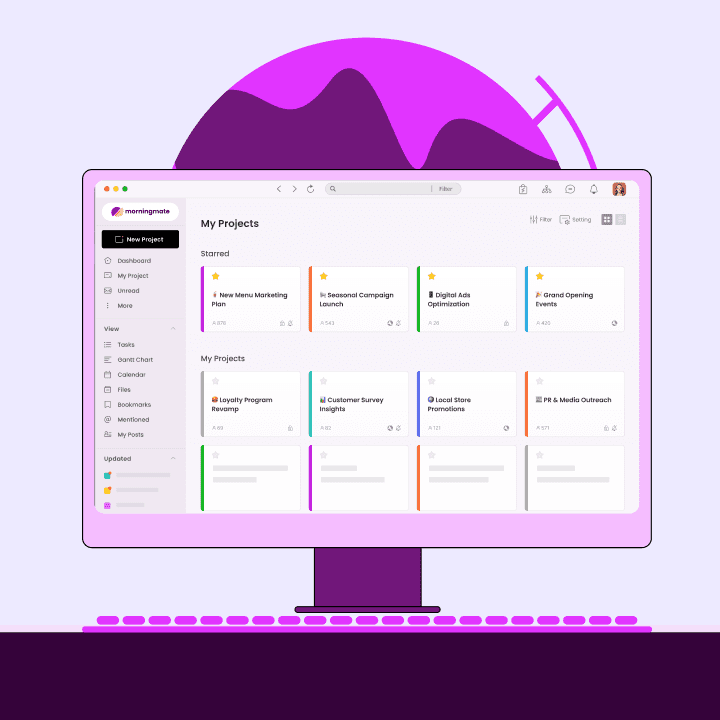
On the lighter end, there are tools designed to give teams a simple, organized workspace without the learning curve. Morningmate sits in this space — it combines task management with a built-in team chat (with an interface similar to WhatsApp, so there's almost no onboarding friction) and a Feed view that organizes updates in a format that looks and feels like social media. That familiar interface makes it approachable for non-tech teams who would otherwise abandon more complex tools within a week.
Key Differences Between the Two
If you're still unsure which category applies to your situation, here's a direct comparison:
The distinction matters because buying membership management software to run your operations team is like using accounting software to manage your content calendar. The categories may overlap in name, but they don't overlap in function.
Dimension | Membership Management Software | Team Work Management Software |
|---|---|---|
Primary users | Admins managing an external member base | Teams managing internal work and projects |
Core function | Track memberships, billing, and renewals | Track tasks, deadlines, and team progress |
Communication | Email newsletters, member portals | Real-time chat, task comments, updates |
Reporting focus | Member growth, retention, revenue | Project status, workload, productivity |
Example tools | WildApricot, MemberClicks | Morningmate, Asana, Monday.com |
Why Teams End Up With the Wrong Tool
This happens more often than you'd think — and usually for one of three reasons.
1. A Generic Search Leads to the Wrong Category
When someone searches for "team management software," they may land on membership tools because the category names sound similar. Without a clear understanding of what each type does, it's easy to book a demo for the wrong product entirely.
2. The Tool Looked Right on the Surface
Membership tools often have a "teams" section or "admin dashboard" that looks like project management. But user management is not the same as task management. Having a list of team members in a system doesn't help you assign work, track deadlines, or keep everyone aligned on priorities.
3. No One Evaluated the Communication Layer
One of the biggest gaps teams discover after adopting the wrong tool is communication. Membership management platforms aren't built for real-time team chat or threaded task discussions. So people end up back in WhatsApp or email, and the tool becomes irrelevant. Harvard Business Review has noted that fragmented communication is one of the primary culprits behind team misalignment — which is exactly what happens when your work tool and communication tool don't connect.
How to Evaluate What Your Team Actually Needs
Before you evaluate any software, answer these five questions honestly:
Are you managing people inside your organization, or members of an external community? If internal — work management. If external — membership management.
Do you need to track tasks, deadlines, and project progress? If yes, you need work management software with task features.
Does your team communicate primarily through personal messenger apps? If yes, you need a tool with a built-in chat — not just a task board.
Is information currently scattered across email, WhatsApp, and spreadsheets? If yes, you need a centralized work hub, not a member directory.
Would non-technical team members need to use this daily? If yes, prioritize simplicity and familiar interfaces over feature depth.
If your answers pointed consistently toward internal work coordination, you're looking for a team work management tool — and you should focus your evaluation there.
What to Look for in Team Work Management Software
Once you've confirmed that work management is what you need, the next challenge is finding the right fit. Not all work management tools are created equal — and more features doesn't mean better outcomes.
Ease of Adoption Matters More Than Feature Count
McKinsey research consistently shows that digital tool adoption fails not because of lack of features, but because of poor user experience and change resistance. If your team won't actually use the tool, it doesn't matter how many integrations it has.
This is where lightweight, intuitive tools tend to win. Morningmate, for example, is designed so that even teams with no previous experience using project management software can get started quickly. Its Feed view organizes team updates in a familiar, scroll-based format — reducing the mental overhead of "learning a new system."
Communication Should Be Built In
The single biggest productivity leak in most teams is context-switching — jumping between a task tool, a chat app, and email to piece together what's happening. Look for a work management tool that includes real-time messaging so that task context and conversation live in the same place.
If your team currently runs on WhatsApp or Telegram for work conversations, the transition to a proper work tool is easier when the chat interface already feels familiar. That's a meaningful consideration, not a cosmetic one.
Visibility Across the Team Is Non-Negotiable
For managers and operations leads, the core value of work management software is visibility — knowing what's in progress, what's blocked, and what's falling behind without having to chase people for updates. Look for tools that offer clear task status views and team-level reporting without requiring you to configure complex dashboards.
Tools like Morningmate give managers a clear view of what their teams are working on, with tasks organized under projects and updates flowing through a shared feed — so visibility comes naturally, not from manual check-ins.
When You Might Need Both
There is one scenario where both types of software make sense: organizations that have both an external membership community and an internal operations team. A professional association, for example, might use WildApricot to manage member renewals and event registrations, while using a work management tool like Morningmate to coordinate the internal staff who run those programs.
These two tools serve completely different audiences within the same organization. The mistake is trying to use one to do the job of both — or assuming that a membership platform's internal "team" features are robust enough to replace a dedicated team collaboration tool.
Making the Right Call for Your Team
The membership management software vs. team work management question has a straightforward answer once you're clear on who you're managing and what problem you're solving. If you're managing tasks, projects, and people inside your organization — especially across a distributed or hybrid team — work management software is the right category, full stop.
Within that category, the best choice depends on your team's size, technical comfort level, and how much complexity you actually need. For many teams — especially those moving away from email and personal messenger apps — the biggest win isn't adding more features. It's finally having one organized, reliable place where work happens and communication is part of the same system.
Start by auditing where your team's work actually lives today. If the honest answer is "scattered across email, WhatsApp, and spreadsheets," that's your baseline — and it's exactly the problem the right work management tool is built to solve.