Project Management

You've built the checklist. You shared it with the team. And then... nothing. Tasks get skipped, steps get forgotten, and the same mistakes keep happening. Sound familiar? A team checklist system sounds simple in theory, but getting people to actually follow it is a different problem entirely.
The issue usually isn't the checklist itself — it's how it lives (or dies) inside your team's daily workflow. When checklists exist in a Google Doc nobody opens, a sticky note on someone's desk, or buried in a long email thread, they stop being tools and start being friction. What your team needs isn't just a list of steps. It's a system that makes following those steps feel natural.
This guide breaks down how to build a team checklist system that people actually use — one that's tied to real accountability, fits into how your team already works, and doesn't require constant chasing to maintain.
Why Most Team Checklists Fail
Before fixing the system, it helps to understand why it breaks. Most checklist failures come down to three root causes: poor visibility, no ownership, and zero integration with daily work tools.
Research highlighted in the Harvard Business Review around Atul Gawande's work on checklists shows that even in high-stakes environments like surgery and aviation, checklists only work when they are treated as team communication tools — not just personal reminders. The act of checking off a step has to be a shared, visible signal, not a private action.
The Visibility Problem
If your checklist lives somewhere separate from where work actually happens, your team will forget it exists. People aren't being negligent — they're just busy. When a checklist requires opening a separate app, finding the right folder, or remembering a link, it adds cognitive load that most people quietly skip.
The Ownership Problem
A checklist with no named owner is a checklist nobody owns. When every team member assumes someone else is tracking it, steps fall through the cracks. Clear ownership — not just of the checklist as a whole, but of individual items — is what turns a list into an accountable workflow.
The Integration Problem
If completing a checklist step requires switching tools, updating a separate tracker, and then notifying someone in yet another app, the system becomes a job in itself. The best checklist systems are embedded directly inside the tools your team uses every day — where tasks, conversations, and updates all live together.
The Anatomy of a Checklist System That Gets Followed
A checklist that actually gets followed has four core characteristics. It is specific, assigned, visible, and connected to a consequence — even if that consequence is just a team update or status change.
1. Make Every Item Specific and Actionable
Vague checklist items invite interpretation — and delays. "Update the client" is not a task. "Send project status email to client by 3pm Friday" is. When writing checklist items, apply the rule: if a new team member couldn't complete this step without asking a follow-up question, rewrite it.
Use action verbs: send, upload, confirm, review, approve
Add a deadline or trigger condition where possible
Specify the output, not just the activity
2. Assign Every Item to One Person
Shared responsibility is often no responsibility. Each checklist item needs a single named owner who is accountable for completing it. This doesn't mean others can't contribute — it means one person is on the hook for making sure it's done.
This is especially important in remote and hybrid teams where there's no shoulder to tap and no visual cue that something's been missed. Named ownership creates a lightweight accountability layer without requiring a manager to chase updates.
3. Tie Checklists to Real Workflows, Not Separate Documents
This is where most teams lose. Checklists need to live inside the same space where work gets done — not in a separate document, shared drive, or tool that no one opens proactively.
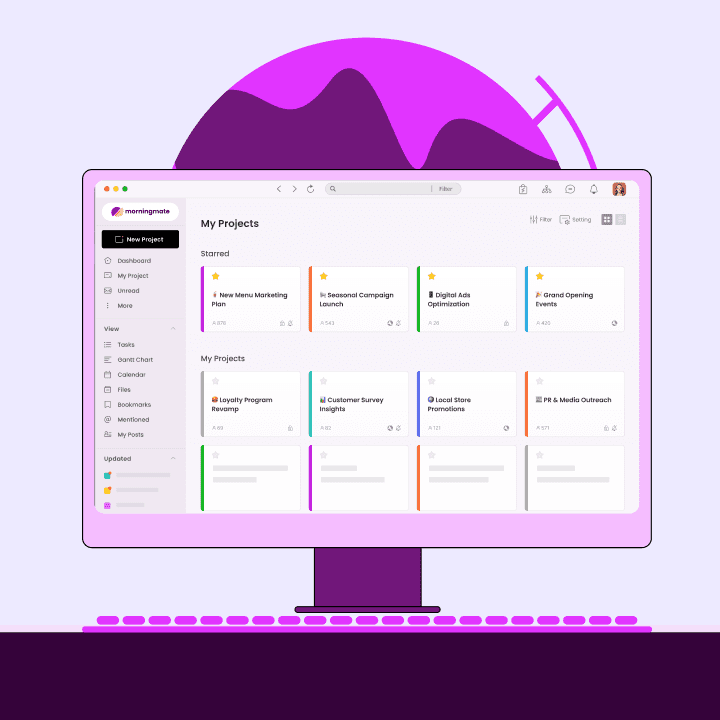
Tools like Morningmate — a lightweight work management platform used by over 550,000 teams — let you attach tasks and checklists directly to posts in a team feed, so checklist items appear in context alongside the relevant discussion and files. Instead of hunting for a checklist in a Google Drive folder, your team sees open items right where the work conversation is happening.
4. Build In a Review Moment
Even the best checklist needs a human checkpoint. Build a brief review moment into your team's existing rhythm — a weekly standup, an end-of-sprint wrap, or a daily async update. The goal isn't to police the checklist; it's to make checklist completion a normal part of how your team closes out work.
How to Roll Out a Team Checklist System Step by Step
Rolling out a new system to a resistant or busy team requires more than sending a message that says "use this from now on." Here's a practical approach that builds adoption without forcing it.
Step 1: Start With One Recurring Process
Don't try to checklist everything at once. Pick one repeatable process that currently causes friction — onboarding a new client, running a weekly team update, publishing a piece of content, or processing an invoice. Build a tight checklist for just that process and get your team to follow it consistently before expanding.
Step 2: Involve the Team in Building It
A checklist built by one person and handed down to a team rarely gets followed. When team members help write the checklist — even just by reviewing and editing it — they feel invested in using it. Run a short async session where each person adds the steps they know from their own experience. You'll often discover steps that managers didn't even know existed.
Step 3: Put It Where Work Happens
Once you have your checklist, embed it inside your primary work tool. If your team communicates in a work platform, the checklist should live there — not in a separate tab. Morningmate's task management feature lets you convert checklist items into assignable tasks with due dates, so nothing gets lost between a conversation and an action. It bridges the gap between "we discussed this" and "this got done."
Step 4: Run It for Two Weeks Before Adjusting
Give the checklist a fair run before editing it. Two weeks of consistent use will surface what's missing, what's redundant, and what's confusing — without the noise of first-week friction. After two weeks, do a quick team retro: what steps were consistently skipped, and why? That answer will tell you more than any audit.
Step 5: Make Completion Visible
Visibility drives behavior. When the team can see which checklist items are done and which are open — without asking — the need for status meetings drops and accountability becomes self-regulating. Async-first teams in particular benefit from this kind of passive transparency, where progress is visible by default rather than by request.
Checklist Systems for Different Team Types
Not every team runs the same way. The checklist system that works for a fully remote startup looks different from the one that works for a hybrid operations team. Here's how to adapt the approach.
For Remote Teams
Remote teams need checklists that communicate status without requiring a meeting. Each checklist item should have a clear owner and a visible completion status that anyone on the team can check at any time. Async updates tied to checklist items — a quick comment when a step is done — replace the need to ask “where are we on this?”
For Hybrid Teams
Hybrid teams face a coordination tax: in-office members may get verbal updates while remote members miss them entirely. A shared digital checklist becomes the equalizer — everyone sees the same status regardless of where they’re working. According to McKinsey’s research on hybrid work models, teams that use shared digital workflows report significantly fewer coordination failures than those who rely on in-person communication alone.
For Non-Technical Teams
Operations teams, logistics teams, and frontline staff often struggle with tools that feel too complex. A checklist system only works if people can use it without a training course. This is where Morningmate‘s design philosophy makes a difference — its interface is built to feel familiar, similar to how most people already use messaging apps, so non-technical team members can adopt it without a steep learning curve. The right work management tool for non-tech teams is one that gets out of the way and lets people focus on the work itself.
Common Mistakes to Avoid
Even well-intentioned checklist systems collapse under a few predictable mistakes. Watch out for these.
Making the checklist too long: If a checklist has 30 items, it becomes a project plan, not a checklist. Aim for 5–12 items per process. Break long processes into smaller checklists.
Not updating it: Processes change. A checklist from six months ago may have steps that no longer apply — or may be missing new ones. Review checklists every quarter.
Using it only for audits: If your team only touches the checklist when something goes wrong, it becomes associated with blame rather than workflow. Use it proactively, every time.
No feedback loop: If team members flag issues with a checklist step and nothing changes, they stop flagging — and eventually stop using the checklist. Build in a simple way to suggest edits.
What Good Looks Like
A team checklist system that works looks like this: a repeatable process has a named checklist, each item is assigned, completion is visible to the whole team, and the checklist is reviewed and updated regularly. Nobody has to ask where things stand — the checklist tells them.
Teams that run this way tend to have fewer dropped balls, faster onboarding for new members, and less time spent in status update meetings. Gallup’s research on team performance consistently shows that clarity of expectations — knowing exactly what needs to happen and who is responsible — is one of the strongest drivers of both engagement and output.
The checklist isn’t about micromanagement. It’s about giving your team a shared map of what “done” looks like — so everyone can move faster, with less confusion, and fewer things slipping through the cracks. Start with one process, build the habit, and the rest follows.