Project Management

Good task management is not a luxury reserved for companies with a dedicated project manager on staff — it is the difference between a small team that scales and one that slowly burns out trying to keep up. If you run a business with fewer than 50 people, you already know the feeling: work is growing faster than your headcount, and somewhere between the client calls, the supplier emails, and the staff questions, things fall through the cracks. Not because your team is bad at their jobs, but because task tracking was never set up properly in the first place.
Most small business owners assume the answer is to hire a project manager. That is an expensive reflex. A mid-level PM can cost you $60,000–$90,000 a year before benefits. And in a lean team, that hire often creates more overhead than it solves — someone who needs to be briefed, managed, and integrated into workflows that are already fragile. The better question is: can you build the task management system itself, so you do not need a dedicated person to run it?
The answer is yes — if you are willing to stop patching the problem with more messages and start fixing the underlying structure. Here is how to do it without hiring anyone new, without adopting a complex tool, and without adding another weekly meeting to your calendar.
The Real Cost of Unmanaged Task Coordination
Let us start with what unstructured task management is actually costing you. Not in vague "productivity" terms — in real money and time.
According to research by Atlassian, employees spend an average of 31 hours per month in unproductive meetings, and much of that time is spent re-establishing context that a proper task workflow would have made visible from the start. For a team of ten people, that is hundreds of hours a year spent catching up instead of moving forward.
Then there is the cost of dropped work. When task tracking lives in a mix of email, WhatsApp, and verbal hallway conversations, things get missed — not maliciously, but structurally. Someone thought someone else was handling it. A deadline was not written down. A deliverable was buried in a thread from three weeks ago.
Here is a breakdown of what reactive vs. structured task management looks like in practice:
Area | Reactive (no system) | Structured task management |
|---|---|---|
Task visibility | Owner chases updates manually | Status visible at a glance |
Accountability | Unclear who owns what | Named owner per task |
Deadline tracking | Remembered or forgotten | Set, visible, and notified |
Onboarding new staff | Weeks of shadowing and verbal handoffs | Work context is already documented |
Owner's time on admin | 5–10 hrs/week chasing status | Under 1 hr/week on check-ins |
Why Task Management Breaks Down as You Grow
When you were a team of three or four, task coordination happened naturally. You sat near each other. You knew what everyone was working on. A quick chat resolved most things. That informal system worked — because the team was small enough for one person's memory to hold all the moving pieces.
Scale that to fifteen or twenty people across different roles, and the same informal system becomes a liability. Harvard Business Review has documented that as teams grow, the time spent on coordination and communication increases disproportionately — often consuming 85% of a knowledge worker's week. For a small business owner, that coordination load lands almost entirely on you.
The root cause is simple: you never built a task management structure because you never needed one. Now you do, and you are trying to retrofit it onto a team that is already mid-flight. The answer is not to hire someone to manage the chaos — it is to reduce the chaos itself.
Where Owner Time Goes Weekly Without Structured Task Tracking
35%
Chasing updates
28%
Clarifying priorities
22%
Re-explaining missed work
15%
Actual strategic work
Fig 1: Illustrative breakdown of owner time when no task management system is in place
A Practical Task Management System for a Lean Team
You do not need a certified project manager to bring order to your team's work. You need a repeatable structure that anyone on the team can follow. Here is a five-step approach you can implement this week.
Step 1: Define what a "task" actually is
Before you can track tasks, your team needs to agree on what counts as one. A task is any piece of work with a clear output, a single owner, and a deadline — even a loose one. "Fix the homepage" is not a task. "Update homepage hero copy by Friday — owner: Sarah" is. Getting specific here removes 80% of the ambiguity that causes missed work.
Step 2: Create one place where all tasks live
This is the most important step. Task management fails when tasks live in five different places — email, chat, sticky notes, spreadsheets, and someone's memory. Pick one tool and move everything there. It does not need to be complicated. It needs to be the single place everyone checks.
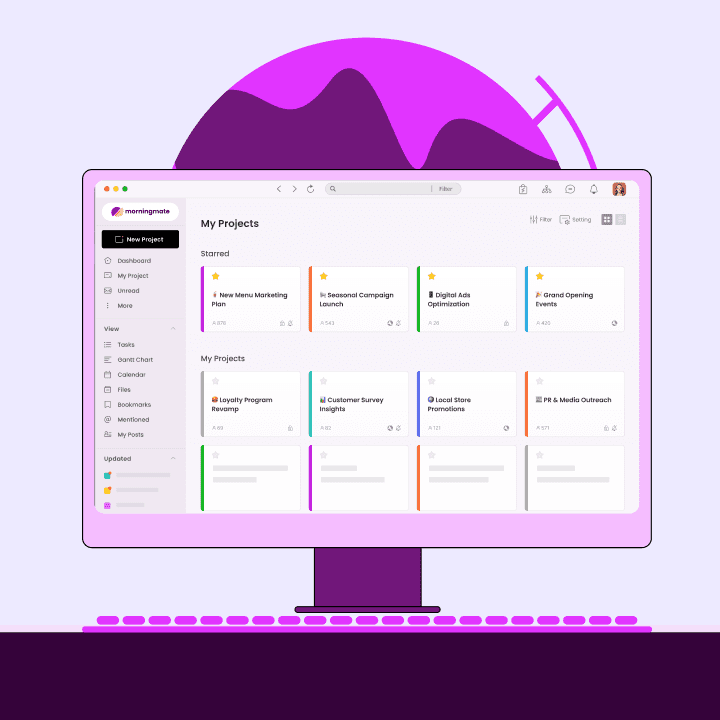
This is where a tool like Morningmate removes a common small-business headache. Rather than juggling a chat app, a task list, and an email thread separately, Morningmate gives your team a single workspace where tasks are assigned, tracked, and discussed in context — without the complexity of enterprise tools like Jira or Asana that require configuration and training to use properly. It is used by over 550,000 teams globally precisely because it is lightweight enough for non-technical teams to adopt without a rollout plan.
Step 3: Assign one owner per task — not two
Shared ownership is no ownership. Every task in your task tracking system should have exactly one person responsible for its completion. Others can be looped in as contributors or reviewers, but there should be one person who cannot pass the buck. This single rule eliminates most of the "I thought you were handling that" conversations.
Step 4: Use status labels consistently
Three statuses are enough to start: Not Started, In Progress, Done. If you want more granularity later, add Blocked. The goal of task management is not to create a complex workflow — it is to make the state of work visible at a glance, so you stop having to ask.
Step 5: Run a 10-minute weekly task review, not a status meeting
Once your task coordination system is live, replace your current status meetings with a ten-minute async review. Each team member updates their task statuses before end of day Monday. You review the board Tuesday morning. Questions and blockers are flagged in the task thread itself. This one change can eliminate two or three standing meetings per week.
Choosing the Right Tool for Small-Team Task Management
The wrong tool choice is what kills most task management rollouts in small businesses. Owners pick something powerful and flexible — and the team hates it within two weeks because it takes too long to log a simple task. According to Gartner's 2026 technology priorities for SMBs, simplicity of adoption is now the primary driver of tool retention in small organizations — ahead of features and price.
Here is how to evaluate your options against what your team actually needs:
Requirement | Spreadsheet / Email | Heavy PM tool (Jira/Asana) | Morningmate |
|---|---|---|---|
Setup time | Low (but breaks fast) | Days to weeks | Under an hour |
Non-tech adoption | Variable | Low — steep learning curve | High — familiar social-feed interface |
Built-in chat | No | Limited | Yes — WhatsApp-style interface |
Task tracking + files in one place | No | Yes, but complex | Yes, lightweight |
Cost for 15-person team | Free, but time-costly | $150–$300/month+ | Affordable flat pricing |
The interface matters more than the feature list when you are running a lean team. Morningmate's feed-style layout looks like social media — your team already knows how to scroll it, react to posts, and comment on updates. That familiarity cuts the resistance most small businesses face when introducing any new task workflow tool. There is no onboarding course required, and you do not need to be technical to get value on day one.
What Changes When Task Management Actually Works
When your task coordination system is running properly, the shift is visible almost immediately. You stop being the human router for every "what's the status on X?" question. Your team stops duplicating effort because they can see what everyone is working on. Deadlines stop being surprises because they are tracked, not assumed.
The bigger shift is in how you spend your own time. Right now, a significant portion of your week is likely consumed by coordination overhead — chasing, clarifying, and context-switching. Structured task management returns that time to you. That is not a soft benefit. If you bill at $150 an hour and recover five hours per week, that is $3,900 a month in reclaimed capacity — far more than any tool subscription will cost you.
Owner Hours Spent on Coordination: Before vs. After Structured Task Management
12 hrs
Before (no system)
8 hrs
Spreadsheet-based tracking
2 hrs
Structured task management tool
Fig 2: Estimated weekly owner coordination hours by approach (illustrative)
Your Next Step: Start With One Team, One Week
You do not need to overhaul everything at once. The fastest path to better task management is a one-week pilot with your most active team or department. Here is the sequence:
Pick one team or project — ideally one with active deadlines in the next two weeks.
List every open task in a single tool. Assign one owner and one due date to each.
Ask the team to update task statuses daily for five days — it takes two minutes.
At the end of the week, count how many "what's the status?" messages you sent. Compare it to the week before.
If it worked, expand to the rest of the team. If something broke, fix that one thing and repeat.
That is task management as a small business owner actually needs it: lightweight, fast to implement, and immediately measurable. Tools like Morningmate make this pilot even faster because the task workflow, built-in chat, and file management all live in one place — so your team does not need to toggle between apps to stay coordinated. You can read more about what to look for in a first work management tool if you are still deciding.
The goal of better task management is not to build a perfect system. It is to get your workload out of people's heads and inboxes and into one visible, accountable place — so your team can run without you holding everything together. That is what lets you grow without adding headcount, without adding complexity, and without burning yourself out in the process.