Project Management

Good task management should mean your team starts every week knowing exactly what to do. Instead, most small marketing teams spend Monday morning doing something that looks suspiciously like starting over. Priorities shift. The campaign brief that was "almost approved" on Friday is still floating in a thread somewhere. The freelancer who was supposed to start the social assets hasn't seen the updated direction. And you're back in triage mode before 10am.
This isn't a people problem. It's a system problem — specifically, the absence of one. When task tracking lives across chat threads, email chains, and a shared Google Sheet nobody updates, context disappears the moment a conversation ends. Work doesn't carry over. It resets. And every Monday your team pays the price in wasted time, repeated conversations, and quietly slipping deadlines.
The good news: the fix isn't complicated. It's about building a simple task workflow that keeps work visible between sessions — not just during them. Here's how to do it with a tiny marketing team, a founder who reviews everything, and a rotating cast of freelancers.
Why Marketing Task Management Breaks Down Mid-Week
Most small marketing teams don't fail at doing the work. They fail at handing it off. A campaign moves through four different tools before it's live — Slack for brainstorming, email for founder approval, Drive for assets, WhatsApp for quick freelancer check-ins. At every handoff point, context shrinks. By the time Friday arrives, nobody has a complete picture of where things actually stand.
Asana's Anatomy of Work report found that workers switch between apps 25 times per day on average, and more than 60% of work time is spent on coordination rather than skilled work itself. For a three-person marketing team, that coordination tax is catastrophic. It means your best creative energy is going to chasing approvals, not building campaigns.
The Monday Reset in real life
Here's a scenario that probably sounds familiar. It's Thursday afternoon. Your email campaign draft is with the founder for approval. Your freelance designer has the social graphics in progress. You ping both on different apps and call it a day. Friday rolls by quietly. Monday arrives and you open your laptop to find: no approval on the email, the designer asking for a revised brief they never got, and a Slack message from the founder asking "where are we on the campaign?" You spend the first two hours of your week just reconstructing what happened last week. That's the Monday reset — and it happens because task coordination lived in conversations, not in a system.
According to research published in Harvard Business Review, unclear ownership of tasks is one of the top drivers of missed deadlines in small teams. When nobody formally owns the next step, the next step doesn't happen.
Task workflow problem | Where it usually lives | Cost by Monday |
|---|---|---|
Approval stuck with founder | Email or WhatsApp | Campaign delayed 2–3 days |
Freelancer missing brief update | Separate DM thread | Rework + lost budget |
No clear task owner | Verbal or in-meeting | Task silently dropped |
Status unknown on Friday | Shared spreadsheet (stale) | Monday triage session |
The Priority Reset: How Bad Is It Really?
If you've ever thought "we just need to communicate better," you're solving the wrong problem. The priority reset isn't a communication failure — it's a task visibility failure. Work that isn't documented with a clear owner, deadline, and current status doesn't survive the weekend. Full stop.
Where Marketing Task Tracking Time Goes Each Week
62%
Chasing updates
48%
Recreating context
71%
Re-aligning priorities
Fig 1: Estimated weekly time spent on coordination overhead vs. actual campaign execution (illustrative, based on Asana 2026 work report data)
Gallup's workplace engagement research consistently shows that employees who lack clarity on their priorities are significantly less productive — and more likely to disengage. For a small marketing team where every person is carrying multiple workstreams, that disengagement hits fast and hard.
A Repeatable Task Management Play for Small Marketing Teams
You don't need a complex project management tool with Gantt charts and dependency mapping. You need a lightweight system that captures every task, assigns it clearly, and keeps it visible to everyone who needs to see it. Here's a five-step play you can run this week with whatever team size you have.
Step 1: Define your campaign's task spine every Monday
Every campaign has a natural sequence of tasks: brief → copy → design → approval → scheduling → live. Write that spine down at the start of each campaign and assign one owner to each step. Not a team — one person. Task tracking only works when accountability is singular.
Step 2: Set a "must-move-by" date, not just a deadline
Final deadlines are too far away to drive daily behavior. Instead, give each task a "must-move-by" date — the latest it can sit still before it blocks the next step. For example: the founder approval must happen by Wednesday noon or the Thursday scheduler can't do their job. This changes approval from a vague ask to a specific commitment.
Step 3: Attach context directly to the task
Stop sending briefs in emails that live outside the task. Attach the brief, the reference files, and the feedback directly to the task card itself. When the freelancer opens the task on Tuesday morning, everything they need is right there — no hunting through old messages. This is where a dedicated task management tool pays for itself in hours, not months.
Step 4: Run a Friday 10-minute task audit
Before the weekend, spend ten minutes scanning every open task. Anything without a clear next step or owner gets updated right then. This is the single habit that kills the Monday reset. If every task ends the week with a status and a next action, Monday starts with clarity instead of confusion.
Step 5: Keep approvals inside the task, not outside it
The most common task workflow breakdown in small teams is the approval loop that exits the system. Someone sends a draft to the founder in email, the founder replies with notes, and suddenly the task card is outdated. Fix this by making the task itself the approval vehicle. The reviewer comments on the task, approves or requests changes there, and the whole thread stays with the work — permanently visible to everyone.
Common Failure Points in Task Coordination (and How to Avoid Them)
Even with a solid workflow in place, small marketing teams hit predictable walls. Here are the four most common task management failure points and the specific fix for each.
Failure 1: The founder is a task bottleneck
Founders review everything and respond on their own schedule. If your task workflow depends on an email ping to trigger a review, you're handing control of your campaign timeline to someone else's inbox. Fix: Tag the founder directly on the task with a specific question or action required. A targeted notification tied to a task is ten times more likely to get a response than a forwarded email chain.
Failure 2: Freelancers operate on a separate system
When your freelance copywriter works from a briefing doc in Drive and your designer works from WhatsApp instructions, your team's task tracking is already fractured. Give freelancers access to the same task workflow your internal team uses. Most lightweight tools make this easy with guest or external collaborator access. The brief is the task. The task is the record.
Failure 3: Status updates live in chat, not in tasks
Your copywriter messages "done with draft!" in Slack. Great — but did anyone update the task? If the task card still says "in progress" on Monday, the whole team is working from wrong information. Build a simple rule: when work moves, the task moves. No exceptions.
Failure 4: Too many tools, too little connection
The average SMB marketing team uses 6–8 tools for a single campaign. When tasks, chat, files, and approvals live in different places, the connections between them break constantly. The antidote isn't using fewer tools arbitrarily — it's consolidating the core task workflow into one place where conversation, files, and task status coexist.
How Morningmate Handles Task Management Without the Overhead
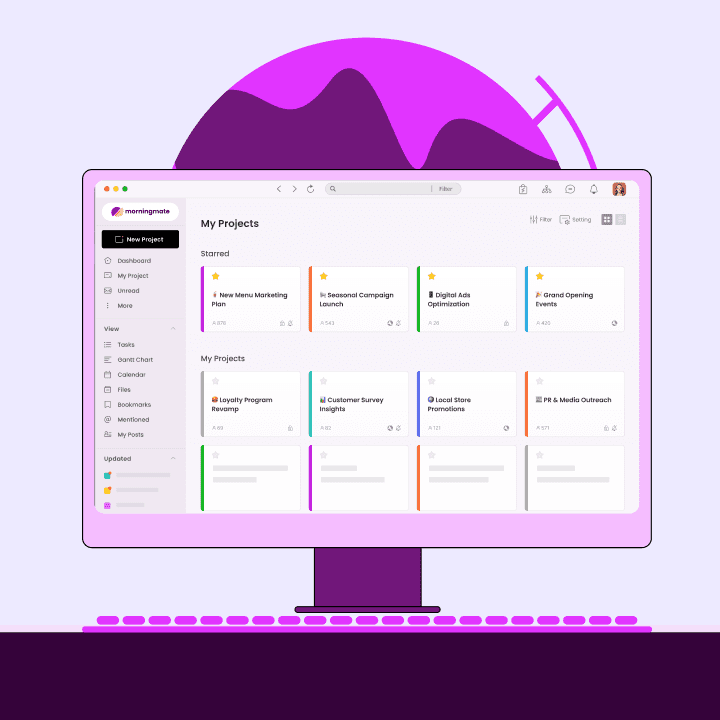
This is exactly where Morningmate — a lightweight work management tool with built-in chat and task tracking — fits naturally into a small marketing team's workflow. It's not trying to be Jira or Asana. It's designed for teams who need real task coordination without a learning curve that takes three weeks and a consultant to climb.
Here's a worked example. Say your team is running a product launch email campaign.
You create a project space in Morningmate and add four tasks: write copy, design header image, founder approval, and schedule send. Each task gets an owner, a must-move-by date, and the brief attached directly inside the task card. Your freelance designer gets external access — they see exactly what's needed without needing a separate email thread. When the copy is ready, the copywriter marks it done and leaves a comment tagging the founder. The founder gets a notification, reviews it directly in the platform, and either approves or leaves specific feedback — all attached to the task, not floating in an email. By Friday, the task workflow shows exactly where every piece stands. Monday morning, your team opens Morningmate and picks up right where they left off. No reset. No reconstruction.
Morningmate's Feed view works like a familiar social-media-style stream, which means even your non-technical founder or freelance contractors can navigate it without training. The built-in chat sits alongside the task management features, so conversation and work stay connected instead of drifting apart across apps. Over 550,000 teams use it for exactly this reason — because lightweight task management that everyone actually uses beats a powerful tool that nobody opens.
Campaign stage | Scattered workflow (before) | Consolidated task management (after) |
|---|---|---|
Briefing | Email PDF + Slack follow-up | Attached directly to task card |
Approval | Email chain with founder | Comment + tag on task, one thread |
Freelancer coordination | WhatsApp + Drive link | Guest access to task + files in one place |
Status on Friday | Unknown until Monday check-in | Visible in task board at a glance |
Monday startup time | 60–90 min re-alignment | Under 10 minutes to pick up and go |
Monday Startup Time Saved After Consolidating Task Tracking
85 min
Email + Chat tools
55 min
Spreadsheet tracking
8 min
Unified task management
Fig 2: Average Monday re-alignment time by workflow type (illustrative estimate based on team coordination research)
Your Task Management Checklist to Apply This Week
Stop letting Monday be a reset button. Here's a practical task management checklist you can run with your team starting today. Pin this somewhere your whole team sees it.
Map your current campaign's task spine — every step from brief to live, with one named owner per step
Replace final deadlines with "must-move-by" dates for every task that blocks something else
Attach briefs, files, and feedback directly to the task — not in a separate email or DM
Give your freelancers access to the same task tracking system your internal team uses
Move all approvals inside the task system — no more email chains for founder reviews
Run a ten-minute Friday task audit: every open task needs a current status and a clear next step before you log off
Try Morningmate's built-in task and chat workspace to consolidate your campaign coordination into one feed everyone can follow
Review your Monday startup time after two weeks — if it's still over twenty minutes, something is still living outside the system
Good task management for a small marketing team isn't about discipline or working harder. It's about making work visible enough that it survives the weekend intact. When your task tracking is solid, Monday morning feels like continuing — not restarting. That shift, compounded across every campaign you run, is where real momentum comes from. Check out how approval workflows fit into your broader task system to take the next step.