Project Management

Task management is not just a productivity concept — it is the difference between a week where your team moves forward with purpose and a week where everyone is busy but nothing actually gets done. If you run a small business, you already know the feeling: Monday rolls around, you have a rough idea of what needs to happen, but by Wednesday you are fielding "what should I be working on?" questions and realizing two people duplicated the same work while something important slipped through entirely.
This is not a people problem. It is a visibility problem. Your team cannot execute what they cannot see clearly. And when task tracking lives in your head, in a scattered email thread, or across three different apps, clarity disappears fast.
The good news: fixing this does not require a big-budget software rollout or a new hire. It requires a simple, repeatable system that gives every person on your team a clear picture of what needs to happen this week — and who owns it. Here is how to build that system, starting today.
Why "Winging It" on Task Management Is Costing You More Than You Think
Most small business owners underestimate the drag that unclear task coordination creates. It does not show up as one big disaster — it shows up as a slow, constant leak. Someone waits two hours for an answer before they can move forward. A deliverable misses its deadline because no one knew it was due Thursday. You spend 45 minutes on a Friday trying to reconstruct what happened during the week.
According to Gallup's research on employee engagement, unclear expectations at work are one of the top drivers of disengagement — and disengaged employees cost businesses significantly in lost productivity. For a 10-person team, even one or two people spinning their wheels without clear direction is a material problem.
Here is what poor task management actually costs in a typical week for a small team:
Pain Point | How It Shows Up | Estimated Weekly Cost (10-person team) |
|---|---|---|
Chasing status updates | Slack messages, calls, "just checking in" emails | 3–5 hours of manager time |
Duplicated work | Two people working on the same thing unknowingly | 4–8 hours of wasted effort |
Missed deadlines | No one knew the deadline; no one flagged the risk | Client trust, rework cycles |
Context switching | Team checks 4+ apps to find task details | 20–30 min lost per person per day |
Add that up across a month and you are looking at a significant chunk of payroll delivering zero output. That is the real cost of not having a clear task management system.
The Root Cause: Task Management Lives in Too Many Places at Once
In most small businesses, "task management" is not really one system — it is five half-systems that do not talk to each other. Tasks get assigned in a Monday morning meeting and forgotten. Someone sends a follow-up email that gets buried. A reminder gets posted in a chat app and scrolled past by lunchtime. The file lives on someone's desktop.
This fragmentation is not laziness. It is what happens when a business grows past five people without deliberately choosing how work gets tracked. Harvard Business Review has noted that as team size grows, coordination costs rise disproportionately — and small businesses feel this acutely because there is no dedicated operations function to absorb the overhead.
The fix is not to add another app. The fix is to consolidate task coordination into one visible, shared place — and build a rhythm around it.
Where Small Teams Say Tasks Most Often Get Lost
61%
Email threads
54%
Chat apps
47%
Verbal handoffs
12%
Dedicated task tool
Fig 1: Top sources of task coordination failure in small teams (illustrative, based on industry research patterns)
A Practical Task Management System Any Small Team Can Run
You do not need a complicated project management methodology. You need a simple rhythm that takes about 20 minutes to set up each week and keeps everyone oriented without constant check-ins. Here is how to build it in five steps.
Step 1: Define Your Weekly Task Horizon
Start by agreeing on what "this week" actually means for your team. That sounds obvious, but most teams mix quarterly goals, monthly milestones, and daily to-dos into one undefined pile. Your task tracking system needs a weekly layer that is separate from everything else.
Every Monday, identify the five to ten things that must be done or meaningfully advanced by Friday. These are your weekly anchors. Everything else is secondary.
Step 2: Assign an Owner to Every Task — No Exceptions
Shared ownership is no ownership. Every task in your task workflow must have exactly one person's name on it. That person is responsible for either completing it or flagging if something is blocking them. This is the single highest-leverage change most small teams can make.
If a task genuinely requires two people, break it into two tasks — one per person. Task coordination becomes dramatically easier when accountability is unambiguous.
Step 3: Make the Task List Visible to Everyone, Not Just Managers
This is where most small business task management breaks down. The owner or manager knows the plan, but team members are operating on partial information. When everyone can see the full picture — what is assigned, to whom, and when it is due — three things happen: people self-coordinate better, blockers surface faster, and the "what should I be working on?" questions drop dramatically.
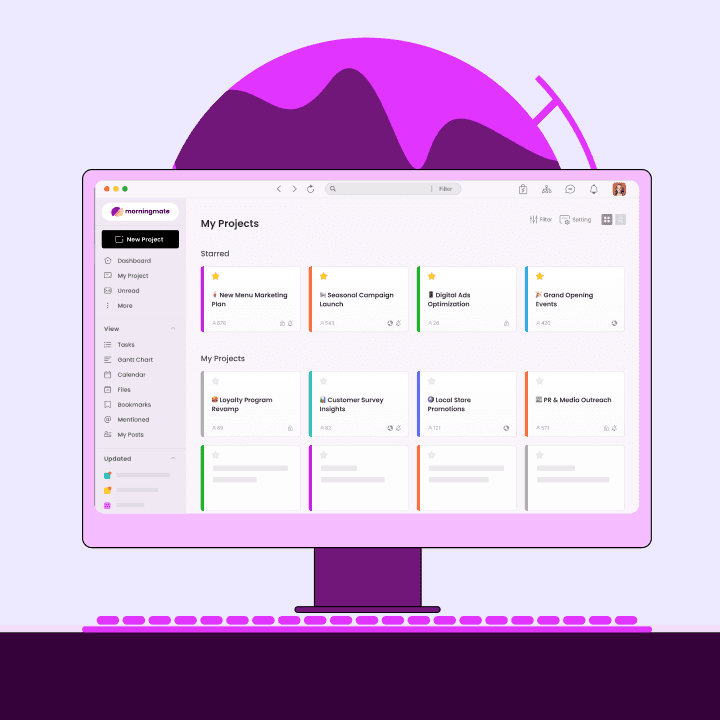
This is exactly where a tool like morningmate earns its keep. Morningmate is a lightweight work management platform used by over 550,000 teams. Its task management features let you create tasks, assign owners, set due dates, and display everything in a shared workspace that the whole team can see — without needing any training or technical know-how. The interface looks like a social media feed, which means even non-tech team members are up and running within minutes.
Step 4: Build a 10-Minute Weekly Kickoff Habit
A weekly kickoff does not have to be a meeting. It can be a short async update — a post in your shared workspace where you list the week's priorities, tag the relevant people, and attach any files or context they need. This replaces the Monday morning chaos of scattered messages and verbal briefings with one clear reference point everyone can return to all week.
With Morningmate's Feed view, you can post this weekly kickoff like a social media update — tagging team members, attaching files, and linking directly to the relevant tasks. Everyone sees it when they log in. No separate email, no repeated messages across apps.
Step 5: Do a 5-Minute Friday Wrap-Up
At the end of each week, have each team member mark their tasks as done or carry them forward with a brief note. This takes five minutes and gives you an instant read on what shipped and what did not — without you having to chase anyone for an update. Over time, this data tells you where bottlenecks live and helps you plan more accurately.
Task Management in Practice: One Tool vs. Tool Sprawl
One of the biggest objections small business owners have to improving task coordination is cost and complexity. The fear is understandable: you have already seen teams adopt tools that nobody actually uses after week two. The answer is not to avoid tools — it is to pick one that is simple enough that adoption sticks.
Asana's Anatomy of Work report found that workers switch between apps an average of 10 times per hour — and that context switching is one of the biggest drains on focused work. For a small team, every additional tool you add is another place work can hide and another thing people have to check.
Morningmate is built specifically to solve this. It combines task management, built-in team chat, and file sharing in one place — so your team is not bouncing between a project tool, a messenger app, and an email client to get context on a single task. The chat interface is familiar (it looks and works like WhatsApp), so there is virtually no learning curve. You get structured task tracking without the overhead of a full enterprise project management suite.
Capability | WhatsApp + Email (current state) | Morningmate (consolidated) |
|---|---|---|
Task assignment with due dates | Manual, buried in messages | Structured, visible to all |
Weekly team visibility | Non-existent without meetings | Live shared workspace view |
Team chat | Personal app, no work context | Built-in, linked to tasks |
File sharing tied to tasks | Scattered across email and drives | Attached directly to tasks |
Adoption by non-tech teams | High (but work-inefficient) | High — familiar interface |
What Changes When Your Task Management Actually Works
When task tracking is clear and consistent, the change is not subtle. Managers stop spending their mornings chasing updates and start spending them on actual decisions. Team members stop waiting for direction and start pulling their next task the moment they finish one. Deadlines become commitments rather than suggestions, because everyone can see them.
Small businesses that implement even a basic task management rhythm consistently report fewer dropped balls, shorter meetings, and better morale — because people know what winning looks like each week. This is backed by broader research: McKinsey's research on workforce performance shows that clarity of purpose and role — which includes task clarity — is directly tied to both productivity and retention.
Team Performance Gains After Adopting a Consistent Task Management System
+41%
On-time task completion
-35%
Status check-ins needed
+29%
Team self-coordination
+22%
Reported work clarity
Fig 2: Reported improvements after teams adopted a structured weekly task management rhythm (illustrative, based on aggregated industry benchmarks)
Your Task Management Action Plan: Start This Week
Here is the simplest possible version of task management you can start right now, before you change any tools or run any training sessions:
This Monday: List the five to ten things your team must complete this week. Write them down in one shared place everyone can access.
Assign one name to each task. If you cannot name an owner, the task is not ready to be assigned yet.
Add a due date to every task. "By end of week" counts. Vague is the enemy of task tracking.
Choose one shared workspace. If you are currently using a mix of WhatsApp, email, and sticky notes, pick one place. Morningmate's free plan is a practical starting point — it gives your team task management, chat, and file sharing in one interface without a steep learning curve or a big monthly bill.
This Friday: Ask everyone to mark their tasks done or flag what is carrying over. Five minutes. No meeting required.
Run this for two weeks. You will see the difference before you finish the experiment. Your team will spend less time waiting for direction, you will spend less time answering "what should I be doing?" — and the work that actually matters will get done more reliably.
Clear task management is not about control. It is about removing friction so your team can focus. Give every person on your team a clear view of what needs to happen this week, and you give your business a genuine competitive edge — one that does not cost a headcount to maintain.