Project Management

Task management is only as strong as the system holding it together — and for a growing number of SMBs, that system is a WhatsApp group chat. It starts innocently enough: a quick message to confirm a deadline, a photo of a handwritten brief, a voice note with instructions. But as your team scales past ten, twenty, fifty people, the cracks don't just appear — they compound. What worked for five people becomes a liability for fifty, and the operations manager is left manually stitching together a picture of what's actually happening across the business.
The uncomfortable truth is that WhatsApp was built for personal communication, not professional task coordination. It has no concept of ownership, no status tracking, no searchable context, and no audit trail. Yet Statista data confirms WhatsApp remains the world's most-used messaging app, with billions of active users — many of them managing real work inside it. The familiarity is the trap. Teams adopt it because it's easy, then stay because switching feels disruptive, while the hidden cost of broken task management silently accumulates.
This article lays out a practical framework — the SCALE Breakdown Model — for diagnosing exactly where and why WhatsApp-based task coordination fractures as teams grow. More importantly, it shows you what a standardized task management system looks like in practice, with a worked example you can adapt immediately.
The Compounding Cost of Chat-Based Task Management
Inconsistent process doesn't cost you once — it costs you every single day. A McKinsey Global Institute report found that employees spend an average of 1.8 hours per day searching for information — nearly 20% of the working week. In a WhatsApp-driven workflow, that number skews higher, because there's no structure to retrieve from. Every answer requires scrolling, asking again, or guessing.
Scale that across a team of 30 people, and you're losing roughly 540 person-hours per week to information retrieval alone. That's not inefficiency — that's a structural tax on your growth. And it doesn't include the cost of tasks dropped because they were buried in a thread, decisions reversed because no one could find the original agreement, or onboarding time bloated because institutional knowledge lives in someone's personal phone.
The table below maps the specific failure points that emerge when teams rely on WhatsApp for task tracking versus a structured task management system.
Operational Area | WhatsApp-Based Workflow | Structured Task Management System |
|---|---|---|
Task ownership | Implied, easily missed | Assigned, named, time-stamped |
Status visibility | Requires manual chasing | Real-time, at-a-glance |
File and context retrieval | Buried in scroll history | Attached to the relevant task |
Cross-team coordination | Multiple disconnected groups | Unified workspace, shared visibility |
Onboarding new staff | Knowledge locked in chat history | Processes documented and accessible |
Accountability | Hard to prove, easy to deny | Logged, traceable, auditable |
Introducing the SCALE Breakdown Model for Task Management
The SCALE Breakdown Model identifies the five specific dimensions along which WhatsApp-based task coordination collapses under growth pressure. Each letter represents a failure mode that becomes more acute the larger your team gets. Understanding these isn't academic — each one maps to a concrete operational problem you're likely already experiencing.
S — Structure collapse: Tasks lack ownership, deadlines, and status fields. Everything is a message.
C — Context fragmentation: Decisions, files, and instructions are scattered across dozens of threads.
A — Accountability erosion: With no audit trail, responsibility becomes impossible to enforce.
L — Latency creep: Approvals, confirmations, and updates get lost, slowing execution.
E — Entry barrier for new team members: Onboarding means re-asking questions the group already answered six months ago.
S — Structure Collapse: Task Management Without a Container
In a WhatsApp group, a task looks like this: "Hey can someone sort the supplier invoice before Friday?" That message has no assignee, no due date, no priority level, and no way to mark it complete. It's a request floating in a stream of other requests, memes, and out-of-office replies.
Effective task management requires a container — a defined place where a task lives with all its attributes attached. Without structure, the default becomes whoever happened to see the message and felt responsible. That's not a system. That's luck. As your team grows, luck stops scaling.
% of Tasks Dropped or Delayed by Coordination Method
61%
WhatsApp / Chat Apps
44%
Email-Based Workflows
17%
Structured Task Tools
Fig 1: Estimated task drop/delay rate by coordination method (illustrative, based on reported productivity loss data)
C — Context Fragmentation: Task Tracking Without History
Every task has a story. There's the original brief, the revision, the stakeholder comment, the file version that got approved, and the decision that changed the scope. In a structured task management system, all of that lives in one place — attached to the task itself. In WhatsApp, that story is scattered across multiple group chats, DMs, and voice messages, each living on a personal device.
When a colleague goes on leave, that context disappears with them. When a client dispute requires an audit trail, there isn't one. Research published in Harvard Business Review confirms that disorganized information environments significantly reduce decision quality, particularly in fast-moving teams where speed and accuracy need to coexist. Context fragmentation isn't just annoying — it actively degrades the quality of execution across your operation.
A — Accountability Erosion: Task Coordination Without Proof
Accountability requires evidence. When a task was assigned, who agreed to it, and what the outcome was — these need to be on record. WhatsApp offers none of that in a usable form. Messages can be deleted. Threads scroll out of view. The "I didn't see it" defence is always available and often legitimate, because the platform offers no notification logic tied to task ownership.
For an operations manager standardizing processes across departments, this is a systemic problem. You can't run performance reviews, supplier negotiations, or cross-team handoffs on the basis of "I think someone mentioned it in the group." Task management needs a record. Chat apps don't provide one.
L — Latency Creep: How Task Workflows Slow to a Stop
In WhatsApp, approvals require someone to read a message, remember context from three days ago, respond, and hope the original requester sees the reply in a thread that's since been buried by twenty other messages. Every step in that chain introduces latency — delay that compounds across every task in your pipeline.
A 2026 Asana Anatomy of Work report found that workers spend 58% of their day on work about work — status checks, clarification requests, chasing approvals — rather than on skilled execution. Latency creep is the operational version of this. The more your team relies on chat to coordinate task tracking, the more time disappears into coordination overhead rather than delivery.
E — Entry Barrier: Onboarding Without Accessible Task History
Ask any operations manager what the hidden cost of growth is, and onboarding is near the top of the list. When processes live in people's heads and WhatsApp histories, every new hire starts at zero. They can't search the chat archive they weren't part of. They can't reference the task that established the process. They have to ask — repeatedly — pulling time from team members who should be focused on delivery.
Standardized task management creates an institutional memory that survives staff turnover. When your task workflow system holds context, files, and decisions as part of the task record, a new team member can get up to speed independently. That's not a nice-to-have as you scale — it's a structural requirement.
Applying the SCALE Model: A Standardized Task Management Flow in Morningmate
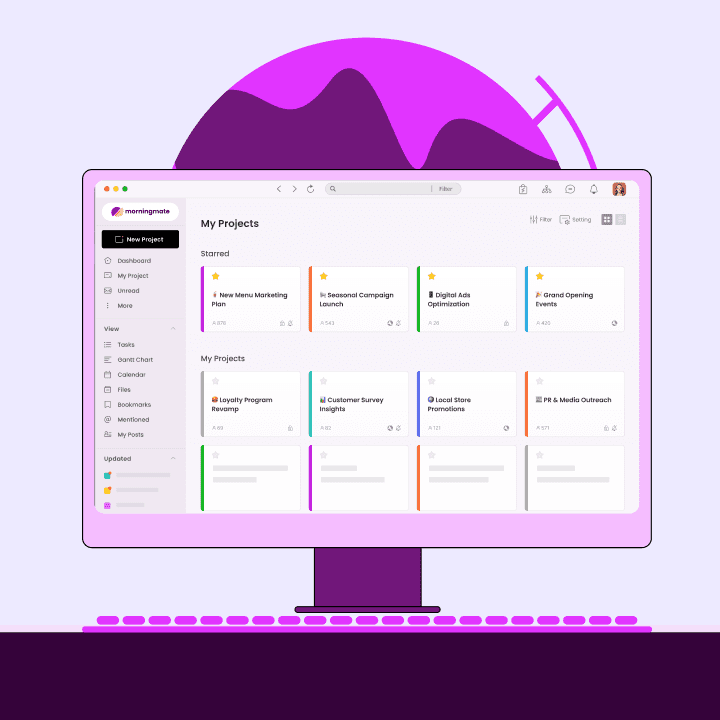
Theory only matters if it translates to practice. Here's a worked example of how an operations team can replace a fragmented WhatsApp workflow with a standardized task management process using Morningmate — a lightweight work management tool used by over 550,000 teams worldwide that combines structured task tracking with built-in chat in a single, familiar interface.
Scenario: A 35-person marketing and operations team is coordinating a product launch across three departments. Previously, this happened across four WhatsApp groups, two email chains, and a shared drive folder that nobody maintained.
Step 1 — Create a dedicated project space. In Morningmate, a project board is set up for the launch. Every task related to the launch — copy approvals, design briefs, vendor confirmations, internal sign-offs — lives here, not scattered across apps.
Step 2 — Assign tasks with full context. Each task is created with an owner, a due date, a priority level, and all relevant files attached directly to the task card. No more "check the WhatsApp group from Tuesday." The brief is on the task.
Step 3 — Use built-in chat for discussion, tasks for decisions. Morningmate's built-in chat — with an interface similar to what teams already know from WhatsApp — handles real-time conversation. But decisions, approvals, and task updates are logged on the task itself, not buried in a thread. This separates communication from coordination, which is the core discipline that WhatsApp collapses.
Step 4 — Monitor status without chasing. The Feed view in Morningmate surfaces task updates in a format similar to a social media timeline — easy to scan, contextual, and live. The operations manager sees what's moved, what's blocked, and what's overdue, without sending a single "any updates?" message.
Step 5 — Onboard the next team member. When a new coordinator joins the launch mid-flight, they open the project board, read the task history, and understand the current state immediately. No onboarding call required. No WhatsApp group access request. The work is self-documenting.
Process Step | WhatsApp Workflow (Before) | Morningmate Workflow (After) |
|---|---|---|
Task creation | Message in group, no structure | Task card with owner, date, priority |
File sharing | Uploaded to chat, lost in scroll | Attached to task, always retrievable |
Status check | "Any update?" message required | Feed view shows live task progress |
Approval flow | DM or group message, no record | Logged on task with timestamp |
New hire onboarding | Re-briefed verbally, lost context | Task history self-documents process |
The Before/After in Numbers: Task Management Adoption Impact
The operational improvement from moving to structured task management isn't anecdotal. Teams that standardize task coordination consistently report measurable reductions in coordination overhead, missed deadlines, and onboarding time. The chart below illustrates representative improvement across key operational metrics after switching from chat-based coordination to a structured task management system.
Operational Improvement After Adopting Structured Task Management (%)
72%
Fewer Missed Tasks
65%
Faster Onboarding
58%
Less Status Chasing
80%
Better Accountability
Fig 2: Representative operational improvements reported by teams moving from chat to structured task management (illustrative)
Implementation Checklist: Standardizing Your Task Management System
Migrating from WhatsApp to a structured task management workflow doesn't require a six-month project. It requires clarity on what you're replacing and discipline in the first thirty days. Use this checklist to get started.
Audit your current state. List every WhatsApp group used for work coordination. Map what task type each one handles: approvals, status updates, briefings, or file sharing.
Define your task schema. Agree on what every task must have: owner, due date, priority, and linked files. No task should exist without these four fields.
Choose a tool that matches your team's comfort level. A tool nobody uses is worse than WhatsApp. Look for something with a familiar interface — like Morningmate, which mirrors the chat UX your team already knows but adds the structure that task management requires.
Migrate one workflow first. Don't boil the ocean. Pick the highest-friction process — likely cross-team project coordination or approvals — and move it entirely to your task management system.
Set a "no task in chat" rule. Conversations belong in chat. Tasks, decisions, and files belong in the task system. Enforce this as a team norm for the first month.
Review task completion rates weekly. Use your task management dashboard to review what was completed, what slipped, and why. This data replaces the "any update?" culture with evidence-led operations.
Build your onboarding template. Once your first workflow is running cleanly, document it as a repeatable template. Every new hire should be able to understand their role from the task system alone.
The core shift in effective task management isn't technological — it's cultural. WhatsApp feels fast because responses are immediate. But speed without structure isn't efficiency; it's noise. When your task workflow is standardized, searchable, and owned, your team doesn't just move faster — it moves with certainty. And that's the operational advantage that compounds in your favor as you scale. Tools like Morningmate are built precisely for this transition: structured enough to give you real task coordination, simple enough that your team won't resist the change.