Project Management

Good task management is the difference between a team that hums through a packed week and one that constantly drops the ball — and as a small business owner, you feel that gap more acutely than anyone. When your crew is eight people handling the work of twenty, there is no slack in the system. One missed deadline, one forgotten handoff, one conversation that happened in someone's head and never got written down — and a whole project unravels. The hard truth is that most small teams don't fail because of talent or effort. They fail because they never built a rhythm that holds up under pressure.
A "team rhythm" is not a motivational concept. It is a set of repeatable habits — around task coordination, communication, and accountability — that keeps work moving even when you are pulled in six directions at once. Without it, every busy week becomes a fire drill. With it, your team can self-manage, stay aligned, and still meet Friday's deadline even if you spent Tuesday in back-to-back client meetings.
This article walks you through exactly how to build that rhythm: what breaks it, what it costs you, and the specific steps to install it — without adding headcount, buying a suite of expensive tools, or turning your team into project managers.
The Real Cost of a Team With No Rhythm
Picture this: it is Thursday afternoon. A client is expecting a deliverable by end of day Friday. You ask your sales coordinator for a status update. She checks WhatsApp. He thinks it was in an email thread. Someone else assumed it was already done. The task existed — it just never had an owner, a deadline, or a home anyone could find. You spend the next two hours personally firefighting something that should have been handled without you.
That scenario is not rare. Asana's Anatomy of Work report found that employees spend roughly 58% of their time on work about work — status checks, chasing updates, duplicated effort — rather than doing the actual job. For a team of ten, that is effectively five people's worth of productivity evaporating every single week.
The financial bleed is real. If your average employee costs $4,000 a month and half their time is administrative noise rather than output, you are paying for results you are not getting. Multiply that across your whole team and the number gets uncomfortable fast.
What's Missing | Symptom You See | Real Business Cost |
|---|---|---|
Clear task ownership | Nobody knows who is responsible | Deadlines missed, client trust eroded |
Centralized task tracking | Updates scattered across apps | Hours lost chasing status every week |
Recurring task workflow | Same things get forgotten repeatedly | Rework costs, team frustration |
Predictable check-in cadence | Owner becomes the only update source | You can't step away without things stalling |
Why Task Management Breaks Down — The Root Cause
Most small teams are not bad at their jobs. They are bad at capturing their jobs. Work gets assigned verbally in a hallway, buried in a group chat, or sketched in someone's personal notebook. Every individual is doing task management — just in a different place from everyone else.
The result is a fractured system with no single source of truth. When a busy week hits and the volume of work spikes, those cracks become chasms. Research published in Harvard Business Review consistently shows that unclear accountability is the single biggest predictor of missed work — not lack of effort, not skill gaps, not even workload.
As the owner, you probably already know this. The problem is not insight — it is that fixing it feels like another thing to manage. The goal here is a fix that practically runs itself once you set it up.
Where Work Coordination Time Gets Lost Each Week
62%
Chasing status updates
48%
Duplicate or unclear tasks
71%
No single source of truth
55%
Unrecorded decisions
Fig 1: Share of teams reporting each coordination problem as a weekly occurrence (illustrative, based on industry benchmarks)
How to Build a Task Management Rhythm in 5 Steps
This is not a methodology. It is a repeatable operating routine you install once and then leave alone. Each step takes less than an hour to set up. The whole system can be running by the end of this week.
Step 1: Give Every Task an Owner and a Due Date — No Exceptions
This is the non-negotiable foundation of any working task management system. A task without a named owner is a wish. A task without a deadline is a suggestion. From this point forward, nothing counts as assigned unless it has both — in writing, in a place your whole team can see.
Do not delegate this rule. Make it the team standard. When someone raises a new action — in a meeting, in a conversation, anywhere — the next words out of someone's mouth should be "Who owns it and when is it due?" It sounds rigid at first. Within two weeks, it becomes automatic.
Step 2: Put All Task Tracking in One Place
Pick one tool and use it for everything. Not one tool for projects, another for daily tasks, another for client work. One place. This is where tool sprawl quietly destroys small teams — every extra app is another silo, another place for things to fall through.
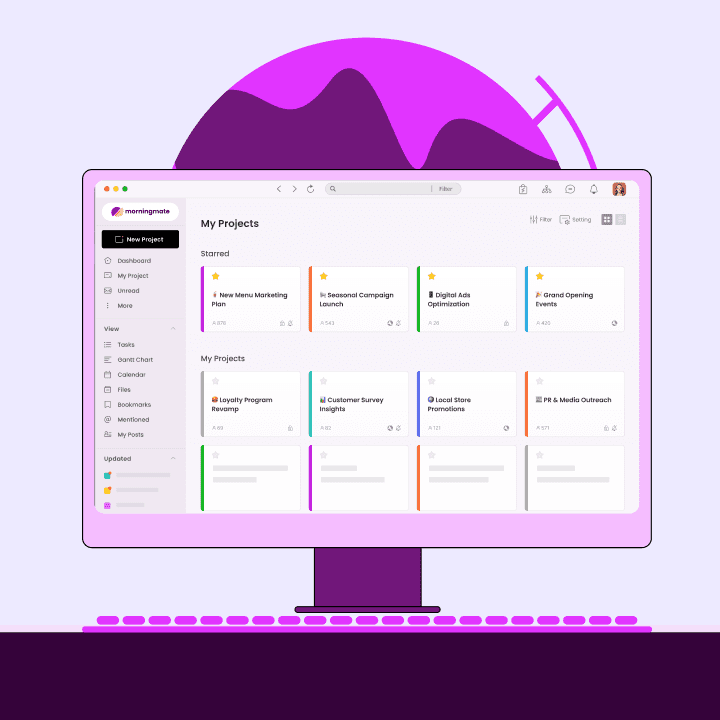
Morningmate works well here precisely because it keeps task management and team communication in the same workspace. Instead of tasks living in Trello and conversations living in WhatsApp and files living in email, your team has a single hub. The feed view is familiar — it works like a social media timeline, so even non-technical people pick it up in minutes. Tasks, updates, and files all live in one place your whole team actually opens.
Step 3: Install a Monday Morning Task Review
This is the heartbeat of your team rhythm. Every Monday, spend fifteen minutes — not a meeting, just a shared async review — where each person checks their open tasks, flags anything blocked, and confirms their priorities for the week. No slides, no lengthy write-ups. Just a quick scan of what is on their plate and what needs attention.
The magic of this habit is that it surfaces problems on Monday, not Thursday. When someone sees a task is blocked at the start of the week, there is time to fix it. When they notice on Thursday, the client deadline is already at risk.
Step 4: Add a Wednesday Mid-Week Check-In
A brief mid-week pulse keeps momentum without creating meeting fatigue. This does not need to be live. A quick async update — "here's where I am, here's what's blocking me" — posted by each team member on Wednesday afternoon gives you a real-time read on whether the week is on track. It also creates a paper trail so that when something slips, you can see exactly when the warning sign appeared.
Using Morningmate's built-in chat alongside its task tracking means those Wednesday updates sit right next to the actual tasks they reference. No digging through separate apps to connect the conversation to the work.
Step 5: Run a Friday Close-Out
End every week the same way. Each team member marks tasks complete, moves anything unfinished to next week with an updated note, and flags anything that needs your attention before Monday. This ten-minute habit does two things: it gives you visibility without requiring you to chase anyone, and it gives your team a psychological close to the week so they are not carrying mental load into the weekend.
McKinsey research on team performance consistently finds that teams with structured closure rituals report higher engagement and lower burnout — both of which directly affect how much output you get from a small crew.
Comparing Task Management Approaches for Lean Teams
Not all task management setups are created equal. Here is how three common approaches stack up against the specific pressures of a small business running at full capacity.
Criteria | Chat apps only (WhatsApp, Slack) | Heavy PM tools (Jira, Asana) | Morningmate |
|---|---|---|---|
Task tracking clarity | Low — tasks buried in messages | High — but complex to set up | High — simple and visual |
Onboarding time | Minimal — but misused for work | Weeks to configure properly | Hours — familiar interface |
Communication + tasks in one place | Communication only | Tasks only — needs integrations | Both, natively |
Suitable for non-tech teams | Yes — but not built for work | No — steep learning curve | Yes — designed for it |
Cost for a 10-person team | Low to free | $100–$300/month+ | Affordable — free plan available |
What This Task Management Rhythm Actually Delivers
Small teams that shift from ad-hoc task coordination to a structured rhythm report significant improvements — not just in output, but in owner sanity. When task management runs on autopilot, you stop being the human glue holding everything together. Your team can answer "what's the status?" by looking at the board, not by texting you.
The rhythm also makes it far easier to spot your real bottlenecks. When tasks are tracked and visible, you can see patterns: which team member is consistently overloaded, which client is generating disproportionate rework, which internal process keeps spawning last-minute fires. That visibility is something you simply cannot get when task management is happening inside people's heads and inbox folders.
Team Performance Improvements After Adopting a Structured Task Management Rhythm
68%
Fewer missed deadlines
54%
Less time on status chasing
41%
Reduction in rework
77%
Team self-sufficiency gain
Fig 2: Reported improvements by SMB teams after implementing structured task workflow and weekly rhythm (illustrative, based on industry benchmarks)
The One-Week Action Plan: Build Your Task Management Rhythm Right Now
You do not need a consultant or a three-month rollout. Here is what to do this week, in order, to get your task management rhythm off the ground.
Day 1 — Audit: List every active project or recurring responsibility your team handles. Count how many have a named owner and a written deadline. Be honest about how many do not.
Day 2 — Centralize: Pick one tool to house all task tracking going forward. Set up your workspace. If you have never done this before, start simple — a tool with a visual task board and built-in communication is enough.
Day 3 — Migrate and assign: Move every active task from your head, your inbox, and your chat apps into the tool. Every task gets an owner. Every task gets a due date.
Day 4 — Set the cadence: Schedule the Monday review, Wednesday pulse, and Friday close-out as recurring reminders. Write a one-paragraph description of what each team member should do at each checkpoint.
Day 5 — Run your first Monday review: Do not make it a big deal. Just have everyone check their tasks, flag blocks, and confirm their top three priorities for the week. The whole thing should take fifteen minutes.
Morningmate is purpose-built for exactly this kind of lean setup. It is used by more than 550,000 teams worldwide and was designed so that non-technical staff — field teams, ops, customer service — can use it without training. The feed-style interface means your team is not learning new software; they are using something that already feels familiar. Effective task management does not have to be complicated — it just has to be consistent.
Your Takeaway: Task Management Is Your Highest-ROI Investment This Month
You cannot buy more hours. You cannot clone yourself. But you can install a task management system that makes your existing team operate like one that is twice its size. The five-step rhythm above — clear ownership, one centralized tool, Monday review, Wednesday pulse, Friday close-out — takes less than a week to build and pays dividends every week after that in hours recovered, deadlines met, and headcount you do not need to hire.
The next action is not to think about this. It is to spend thirty minutes today auditing your current task workflow and identifying the single biggest gap. Odds are it is either unclear ownership or no central place for task tracking — and both are fixable before Friday. Start there, build the rhythm, and let the system do what you have been doing manually.