Project Management

Effective task management is the backbone of any operation that wants to scale without falling apart — yet most growing SMBs discover its absence only after the damage is done. A missed handoff here, a duplicated effort there, a critical update buried in someone's inbox: individually, these feel like minor nuisances. Collectively, they compound into something far more costly. According to Gallup's research on workplace productivity, employees who lack clear role expectations and process clarity are 57% less engaged — and disengagement carries a price tag in the trillions globally. More specifically, McKinsey estimates that knowledge workers spend nearly 20% of their workweek simply tracking down information that should already be accessible.
Here's what makes this particularly frustrating for an operations manager: the instinctive fix is more communication. More status meetings. More pings. More check-ins. But messaging volume is not the same as alignment. You can have a team that's constantly talking and still have no shared understanding of who owns what, what's blocked, or what "done" actually looks like. That's not a communication problem. That's a task management structure problem.
This article gives you a named framework for diagnosing exactly where your task workflow breaks down, concrete examples at each failure point, and a worked example of how to standardize the whole flow so you stop chasing and start leading.
The Compounding Cost of Inconsistent Task Management
Inconsistency doesn't announce itself. It accretes. A task assigned verbally in a meeting has no owner in any system. A deadline communicated over chat gets buried under 200 subsequent messages. A process that one team member follows perfectly is completely unknown to the person who joins three months later. Each gap is small. The total is staggering.
A 2026 Anatomy of Work report by Asana found that workers switch between apps an average of 10 times per hour to manage their tasks and communications — and that this context-switching costs teams roughly 9 working hours per person per week. For a team of 20, that's 180 hours of productive capacity lost every single week. Not to low morale. Not to poor hiring. To process fragmentation.
The table below breaks down what inconsistent task coordination actually costs versus what a standardized task tracking system recovers.
Ops Reality | Without Standardized Task Management | With Standardized Task Management |
|---|---|---|
Onboarding a new hire | 2–4 weeks of informal shadowing, knowledge gaps persist | Structured task checklist from day one, consistent every time |
Cross-team handoffs | Verbal or chat-based, frequently dropped or misunderstood | Documented, assigned, trackable with clear acceptance criteria |
Status visibility | Manager must manually ask for updates multiple times | Live task status visible without a single message sent |
Process knowledge | Lives in one person's head; disappears when they leave | Embedded in repeatable task templates the whole team uses |
Accountability | Unclear ownership leads to blame, not resolution | Every task has a named owner and a deadline, no ambiguity |
Introducing the STAR Task Management Framework
To diagnose and fix team misalignment at the process level, use the STAR framework: Structure, Transparency, Assignment, and Rhythm. Each component targets a distinct failure mode in task coordination. Together, they form the foundation of a system that works whether your team is five people or fifty, in-office or distributed.
The goal is not to add bureaucracy. It's to replace the invisible, informal systems your team is already running — badly — with explicit, repeatable ones that don't depend on any single person's memory or availability.
S — Structure: Task Management Starts Before the Task Is Created
Most task management failures happen before anyone types a single character into a tool. They happen when a task is conceived verbally, assigned informally, or created without a standard format. Structure means deciding — in advance — what every task record must contain.
At a minimum, every task in your system should carry: a clear title that describes the output (not the activity), a single named owner, a due date, a priority level, and enough context that someone picking it up cold can understand what "done" looks like. That last part is the most commonly skipped — and the most expensive to skip.
Ops example: Your team is onboarding a new client. Without structure, five different people create five different interpretations of what "client onboarding" involves. With structure, you build a standard onboarding task template: a fixed set of subtasks with named owners, ordered sequentially, with file attachments for each deliverable. Every new client gets the same reliable process. Onboarding time drops. Gaps disappear.
T — Transparency: Making Task Status Visible Without Asking
If you have to send a message to find out where something stands, your task tracking system has already failed you. Transparency means that the current status of any task — not started, in progress, blocked, complete — is visible to everyone who needs to see it, in real time, without requiring the owner to report it manually.
This is where most SMBs hit a wall. They're managing tasks in chat threads or email chains where status is implied, not stated. "Re: Re: Re: Supplier contract" is not a task management system. It's an archaeology dig.
Ops example: Your logistics team is coordinating with finance on a vendor payment approval. In a transparent task management setup, the approval request lives as a task with a clear status field. Finance sees it's waiting on their action. Logistics sees it's pending. No one needs to send a follow-up message. The task record itself communicates the situation.
Hours Lost Per Week to Status-Chasing by Team Size
4 hrs
5-person team
18 hrs
20-person team
45 hrs
50-person team
Fig 1: Estimated weekly hours lost to manual status-chasing as teams grow (illustrative, based on Asana Anatomy of Work data)
A — Assignment: Single Ownership in Task Coordination Is Non-Negotiable
Group ownership is no ownership. When a task is assigned to a team, a department, or — worst of all — left unassigned, it exists in a responsibility vacuum. Everyone assumes someone else is handling it. Nobody is.
The assignment component of the STAR framework enforces a simple rule: every task has exactly one owner. That person may delegate subtasks, may collaborate with others, may need input from three departments — but there is always one person whose name is on the task and who is accountable for its completion.
Ops example: A cross-team deliverable involves marketing, product, and ops. In your task management system, the parent task is owned by the ops lead. Marketing and product have named subtasks with their own owners. Everyone knows their piece. The ops lead can see at a glance whether their dependencies are on track without convening a meeting to find out.
R — Rhythm: Task Workflows Need Cadence, Not Constant Interruption
The final component is often the most overlooked. Rhythm means building predictable, recurring check-in points into your task management cadence so that the work itself sets the pace — not reactive pings and ad-hoc fire drills.
This doesn't mean more meetings. It means defining when tasks get reviewed, when blockers get escalated, and when status updates happen — and making those moments systematic rather than manager-dependent. A well-designed task tracking rhythm means your team knows: every Monday morning, the project board is reviewed; every Friday, tasks due next week are confirmed. No one has to be reminded. The system prompts it.
Ops example: Instead of a Monday scramble to figure out what's overdue from last week, your operations board shows every task with a due date in the past three days. In a 15-minute weekly review, you triage blockers, reassign where needed, and close out completed items. The rhythm is embedded in the process, not in your calendar.
Applying the STAR Framework with Morningmate: A Worked Example
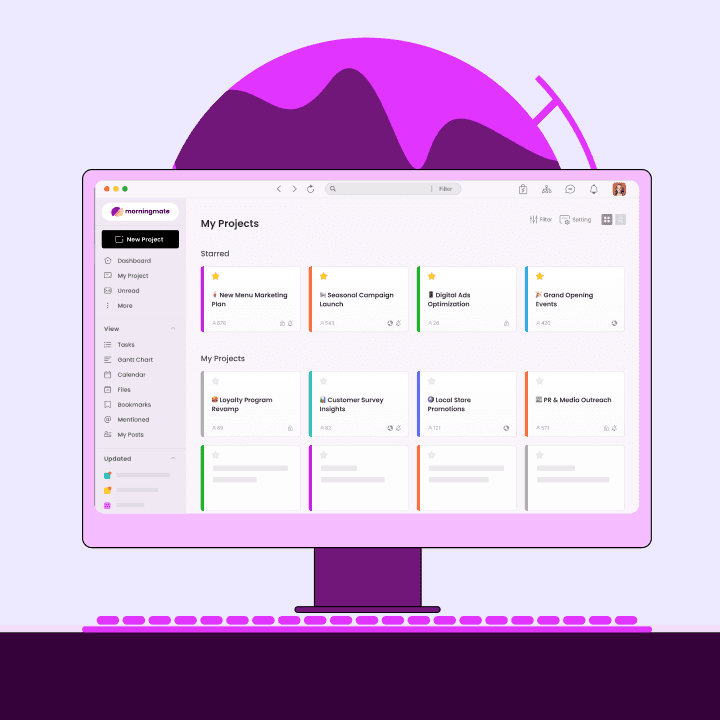
Here's what a standardized new employee onboarding flow looks like when you apply all four STAR components inside Morningmate — a lightweight work management tool used by over 550,000 teams that combines task management with built-in team chat in a single workspace.
Structure: Build a reusable onboarding project template in Morningmate with fixed task cards for each step: IT setup, HR documentation, tool access provisioning, team introduction, 30-day goal setting. Each task card has a pre-filled description, required attachments, and a defined completion checklist. Every new hire gets the same template instantiated on day one.
Transparency: Morningmate's task board gives the operations manager a live view of where each new hire is in the process. HR can see that IT provisioning is still in progress. IT can see that HR documentation was completed yesterday. No one needs to ask. The task visibility is built into the workflow itself.
Assignment: Each task card is assigned to a specific person — IT lead owns the setup task, HR lead owns the documentation task, the new hire's direct manager owns the 30-day goal task. The new hire can see their own onboarding tasks in their personal task view from their first login. There's no ambiguity about who does what.
Rhythm: A recurring task is set in Morningmate for the ops manager to review new hire progress at the end of day three and day seven. Questions and clarifications happen in Morningmate's built-in chat — which looks and feels familiar, like the messaging apps people already use — keeping all onboarding conversation attached to the context of the work, not floating in a separate app. This is one of the features that makes Morningmate particularly useful for non-technical teams who resist adopting complex tools: the interface is immediately intuitive.
The result: onboarding takes less manager time, fewer things fall through the cracks, and the process is identical whether you're onboarding one person or ten. That's the point of standardized task management — it should work at scale without you working harder.
Manual vs. Standardized Task Management: The Before/After
To make the impact concrete, here's a direct before-and-after comparison across the most common ops pain points.
Pain Point | Manual / Ad-hoc Approach | STAR-Standardized Task Management |
|---|---|---|
Getting a status update | Send a message, wait, follow up, get partial answer | Open the task board. Status is live and current. |
Handling a blocker | Discovered late in a meeting or not at all until deadline | Flagged in the task record early; escalation is systematic |
Knowledge retention | Process knowledge exits with the employee | Documented in task templates; transferable and repeatable |
Cross-team coordination | Misaligned expectations, missed handoffs, duplicated work | Dependencies visible in shared task workspace; clear handoff points |
Manager time spent | 40%+ of time chasing updates and coordinating manually | Review time cut to structured weekly rhythm; manager leads, not chases |
Manager Hours Recovered Per Week After Standardizing Task Workflows
1.2 hrs
Email-only teams
3.5 hrs
Partial task tools
7.8 hrs
Full STAR system
Fig 2: Estimated manager hours reclaimed weekly when task management is fully standardized (illustrative)
Implementation Checklist: Standardize Your Task Management in 30 Days
Effective task management doesn't require a six-month transformation project. Here's a focused 30-day checklist to get your STAR system operational. Work through it in sequence — each step reinforces the next.
Week 1 — Structure: Audit your three most repeated operational processes (onboarding, client delivery, cross-team requests). Document the steps. Build a task template for each with required fields: owner, due date, priority, definition of done.
Week 1 — Structure: Select one task management tool your whole team will use. Keep it simple — if it requires a training course to adopt, your non-technical team members will resist it. Morningmate's familiar, social-feed interface makes adoption fast for teams with no PM tool experience.
Week 2 — Transparency: Move all active work into the task management system. No new tasks in chat. No new tasks in email. If it's real work, it gets a task record.
Week 2 — Transparency: Define your status taxonomy: Not Started / In Progress / Blocked / Complete. Make sure everyone uses the same labels so the board is readable at a glance.
Week 3 — Assignment: Audit every open task. Any task without a single named owner gets one assigned within 24 hours. Group assignments are eliminated.
Week 3 — Assignment: For cross-team tasks, add a "coordinator" field — the person responsible for ensuring the handoff happens, even if they don't own the downstream work.
Week 4 — Rhythm: Set recurring weekly review events: Monday board triage (15 min), Friday completion sweep (10 min). Put these in the calendar as non-negotiable. They replace your status meetings, not add to them.
Week 4 — Rhythm: Review your accountability system after 30 days: Which task templates are being used consistently? Which aren't? Adjust the templates, not the people.
The compounding cost of inconsistent task management is real, measurable, and entirely preventable. The STAR framework gives you a structured lens — Structure, Transparency, Assignment, Rhythm — to pinpoint exactly where your task coordination breaks down and rebuild it with intention. Alignment doesn't come from more messages. It comes from a system your whole team can see, trust, and use every day. Start with one process, standardize it completely, and let that first win build the case for the rest.