Project Management

Effective task management is not a luxury for growing teams — it is the foundation every reliable operation is built on. Yet across thousands of SMBs, the same pattern repeats: a team starts coordinating work in WhatsApp because it is fast and familiar, and for a while, it works. Then the team grows. Complexity increases. And what was once a convenient shortcut becomes the single biggest drag on operational consistency. This article gives you a named framework for diagnosing exactly where informal task coordination breaks down, and a concrete path to fixing it — permanently.
The problem is not WhatsApp itself. The problem is applying a personal messaging tool to a business function it was never designed to support. Task tracking inside a chat thread has no owner fields, no due dates, no status tracking, and no audit trail. Every decision made in a group chat is one backup failure or staff departure away from being lost forever. If your operations depend on information living inside someone's phone, you do not have a process — you have a risk.
According to McKinsey Global Institute, employees spend an average of 28% of their workweek managing email and messages — and that figure climbs sharply in teams relying on informal channels for task coordination. The compounding cost is not just time lost. It is decisions made without context, onboarding that takes weeks longer than it should, and managers who spend more time chasing status than doing actual operational work.
The Compounding Cost of Informal Task Management
Inconsistent task management does not create one large, visible problem. It creates dozens of small ones that compound quietly. A task assigned in a WhatsApp message gets buried under 40 subsequent messages. A deadline is missed because the assignee thought someone else owned it. A new hire spends their first two weeks asking colleagues for context that should have been documented from day one.
Each of these micro-failures costs time. But more critically, they cost trust — between team members, between managers and their teams, and between your operations and the business results you are responsible for delivering. Gallup's State of the Global Workplace report consistently finds that unclear roles and poor coordination are among the top drivers of employee disengagement. Poor task coordination is not an inconvenience. It is an organizational liability.
Before exploring the framework, look at what informal versus standardized task management actually costs across common operational dimensions:
Operational Dimension | WhatsApp / Informal Channels | Standardized Task Management |
|---|---|---|
Task ownership | Assumed, rarely confirmed | Explicitly assigned, tracked |
Status visibility | Requires manual chasing | Real-time, always visible |
Onboarding speed | 2–4 weeks to context | Days, with documented workflows |
Knowledge retention | Lost when staff leave | Stored in the system of record |
Cross-team coordination | Siloed, fragmented | Unified view across functions |
Audit trail | None | Full history, searchable |
Introducing the SCOPE Framework for Task Management Standardization
To systematically fix informal task coordination, operations teams need more than a tool swap. They need a repeatable model for diagnosing and rebuilding their task workflows. The SCOPE Framework gives you exactly that — five components that together create a fully standardized task management system your team can actually sustain.
SCOPE stands for: Structure, Context, Ownership, Progress visibility, and Escalation paths. Each component addresses a specific failure mode of informal task management in growing SMBs.
S — Structure: Task Management Needs a Defined Home
The first failure of WhatsApp-based task coordination is structural. There is no dedicated space for task tracking — tasks live inside conversations, mixed with memes, voice notes, and off-topic threads. Structure means creating a purpose-built environment where tasks are created, stored, and managed separately from chat.
In practice, this means establishing a workspace where every project or workstream has its own dedicated area. For an ops team managing vendor onboarding, facilities requests, and cross-departmental projects simultaneously, a single WhatsApp group is structurally incapable of holding all of that. You need separate, organized spaces — one per function or project — with task lists that persist independently of the chat timeline.
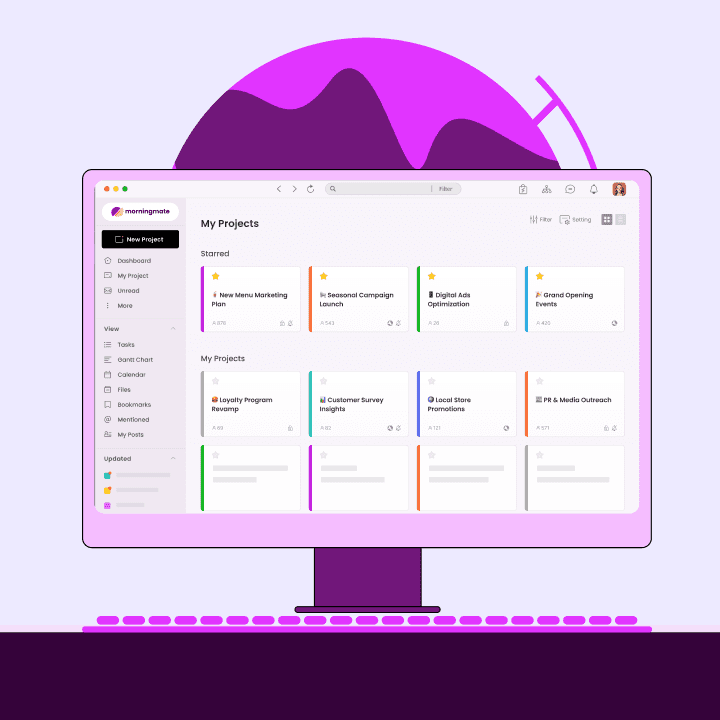
This is where tools like Morningmate change the game for ops teams. Morningmate organizes work into dedicated project spaces — each with its own task board, file storage, and built-in discussion thread — so task tracking is never mixed in with casual conversation. Every task has a permanent home that any team member can find, regardless of when they joined the project.
C — Context: Every Task Needs the Information to Execute It
The second breakdown in informal task management is context loss. A message that says "can you follow up with the supplier?" contains no deadline, no relevant documents, no prior conversation history, and no definition of what "follow up" means. The recipient has to chase context before they can even begin the task.
Standardized task management requires that every task carries its own context: a clear description, relevant files, links to prior decisions, and any dependencies. In an onboarding workflow, for example, each step — IT setup, HR documentation, systems access — should be a standalone task with the relevant checklists and contacts attached directly to it. New hires and new managers can get started without interrogating colleagues.
Context also protects against knowledge silos. When institutional knowledge lives only in someone's head or phone, it walks out the door when they leave. Attaching context to tasks keeps that knowledge inside your operational system where it belongs.
O — Ownership: Task Tracking Fails Without Clear Accountability
In a WhatsApp group, tasks are often addressed to the group rather than to a specific person. That diffusion of responsibility is one of the most well-documented causes of execution failure. When everyone is responsible, no one is.
Standardized task management assigns every task to a named individual with a confirmed due date. In cross-team coordination — say, a product launch involving ops, marketing, and sales — each workstream task must have a single DRI (directly responsible individual), not a team or a group chat. This makes accountability visible and eliminates the "I thought someone else was handling it" failure mode that derails timelines in growing companies.
Asana's Anatomy of Work Index found that 27% of missed deadlines were directly attributable to unclear ownership — making this the single most impactful component of the SCOPE framework to get right.
Top Causes of Missed Deadlines in Growing SMBs (%)
27%
Unclear ownership
23%
Missing context
31%
No status visibility
19%
No escalation path
Fig 1: Primary causes of deadline failure in SMB operations teams (illustrative, based on industry research)
P — Progress Visibility: Task Coordination Requires a Single Source of Truth
As an operations manager, you should never have to send "any update on this?" messages. That kind of status chasing is a symptom of a broken task visibility system — and it is one of the most consistent complaints from ops leads in growing SMBs. Progress visibility means that the current status of every active task is available to the right people, without anyone having to ask.
This requires task statuses that are actively maintained — not just created and forgotten. It also requires a view that aggregates tasks across projects so a manager can see, at a glance, what is on track, what is blocked, and what needs attention today. That aggregate view is simply impossible in a WhatsApp group with 40 members and 300 daily messages.
Morningmate's task board gives ops managers exactly this kind of visibility. Tasks across all project spaces are tracked with status labels, due dates, and assignees — so instead of chasing updates, you open one view and see the full picture. For non-technical teams who find tools like Jira overwhelming, Morningmate's interface is intentionally approachable, built around familiar patterns that anyone can learn in under an hour.
E — Escalation Paths: Task Management Needs Defined Exception Handling
The final component of the SCOPE framework is often the most overlooked. Even well-structured task workflows hit blockers. A vendor does not respond. A dependency slips. A task owner goes on leave unexpectedly. Without a defined escalation path, blocked tasks simply stall — and no one knows whether to wait, re-assign, or escalate to leadership.
Standardized task management includes explicit protocols for what happens when a task is at risk. This might be a "blocked" status label that triggers a notification to the project lead, a defined SLA for unresolved blockers, or a regular ops review cadence where at-risk items are surfaced and resolved. The specific mechanism matters less than the fact that one exists and everyone knows it.
Applying the SCOPE Framework with Morningmate: A Worked Example
Here is how the SCOPE framework applies to a real operational scenario: standardizing the employee onboarding workflow across a 60-person company with HR, IT, and three business unit managers involved.
Before SCOPE: Onboarding tasks were coordinated across three WhatsApp groups and a shared Google Doc nobody kept current. New hires regularly arrived on day one without laptop access, system credentials, or a clear first-week agenda. HR was spending 4–6 hours per hire chasing confirmations from IT and managers.
After applying SCOPE in Morningmate:
Structure: A dedicated "New Hire Onboarding" project space is created in Morningmate for every new hire, templated from a master checklist.
Context: Each task in the template includes a description, the relevant policy document or form attached directly to the task, and a link to the prior decision or requirement it fulfils.
Ownership: IT setup tasks are assigned to the IT lead. HR documentation tasks go to the relevant HR coordinator. Manager intro tasks are assigned to the hiring manager — each with a named owner and a due date tied to the hire date.
Progress visibility: HR can open the project space 48 hours before the hire date and see instantly which tasks are complete, which are in progress, and which are not started.
Escalation: Any task not marked complete 24 hours before the hire date automatically surfaces in the team's daily ops check-in, with the project lead notified to intervene.
The result: onboarding coordination time dropped from 4–6 hours per hire to under 45 minutes. New hires reported a materially better first-day experience. And HR stopped being the human glue holding a broken process together.
Before and After: Standardized Task Management at a Glance
Workflow Area | Before SCOPE (WhatsApp-based) | After SCOPE (Standardized) |
|---|---|---|
Task creation | Ad hoc message in group chat | Templated task with owner + due date |
Status update | Manager sends "any update?" daily | Live status visible on task board |
Cross-team handoff | Forwarded message, often missed | Reassigned task with full history |
New hire ramp-up | 2–4 weeks of context-gathering | Structured onboarding task list from day one |
Blocker resolution | No protocol — tasks silently stall | Defined escalation triggers review |
Process documentation | In someone's memory or phone | Embedded in task templates, always accessible |
Ops Manager Time Reclaimed After Task Management Standardization (hrs/week)
8 hrs
Chasing status (before)
1 hr
Chasing status (after)
5 hrs
Onboarding overhead (before)
0.75 hr
Onboarding overhead (after)
Fig 2: Estimated weekly hours recovered per ops manager after implementing SCOPE-based task management (illustrative)
Your Task Management Implementation Checklist
Standardizing task management does not require a six-month transformation project. Most ops teams can implement the SCOPE framework incrementally, starting with the highest-friction workflow and expanding from there. Use this checklist to guide your rollout:
✅ Audit your current task channels — identify every place tasks are currently assigned (WhatsApp, email, verbal, meetings) and estimate the volume in each.
✅ Select a dedicated task management tool — it should support named ownership, due dates, file attachments, and status tracking as a minimum. Tools like Morningmate offer all of this in a simple interface that non-technical teams can adopt quickly, without the complexity of enterprise PM platforms.
✅ Build your first process template — choose your highest-volume or highest-risk workflow (onboarding, vendor management, cross-team approvals) and build a reusable task template for it.
✅ Assign a single DRI to every task — remove group assignments. Every task must have one named owner.
✅ Establish a weekly ops review cadence — use the task board as the agenda. Review blocked items, check upcoming deadlines, and close completed tasks.
✅ Define your escalation protocol — decide what triggers escalation (task overdue by X hours, status unchanged for X days) and who gets notified.
✅ Archive your old task channels — do not allow parallel task coordination to continue in WhatsApp. A clean cut accelerates adoption.
✅ Review and iterate quarterly — task management processes should evolve as your team grows. Build in a quarterly review to update templates and protocols.
Inconsistent task management is not a people problem — it is a systems problem. The SCOPE framework gives you a structured approach to replacing informal coordination with reliable, scalable task workflows. Whether you are managing a team of 15 or 150, the principles are the same: structure your work, document the context, assign clear ownership, make progress visible, and define what happens when things go wrong. That is how operations teams stop chasing status and start driving results.