Project Management

Good task management is supposed to be the easy part. You have the campaign brief, the deadline is locked, the freelancer knows what to do — and yet, three days before launch, the approval still isn't in, the copy is sitting in someone's inbox, and your founder has no idea the blog post needed a sign-off. Sound familiar? Recurring tasks — the ones your team runs every single week or month — are the ones most likely to quietly fall apart, not because anyone is incompetent, but because the system around them is broken.
The frustrating truth is that recurring task coordination doesn't fail on complex campaigns. It fails on the simple stuff: weekly social posts, monthly newsletter approvals, ad creative sign-offs, content calendar updates. These are tasks that live in no one's brain as a priority precisely because they feel routine. And that familiarity is exactly what makes them dangerous.
According to Asana's Anatomy of Work report, workers spend nearly 60% of their time on work about work — status updates, chasing approvals, searching for files — rather than the skilled work they were hired to do. For a small marketing team, that percentage hits even harder. You're already stretched across content, social, email, and paid. Every dropped task is a missed opportunity, not just an inconvenience.
Where Task Management Actually Breaks Down
Before you can fix recurring task workflows, you need to name the real breakdown point. Most small teams assume the problem is communication. But communication is usually fine — the real failure is in task coordination: who owns what, what the current status is, and what needs a decision before work can move forward.
The Three Pressure Points in Recurring Task Workflows
Think about how your team handles a recurring deliverable — say, the weekly social media batch. Here's where the cracks typically appear:
Handoff gaps: The freelancer finishes the copy and drops it in a Slack message or email. The marketing manager sees it, but the founder's approval gets buried under twelve other notifications.
Status invisibility: No one knows if the creative is "under review," "approved," or "waiting on revision" without sending a separate message to ask.
Context collapse: When a task resurfaces next week, the thread, the file, and the feedback are in three different places. Someone spends twenty minutes reconstructing what was decided last time.
This isn't a people problem. It's a task tracking problem. The workflow exists in people's heads, in chat apps, and in spreadsheets — never in one place where everyone can see the same version of reality.
Recurring Task Type | Most Common Failure Point | Hidden Cost |
|---|---|---|
Weekly social posts | Approval lost in chat | Delayed publish, missed slots |
Monthly newsletter | Feedback scattered across email + chat | Revision loops, late send |
Ad creative sign-off | Founder bottleneck, no deadline visibility | Campaign launch pushed back |
Blog post publication | SEO checklist skipped, file version confusion | Inconsistent quality, rework |
How Often Recurring Task Management Fails — The Numbers
If you're thinking this is just your team, it isn't. Task coordination failures around recurring work are shockingly common, even among teams that consider themselves well-organized. Harvard Business Review notes that repetitive, low-novelty tasks are the most likely to be deprioritized under cognitive load — which means the more routine a task feels, the more likely someone is to assume someone else is handling it.
% of Marketing Teams Reporting Missed Deadlines on Recurring Tasks
71%
Chat-only teams
63%
Email + Spreadsheet
29%
Structured task tracking
Fig 1: Missed recurring task deadlines by workflow type (illustrative, based on industry benchmarks)
A Repeatable Play: Your Recurring Task Management Workflow
Here's the good news: fixing recurring task coordination doesn't require a massive process overhaul. It requires one consistent workflow your whole team — including your founder and freelancers — will actually follow. Run this playbook for any task that repeats weekly or monthly.
Name it and own it. Every recurring task needs one named owner. Not "the team." Not "marketing." One person who is responsible for moving it forward. If ownership rotates, document that rotation in the task itself.
Set the task before the work starts. Create the recurring task entry at the start of the week or month — not after the work is done. Include the deadline, the approver, and the relevant files upfront. This is your single source of truth.
Attach context directly to the task. Brief notes, reference files, previous feedback — all of it lives inside the task record, not in a separate chat thread. Anyone who picks this up mid-stream should be able to get context in under two minutes.
Build in a hard approval checkpoint. Define exactly when the approver needs to act and what "approved" means. A thumbs-up in chat doesn't count. A timestamped approval on the task record does.
Close the loop explicitly. When the task is done, mark it complete with a note. Don't just let it go silent. Next week's version of this task will be easier if this week's is cleanly closed.
This workflow works whether you're managing a three-person team or coordinating across six freelancers. The discipline is in the setup, not the execution.
Common Failure Points in Task Coordination — And How to Avoid Them
Even teams with a defined workflow hit the same landmines. Here's what to watch for:
Failure Point 1: The "I Thought You Had It" Assumption
Recurring tasks feel familiar, so people assume ownership is understood. It isn't. Fix this by putting the owner's name in the task record every single cycle — even if it never changes. Visibility kills assumptions.
Failure Point 2: Approval by Chat Message
Your founder sends a "looks good!" in WhatsApp. Two days later, they've forgotten they approved it and ask for changes. Task management only works when approvals are tied to the task itself, not floating in a chat thread that will scroll out of sight within hours.
Failure Point 3: Feedback Without a Deadline
Sending a creative for review without a response deadline is an open invitation for it to sit unread. Every approval request should include a specific date: "Need your sign-off by Thursday noon." According to Gallup research on workplace engagement, teams with clear expectations and accountability structures are significantly more likely to hit their targets consistently.
Failure Point 4: The "We'll Remember" File System
If your brief is in Google Drive, your feedback is in email, and your approval is in Slack — you don't have a system. You have a scavenger hunt. Task tracking only works when the file, the conversation, and the decision all live in the same record.
How Morningmate Brings Task Management, Approvals, and Chat Together
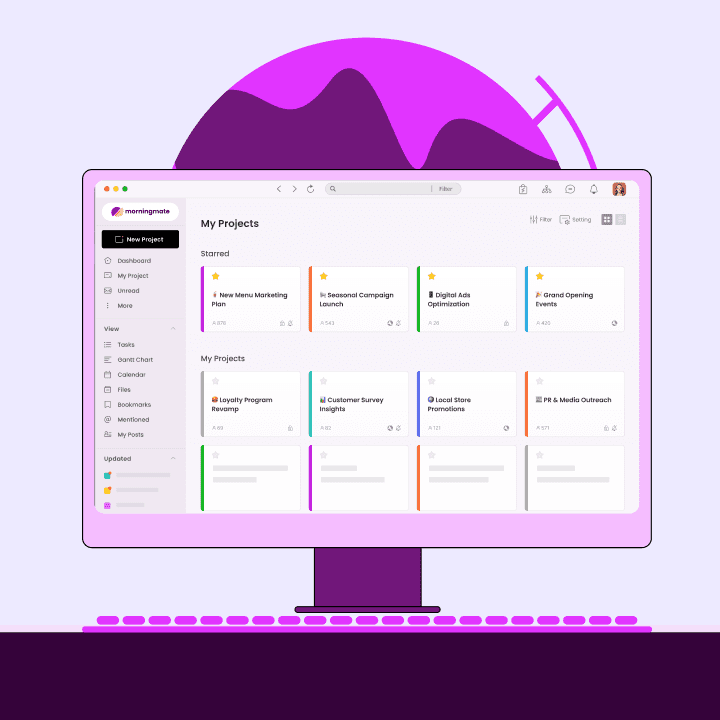
This is exactly the problem morningmate was built to solve. Morningmate is a lightweight work management tool that combines task tracking, built-in chat, and file management in a single workspace — without the complexity of tools like Jira or Asana that your founder will never actually log into.
A Worked Example: The Weekly Social Batch
Let's say your team runs a weekly social media batch: copy from a freelancer, visuals from your in-house designer, and a final sign-off from your founder before scheduling. Here's how this plays out in morningmate:
Step 1 — Task setup on Monday. You create a recurring task called "Weekly Social Batch — Week 24" inside your Marketing project. You assign the copy subtask to your freelancer, the design subtask to your designer, and the approval task to your founder — all with individual deadlines visible to everyone.
Step 2 — Files attached, not forwarded. When the freelancer finishes, they upload the copy doc directly to the task. No email, no separate Drive link. The designer attaches the visuals to the same task record. Everything is in one place.
Step 3 — Approval with a paper trail. Your founder gets a notification, reviews the files attached to the task, and marks the approval subtask complete with a comment. That approval is timestamped and attached to the task — not in a disappearing chat bubble. Morningmate's built-in chat (which works with a familiar interface similar to WhatsApp, so no learning curve for your founder) keeps any back-and-forth in the same thread as the task itself.
Step 4 — Close and repeat. You mark the task complete. Next week, you duplicate it in under thirty seconds. The structure — owner, deadline, approver, files — is already set. You just update the dates.
The whole cycle runs without a single chaser message. No "did you see my email?" No "who approved this?" Just a clean, visible task workflow your whole team can follow.
Workflow Step | Scattered tools (chat + email + sheets) | Morningmate task workflow |
|---|---|---|
Task assignment | Verbal or chat message, easily missed | Named owner + deadline in task record |
File handoff | Email attachment or Drive link in chat | File attached directly to the task |
Approval process | WhatsApp "ok" or email reply | Timestamped approval on task record |
Status visibility | Must ask someone to find out | Visible to everyone in real time |
Next cycle setup | Rebuild from scratch each time | Duplicate task in seconds |
What Changes When Task Tracking Is Actually Consistent
The shift isn't dramatic at first. But after four to six weeks of running a consistent task management workflow, the compounding effect becomes obvious. Your team stops spending time chasing status. Your founder stops being a bottleneck. And you stop being the human routing system between your freelancers and your approval process.
Time Saved Per Week on Recurring Task Coordination (Hours)
0.5 hrs
Before: Chat-only
2.1 hrs
Partial system
4.8 hrs
Full task workflow
Fig 2: Estimated weekly hours saved by marketing managers using structured task coordination (illustrative)
Your Task Management Checklist to Apply This Week
You don't need to rebuild your entire workflow to see results. Start with these actions this week and watch your recurring task coordination get dramatically smoother.
☐ List every recurring marketing task that runs weekly or monthly — social, email, ads, blog
☐ Assign one named owner to each recurring task — no shared ownership
☐ Set a hard approval deadline on every task that requires founder or stakeholder sign-off
☐ Move all task-related files and feedback into the task record — not separate emails or chats
☐ Stop accepting chat messages as approvals — require a task-level confirmation
☐ At the end of each week, mark completed tasks as done with a brief closure note
☐ Set up one workspace (morningmate works well here — it combines task tracking and built-in chat without the learning curve) where your whole team, including your freelancers and founder, can see every task's current status
☐ Run this system for four consecutive weeks before tweaking anything
Your team isn't dropping the ball because they're disorganized. They're dropping it because the task management system around them makes it too easy for things to slip through. The fix isn't a longer to-do list or another check-in meeting — it's a visible, consistent, single-source workflow where every recurring task has an owner, a deadline, a file, and a clear approval path. Build that, and the ball stops dropping.