Project Management

Effective task management is not just about knowing what needs to be done — it is about knowing who owns it, what state it is in, and what comes next. Yet in most growing SMBs, the systems teams rely on to coordinate work were never built for that purpose. Shared inboxes and group chats are communication tools. They move messages. They do not move work. And that distinction, seemingly minor on the surface, compounds into one of the most significant operational drags a scaling organization can face.
The frustration is familiar. Your team is active — messages flying, inboxes humming, group threads full of responses — and yet deliverables slip, handoffs break down, and you are still manually chasing status on things that should have been resolved days ago. The problem is not effort. The problem is that your team is using communication infrastructure to do workflow work, and the two are fundamentally different systems with fundamentally different architectures.
This article breaks down exactly why shared inboxes and group chats fail as task coordination systems, introduces a framework for thinking about the gap, and shows how standardizing your task management layer closes it — permanently.
The Compounding Cost of Workflow-by-Inbox
The hidden cost of running operations through communication tools is not a single failure — it is a slow bleed. According to McKinsey Global Institute, employees spend an average of 28% of their workweek managing email alone. Add group chat monitoring and you are looking at more than a third of your team's productive hours spent inside communication tools that produce no structured output. No task record. No owner. No deadline. Just noise.
For an operations manager, this manifests in specific, painful ways: onboarding checklists buried in email threads, cross-team handoffs lost in a group chat scroll, approval statuses that exist only in someone's memory. Each of these gaps is a process failure waiting to happen. And as your headcount grows, the failures multiply faster than your team can patch them.
Asana's Anatomy of Work report found that 58% of workers' time is spent on "work about work" — status updates, chasing information, attending meetings that exist only to clarify things that should already be documented. That is the exact cost of using chat and email as a workflow layer. The task management gap is not theoretical. It is eating more than half your team's week.
Operational Area | Group Chat / Shared Inbox | Structured Task Management |
|---|---|---|
Task ownership | Unclear — assumed from context | Explicit assignee per task |
Status visibility | Requires chasing manually | Real-time, always visible |
Process repeatability | Rebuilt each time from scratch | Templated, consistent |
Cross-team handoffs | Lost in thread scroll | Logged and traceable |
Knowledge retention | Disappears with staff turnover | Stored in task records |
The COWS Framework: Why Communication Tools Fail at Task Management
To make the gap concrete and actionable, here is a framework built specifically for operations managers: COWS. It maps the four dimensions where communication tools structurally fail as task coordination systems. Every place your workflows break down, you will find one of these four failures at the root.
C — Context Collapse
In a group chat or shared inbox, every piece of information lives in a flat, chronological stream. A task request sits next to a question about lunch orders sits next to a client escalation. There is no structural separation. Context collapses into noise. When someone needs to find the status of an onboarding task from last Tuesday, they are scrolling — not working. Good task management pulls each piece of work into its own structured record with a clear owner, deadline, and thread, completely separate from ambient conversation.
O — Ownership Ambiguity
When a task is assigned in a group chat — "Hey, can someone handle the vendor invoice?" — it belongs to everyone and therefore to no one. Research consistently shows that diffuse accountability is the single fastest way to ensure a task falls through the cracks. Task management systems eliminate ownership ambiguity by requiring an explicit assignee before a task can even be created. That single structural constraint changes behavior across an entire team.
W — Workflow Invisibility
A shared inbox or group chat tells you what was said. It does not tell you what is happening. You cannot see what percentage of this week's onboarding checklist is complete, which cross-team deliverables are blocked, or who has capacity. That is workflow invisibility — and it is why operations managers spend so much time chasing status instead of removing blockers. Structured task tracking surfaces this information automatically, without any additional effort from the team.
S — System Non-Repeatability
Every time a new hire joins or a new process launches, teams using chat and email rebuild the workflow from scratch. There are no templates, no standard sequences, no documented steps — just whoever was involved last time trying to remember what they did. Task management systems allow you to build a process once, templatize it, and repeat it with zero reconstruction overhead. This is the foundation of scalable operations.
How Deep Does the Task Management Gap Actually Run?
The COWS framework is not abstract. Each failure dimension has a measurable operational cost. Consider the following data, drawn from workplace productivity research across SMBs in 2026:
Hours Per Week Lost to Workflow Friction by Tool Type
11 hrs
Shared Inbox Only
13 hrs
Group Chat Primary
4 hrs
Structured Task Mgmt
Fig 1: Estimated weekly hours lost to status chasing, rework, and context-switching by primary workflow tool (illustrative, based on published productivity research)
The gap between a chat-first operation and a task-management-first operation is not marginal. It is the difference between a team that runs and a team that you have to run for them. Every hour spent chasing status is an hour not spent identifying the next bottleneck or improving the next process.
Applying the COWS Framework: A Standardized Onboarding Flow in Morningmate
Theory becomes useful when it becomes a repeatable system. Here is a worked example of what standardized task management looks like in practice — specifically for employee onboarding, one of the highest-friction, most frequently broken processes in growing SMBs.
The Before State: Onboarding by Group Chat
A new hire starts Monday. The ops manager sends a message in the "General" group chat reminding people to get their tasks done. IT says they sent the laptop. HR thinks someone else handled the system access. The hiring manager forgot to assign a buddy. By Wednesday, the new hire has no access to three critical tools, no clear first-week agenda, and a growing sense that the company is chaotic. Meanwhile, the ops manager has sent six follow-up messages and is still not sure what is done and what is not.
The After State: Onboarding as a Structured Task Workflow
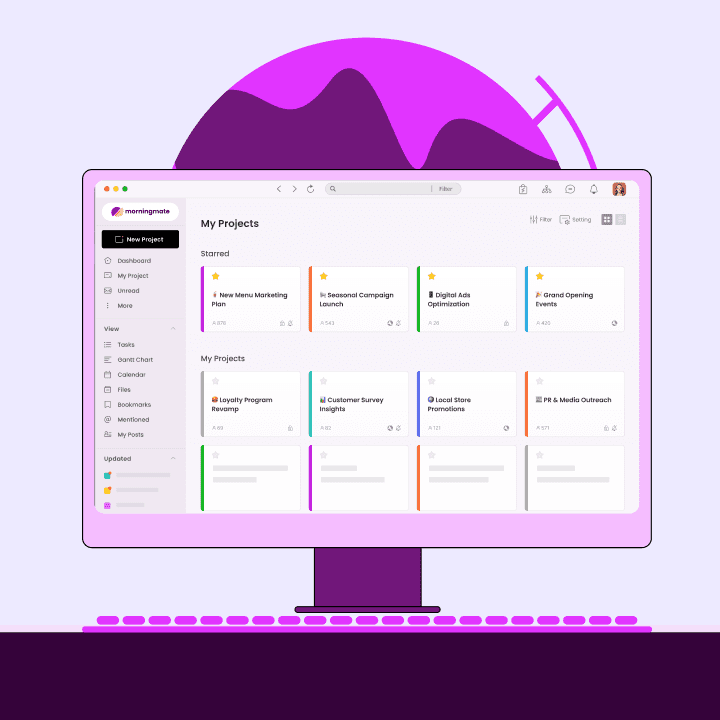
With a standardized task management system in place, the onboarding process works differently from day one. Using Morningmate — a lightweight work management platform used by more than 550,000 teams worldwide — you create a reusable onboarding project template. The moment a new hire is confirmed, you activate the template. Every task auto-populates with the correct assignee, deadline, and step-by-step instructions. IT sees their tasks. HR sees theirs. The hiring manager sees their checklist. Nothing requires a follow-up message because every stakeholder has explicit, visible, owned tasks in a shared workspace.
Morningmate's task management features let you attach files, checklists, and notes directly to each task — so the "how" lives alongside the "what." Its Feed view gives the ops manager a running status view across all onboarding tasks without a single status meeting or chase message. And because the tool has built-in chat, contextual questions stay attached to the relevant task rather than disappearing into a group thread.
This is what separates a shared workflow from a shared inbox: the work is the system, not the conversation about the work.
Before and After: The Task Management Standardization Impact
The operational difference between chat-driven and task-driven workflows is not just qualitative. Teams that standardize their task coordination see measurable changes across the core metrics ops managers actually care about.
Metric | Chat / Inbox Workflow | Standardized Task Management |
|---|---|---|
Onboarding completion rate | ~60%, steps frequently skipped | 95%+, every step logged |
Time to status update | 24–48 hrs (requires chasing) | Real-time, on-demand |
Process setup time (repeat) | 2–4 hrs to rebuild manually | Under 10 minutes via template |
Cross-team handoff failures | Common, discovered late | Visible before they happen |
Manager time on status chasing | 5–10 hrs/week | Under 1 hr/week |
Task Management Adoption: What the Data Shows After Standardization
Teams that shift from communication-first to task-management-first operations do not just feel more organized — they measure it. The efficiency gains appear quickly and sustain over time, particularly in the areas where the COWS failures were most acute.
Team Performance Improvement After Task Management Standardization (%)
67%
Faster Onboarding
72%
Fewer Missed Handoffs
81%
Less Status Chasing
59%
Process Repeatability
Fig 2: Self-reported improvement rates among SMB ops teams after transitioning to structured task management (illustrative, based on published SMB productivity benchmarks)
The message is consistent across all four dimensions: when you give work its own system instead of forcing it through a communication tool, every operational metric improves. Task tracking, process repeatability, cross-team visibility — none of these are achievable in a chat thread, no matter how disciplined your team is.
Your Task Management Implementation Checklist
Standardizing your task management layer does not require a six-month transformation project. Start with these seven steps and you will close the most critical COWS gaps within two to four weeks.
Audit your current workflow tools. List every place work is currently being assigned, tracked, or discussed. Email, group chat, spreadsheets — all of it. This is your baseline.
Identify your three highest-friction recurring processes. Onboarding, approvals, and cross-team project handoffs are the most common culprits. Pick these first.
Define task ownership rules. Every task must have exactly one named owner. No "team" assignments, no "whoever is free" language. Document this as a standing operating procedure.
Build your first process template. Take your highest-friction process and map it into a reusable task workflow — with step names, default assignees by role, and deadlines relative to a start date. Tools like Morningmate let you build and repeat these templates without any technical setup, keeping task coordination accessible even for non-technical teams.
Separate chat from task tracking. Use communication tools for questions and context. Use your task management system for assignments, status, and process records. Draw a hard line between the two.
Set a weekly ops review cadence. A fifteen-minute task review — not a status meeting, but a structured review of open tasks and blockers in your task management system — replaces most of the ad-hoc chasing.
Run a thirty-day pilot on one team. Measure time spent on status chasing before and after. The data will make the case for wider rollout better than any internal presentation.
Shared inboxes will always have a place in your operation. So will group chat. But neither of those tools can carry the weight of coordinating work across a growing team. Task management is not a feature you add on top of your communication stack — it is a separate, foundational layer that makes everything else run. Build it properly, standardize it consistently, and the manual chasing stops. Not because your team got more disciplined, but because the system no longer requires discipline to compensate for its own structural gaps.