Project Management

Good task management is supposed to distribute work across your team. But in many growing businesses, it quietly does the opposite — concentrating coordination, context, and institutional knowledge in one person. That person is usually your most reliable team member. And without realising it, you have built your entire operation around their availability.
This is one of the most common and least visible risks in a scaling SMB. It does not show up on a risk register. It rarely triggers an incident. It just means that every time that person takes a day off, goes on leave, or eventually moves on, the wheels come off quietly — deadlines slip, handoffs stall, and you spend a week re-teaching what should already be documented. That is not a people problem. That is a task management problem.
The fix is not to work around that person or replace them. It is to build the kind of task workflow infrastructure that stops any one individual from becoming the load-bearing wall of your operation. This article gives you a practical model for doing exactly that.
The Hidden Cost of Person-Dependent Operations
When your task management depends on one person's memory, relationships, and initiative, your operational risk is higher than it looks. Consider a common pattern: a logistics coordinator at a mid-sized distribution company becomes the de facto owner of every supplier update, delivery exception, and cross-team handoff. Nothing is formally assigned to her — she just picks things up because no one else does. When she takes two weeks of leave, three shipments are delayed and a new hire has no idea where to start.
The damage is not just the two-week gap. It is the six weeks before, when every process subtly bent around her availability. And the two weeks after, re-explaining what should have been documented. Person-dependent task tracking compounds over time — it does not stay contained.
Operational area | When task management lives in a person | When task management lives in the system |
|---|---|---|
Status updates | Chase the person, wait for a reply | Check the task board, answer in seconds |
Onboarding new hires | Shadow the reliable person, hope they have time | Follow documented workflows, self-directed from day one |
Cross-team handoffs | Verbal or message-based, easily missed | Triggered by task status change, tracked and visible |
When key person is absent | Work stalls or falls to manager | Work continues from documented task state |
Process improvement | Hard to audit — lives in someone's head | Visible, reviewable, improvable over time |
A Practical Model: The Process-First Task Management Design
The goal of this model is simple: every recurring piece of work should have a defined home, a clear owner, and a documented state — not because you distrust your team, but because you want the work to survive any single person. Think of it as designing for continuity rather than competence.
The model has four components, each addressing a specific failure point where person-dependency tends to take root. Together they move task management from informal and individual to structured and shared.
Component 1: Task Ownership That Is Assigned, Not Assumed
The most common root cause of person-dependency is not a lack of process — it is ambiguous ownership. When no one is explicitly assigned a task, the most responsible person in the room picks it up by default. Repeatedly. Until they are the only one who knows how it works.
Effective task management requires that every recurring task — weekly reports, vendor follow-ups, onboarding steps, handoff confirmations — has a named owner recorded in the system, not just understood informally. That owner can delegate or rotate, but the assignment should always be explicit and visible.
In practice: if your operations team runs a weekly inventory reconciliation, that task should exist as a standing item in your task tracking system with a specific assignee, a due date, and a defined output. It should not live in someone's personal to-do list or inside a running thread of messages.
Component 2: Task Context That Travels With the Work
Even when ownership is clear, task management breaks down at handoffs because the context does not transfer. The new owner receives a task title and a deadline — but not the decisions made, the constraints discovered, or the stakeholders involved. So they either redo the work or go back to the original person to ask.
Context should be embedded at the task level, not stored in someone's memory or buried in a chat thread. This means attaching relevant files, recording key decisions in task comments, and logging blockers as they occur rather than summarising them after the fact.
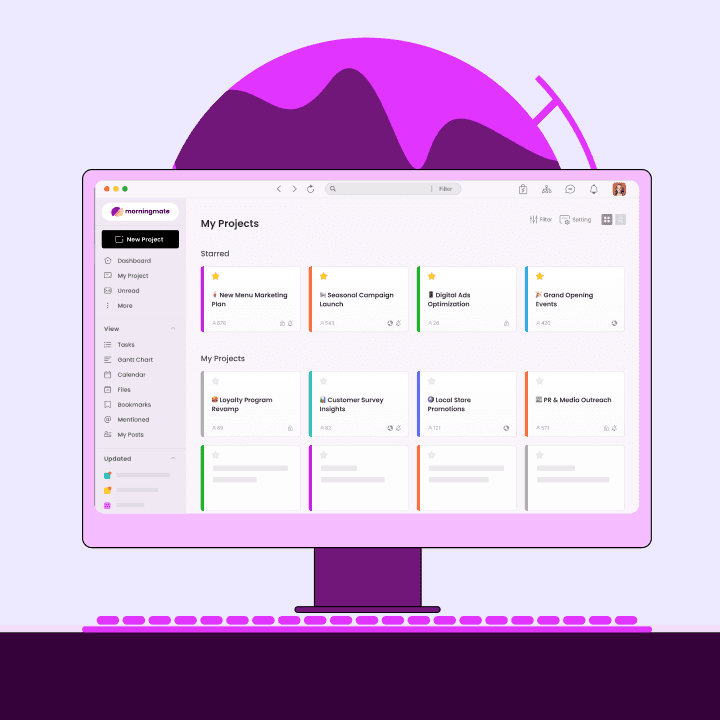
Morningmate — a lightweight work management platform used by over 550,000 teams — structures task management so that comments, files, and status updates all live inside the task itself. When a task changes hands, the next owner opens it and the full history is already there. No archaeological dig through chat history required.
Component 3: Standardised Task Workflows for Recurring Processes
Ad hoc task tracking works fine for one-off work. It fails for recurring operations because every repetition re-invents the wheel. Your onboarding process should not look different for every new hire based on who happens to be running it that week.
Standardised task workflows define the steps, sequence, and ownership for recurring processes once — then replicate them consistently. This is the difference between a checklist that lives in one person's notebook and a task template that any team member can launch and follow.
For an operations team, standardised workflows are the foundation of scale. When you hire a new coordinator, they should not need three weeks of shadowing to understand how a supplier onboarding works. They should be able to open the standard task flow, see each step, and execute with minimal hand-holding. That is what standardised task management actually buys you — operational independence at the team level.
Component 4: Shared Visibility Across Teams and Functions
Person-dependency often persists not because people hoard information, but because the task management system does not make cross-team visibility easy. Each team manages its own tasks in its own space, and the connective tissue between them — who is waiting on whom, what is blocked, what just completed — stays invisible.
Shared visibility means that when the warehouse team completes a goods-received task, the finance team can see it without needing to chase a confirmation email. When a client onboarding task is marked complete, the account manager knows to move to the next phase without a meeting to confirm it.
This is where task coordination pays real operational dividends. It reduces the informal coordination load that tends to fall on your most connected team members — precisely because the system surfaces the status instead of making someone surface it manually.
Applying It: A Standardised Client Onboarding Flow in Morningmate
Here is how this model works in practice. Picture a professional services firm with twelve staff. Client onboarding has historically been run by one senior account manager who knows the steps from memory. When she is on leave, onboarding stalls. When a new hire joins, they shadow her for a week and still feel uncertain.
Using Morningmate, the operations manager builds a standardised onboarding task flow as a reusable project template. Each new client triggers a new instance of that project, pre-populated with every step:
Send welcome pack (assigned to: account coordinator, due: Day 1)
Schedule kickoff call (assigned to: account manager, due: Day 2)
Complete data collection form (assigned to: client, tracked via task, due: Day 5)
Set up client workspace (assigned to: ops coordinator, due: Day 6)
Internal handoff to delivery team (assigned to: account manager, due: Day 7 — triggers next phase)
Every task in the flow carries the relevant brief, links to the relevant document templates, and has a defined owner. When the account manager marks the internal handoff complete, the delivery team's tasks activate automatically. No one has to chase, confirm, or re-explain.
If Morningmate's task-creation agent is enabled, the ops manager can even convert a client intake email directly into the first task in that flow — turning an incoming message into tracked, assigned work without manual re-entry. The context from the original message is logged in the task automatically, so the account coordinator has everything they need before they even open their laptop in the morning.
When the senior account manager takes leave, onboarding continues exactly as designed. The new hire follows the same flow. The ops manager can check status at a glance. No one person is holding it together.
Implementation Checklist: Moving Task Management Into the System
Use this checklist to audit your current task management setup and identify where person-dependency is hiding.
Action | What to check | Target state |
|---|---|---|
Audit recurring tasks | Which recurring tasks have no formal home in the task system? | Every recurring task is logged, owned, and scheduled in the system |
Map assumed owners | Who picks things up by default? What tasks depend on their availability? | Ownership is explicit and rotatable, not personality-dependent |
Build workflow templates | Which processes are run from memory? Onboarding, handoffs, supplier comms? | Each recurring process has a reusable task template any team member can launch |
Embed context in tasks | Can a new person complete this task without asking anyone? If not, what is missing? | Tasks contain the brief, files, decisions, and notes needed to execute independently |
Enable cross-team visibility | Can teams see the status of tasks that affect their work without chasing? | Shared task boards surface dependencies and completions automatically |
Test absence resilience | If your most reliable person is out for two weeks, what breaks? | Nothing critical breaks — task management carries the context the person used to carry |
The goal of strong task management is not to make your best people redundant — it is to free them from being the system itself. When task tracking is built into your workflows rather than into one person's habits, your whole team becomes more capable, your onboarding gets faster, and your operations hold up under pressure. That is the kind of infrastructure worth building before you need it.
If your team is ready to move task management off people and into a system, explore how structured task workflows scale with your team — and take a look at how Morningmate makes that structure simple enough for every team member to actually use it.