Project Management

Effective task management is not just about assigning work — it is the structural backbone that determines whether your team operates as a coherent unit or a collection of individuals improvising their way through each quarter. If your organization has cycled through two or more work tools in the past three years, the instinct is usually to blame the software. The tool was too complex. The interface was clunky. Nobody adopted it. But here is the harder truth that most operations leaders eventually confront: the tool was rarely the problem. The problem was the absence of a standardized process that any tool could support.
According to Gartner's 2025 research on workforce productivity, organizations that lack documented operational workflows lose an average of 20 to 30 percent of their efficiency to duplicated effort, miscommunication, and rework. That is not a tool failure. That is a systems failure. And no amount of switching platforms will fix a system that was never designed in the first place.
This article introduces a practical framework for diagnosing why your team keeps abandoning tools — and how structured task management, applied consistently, breaks that cycle for good. Every component maps directly to the operational challenges an SMB ops manager faces daily: inconsistent workflows, knowledge silos, and the exhausting ritual of chasing status updates across five different channels.
The Compounding Cost of Inconsistent Task Management
Before diagnosing the root cause, it helps to quantify what inconsistency actually costs. Most ops managers feel the pain intuitively — but the numbers make the case undeniable when you need to justify process investment to leadership.
McKinsey research found that employees spend roughly 20 percent of their working week searching for internal information or tracking down colleagues to get it. In a 10-person operations team, that is two full-time equivalents doing nothing but compensating for a broken system. When task tracking lives across email threads, chat messages, shared spreadsheets, and verbal updates, there is no single version of truth — and every handoff becomes a gamble.
The tool-switching cycle accelerates this problem. Each migration resets institutional memory. Standard operating procedures get lost. Onboarding new hires takes longer because nobody can point to a canonical process. Cross-team coordination degrades because different departments end up on different systems — or different interpretations of the same system.
Operational Area | Without Standardized Task Management | With Standardized Task Management |
|---|---|---|
Status visibility | Manager manually chases via chat/email | Real-time view, no chasing required |
Onboarding new hires | Verbal handoffs, tribal knowledge | Documented workflows, self-serve clarity |
Cross-team handoffs | Dropped context, repeated clarifications | Structured handoff with full context attached |
Knowledge retention | Stored in individual inboxes or memory | Centralized, searchable, team-owned |
Tool adoption rate | Low — no process to anchor the tool to | High — tool enforces and supports the process |
Introducing the ANCHOR Framework for Sustainable Task Management
The reason tool-switching recurs is that teams keep solving a process problem with a procurement decision. The ANCHOR Framework reorients that thinking. It stands for: Assign, Normalize, Centralize, Handoff, Own, Review. Each component addresses a specific failure mode in how growing SMBs handle task tracking and operational coordination. Apply all six and you create a system that any reasonable tool can support — rather than a tool hunting for a system that does not exist.
A — Assign: Make Task Management Ownership Unambiguous
The single most common source of dropped work in SMB operations is a task that belongs to "the team." When task tracking starts with a clear, named owner — not a group, not a department — accountability becomes structural rather than cultural. This is not about micromanagement. It is about eliminating the ambiguity that forces managers to chase status.
In practice: every task your operations team creates should carry a single assigned owner, a due date, and a defined output. If a recurring process like vendor invoice approval currently lives in email with no named owner per cycle, that is where you start. Document the owner rotation, create a task template, and make it repeatable. Task management only works when ownership is legible at a glance.
N — Normalize: Standardize Task Workflows Across the Team
Normalization means every team member creates, updates, and closes tasks the same way. Not approximately the same way — exactly the same way. This is where most SMBs fail. Individual contributors develop personal systems that work for them but are invisible to everyone else. The result is a patchwork of task workflows that no tool can unify because the process itself is inconsistent.
Build a task workflow standard: what fields are required at creation, what statuses exist and what they mean, when a task moves from "in progress" to "needs review," and who closes it. Write this down as a one-page SOP. When a new hire joins, this document is their task management orientation — not a two-hour Zoom call with whoever has time that week.
C — Centralize: One Place for All Task Tracking
Knowledge silos are not a personality problem — they are an architecture problem. When task coordination is split across email, a chat app, a spreadsheet tracker, and verbal standups, there is no system of record. Information decays. Decisions made in one channel are invisible to people working in another.
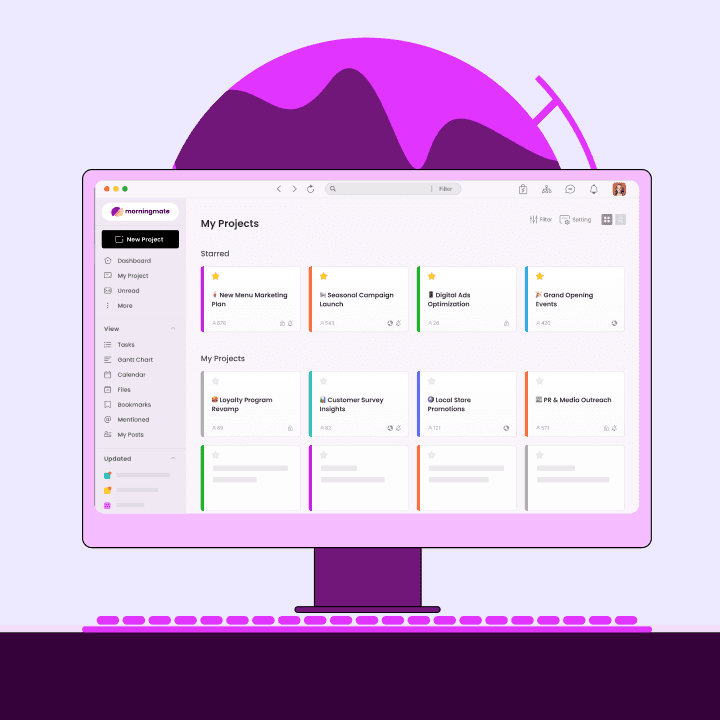
Centralization means choosing one environment where all task management lives — and holding the line. This does not require an enterprise platform. Morningmate, for example, is a lightweight work management tool used by over 550,000 teams that consolidates task tracking and team communication in a single workspace. Its Feed view organizes work updates in a format teams already recognize, which dramatically reduces the friction that kills adoption of more complex tools. When everything is in one place, status is visible without asking.
Where Task Information Currently Lives in SMB Teams (2026 Survey)
61%
Email & Chat
47%
Spreadsheets
29%
Dedicated Tool
Fig 1: Most SMB teams still scatter task tracking across multiple unconnected channels (illustrative, based on 2026 industry benchmarks)
H — Handoff: Build Structured Cross-Team Task Coordination
In growing SMBs, the most expensive failure point is the handoff between teams. Sales passes a won deal to operations. Operations passes a deliverable to finance. Each transition is a moment where context drops, assumptions diverge, and tasks stall. A structured handoff is not a meeting — it is a task record that travels with the work.
Define what information must accompany every cross-team task: background context, the specific output expected, the deadline, and who the receiving owner is. When this is embedded in your task workflow standard rather than left to individual judgment, handoffs become reliable. The receiving team has everything they need without scheduling a clarification call.
O — Own: Build a Culture of Task Accountability
Ownership goes deeper than assignment. It means the person responsible for a task updates its status proactively, flags blockers early, and closes the loop without being prompted. This is a behavior that must be designed into your task management system — not assumed.
Gallup research consistently shows that employees who have clear expectations and a visible path to completion are significantly more engaged and productive. When your task tracking system makes ownership visible — who has what, what is overdue, what is blocked — accountability shifts from managerial policing to team self-regulation. The ops manager stops being a status-chaser and starts being a blocker-remover.
R — Review: Close the Loop on Task Management Systematically
Most teams are decent at starting tasks and weak at closing them cleanly. A task marked "done" that still has open questions, unarchived files, or no documented outcome is a knowledge silo in the making. The Review component builds a lightweight closure protocol into your task management workflow.
For recurring processes — weekly reporting, vendor renewals, compliance checks — a post-task review captures what changed, what the output was, and any notes for the next cycle. Over time, this becomes institutional memory that survives staff turnover. Onboarding a new ops coordinator no longer requires a two-week shadow period; it requires reading the task history.
Applying the ANCHOR Framework with Morningmate: A Worked Example
Here is how the ANCHOR framework plays out for a real operations scenario: monthly vendor invoice approval, a process that typically spans three teams (finance, procurement, and operations) and currently lives in email chains.
Assign: In Morningmate, create a recurring task titled "Monthly Invoice Approval — [Vendor Name]" with a single named owner in the procurement team and a fixed due date three days before payment deadline.
Normalize: Every invoice task uses the same template: invoice number, amount, approval status (pending / approved / queried), and a file attachment field. No variation, no interpretation required.
Centralize: All communication about this invoice happens within the Morningmate task itself — not in a side email thread or a WhatsApp message. Morningmate's built-in chat sits alongside the task, so the conversation and the work record stay connected.
Handoff: When procurement approves, they update the task status to "Approved" and tag the finance owner. The task record carries the full audit trail — no forwarded emails, no lost context.
Own: Finance updates payment status within the task. The ops manager sees progress in the Feed view without sending a single status-request message.
Review: When the task closes, a brief note captures any exceptions — late invoice, disputed amount, changed vendor terms. Next month's cycle starts with that context already attached.
The result: a three-team process that previously required eight to twelve email exchanges per vendor per month now runs as a structured, self-documenting task workflow. The ops manager's role shifts from coordinator to quality reviewer.
Before and After: Manual vs. Standardized Task Management
The operational difference between ad-hoc and standardized task coordination becomes clear when you put it side by side. This comparison reflects what teams typically experience within 60 to 90 days of applying a consistent task management framework.
Scenario | Ad-Hoc Task Management | ANCHOR-Standardized Workflow |
|---|---|---|
New hire onboarding | 10–14 days to reach independent productivity | 3–5 days with documented task workflows |
Weekly status reporting | Manager sends reminders, compiles manually | Auto-visible from task dashboard, no chasing |
Cross-team project handoff | Context lost, clarification calls needed | Full context in task record, zero-call handoff |
Tool adoption after 90 days | Team reverts to email/chat; tool abandoned | Tool embedded in workflow; adoption self-sustaining |
Time spent on status updates | 4–6 hours per manager per week | Under 30 minutes per week |
Manager Hours Reclaimed Weekly After Standardizing Task Management
0.5 hrs
After ANCHOR
5 hrs
Mixed Tools
9 hrs
No System
Fig 2: Estimated weekly manager hours spent on status-chasing by operational maturity level (illustrative)
Implementation Checklist: Start Standardizing Task Management This Week
The ANCHOR framework is only useful if it translates to action. Use this checklist to begin your task management standardization without a multi-month rollout project. Most teams can complete the first three steps within a single sprint.
Audit your current task landscape. List every place work is currently tracked — email, chat, spreadsheets, sticky notes. This is your baseline problem map.
Write a one-page task workflow SOP. Define required fields at task creation, status labels and their meanings, and the closure protocol. Keep it under 400 words.
Choose one tool and commit for 90 days. The tool matters less than the commitment. If you want something lightweight that teams actually adopt, Morningmate gives you task management and built-in team communication without the complexity of enterprise platforms.
Migrate your three highest-friction processes first. Pick the workflows that currently generate the most status-chasing and build ANCHOR-compliant task templates for each.
Define handoff standards for cross-team tasks. Document what information must travel with every task that crosses a team boundary. Enforce this at the SOP level, not individually.
Run a 30-day task audit. After one month, review which tasks were completed on time, which were reopened, and where status updates were still requested manually. Use this data to refine your workflow standard.
Measure time reclaimed, not just task volume. Track how many status-request messages your managers send before and after standardization. This is your clearest signal that task management is working at a systems level.
The teams that stop switching tools are not the ones who finally found the perfect platform. They are the ones who built a process rigorous enough that any reasonable tool could support it — and consistent enough that everyone actually uses it. Structured task management is not a feature you buy. It is a system you build. Start with one workflow, apply the ANCHOR framework, and the tool question becomes the easiest decision you make this year.