Project Management

Good task management is what separates a campaign that ships on time from one that quietly dies in a shared Google Sheet nobody opens anymore. You know the type: the blog refresh, the case study series, the partner co-marketing deck. All valuable, none urgent — until suddenly they are, and you're scrambling to figure out where the last approved draft even lives. If you run marketing for a small business with a lean team, a hands-on founder, and a rotating cast of freelancers, this is your everyday reality.
Low-priority projects are a silent momentum killer. They never make it to the top of the weekly standup, approvals slip by weeks, and task tracking becomes a personal guilt spiral rather than a team system. According to Asana's Anatomy of Work report, knowledge workers spend nearly 60% of their time on work coordination rather than skilled work — and low-priority projects are the biggest victims of that coordination tax.
The fix isn't a bigger team or a stricter calendar. It's a lightweight task management system designed specifically to keep background projects moving without eating your entire week. Here's how to build one — and actually use it.
The Bottleneck: Why Low-Priority Task Management Always Breaks Down
Let's be honest about what "low priority" really means inside a small marketing team. It doesn't mean unimportant. It means "no one is chasing us yet." And that's exactly where task coordination collapses.
The Three-Way Context Collapse
Here's the scenario: It's campaign launch week for your main product push. The founder is in your inbox with last-minute copy feedback. Your social freelancer is waiting on an image brief. And somewhere in a chat thread from three weeks ago is the half-approved blog outline for that "low-priority" thought leadership series you promised a partner by end of month.
By the time you surface that thread, the context is gone. You can't remember what was approved, who gave feedback, or what version of the outline the freelancer was working from. This is context collapse — and it's the number one reason background projects stall. The task tracking system (if you even have one) doesn't connect to where the conversation happened or where the files live.
The Approval Vacuum
Founders are busy. When a project isn't urgent, approvals get postponed indefinitely. You send a draft, you get a "will look at this later," and later never comes until the deadline panic hits. Without a clear task workflow that surfaces review requests automatically, low-priority work just waits in someone's mental queue — invisible and stalled.
Pain Point | What It Looks Like | Impact on Task Management |
|---|---|---|
Context collapse | Feedback buried in chat threads | Work restarts from scratch |
Approval vacuum | Founder review sits for weeks | Deadlines missed silently |
Ownership gaps | No clear task assignee | Everyone assumes someone else is on it |
Tool sprawl | Tasks in sheets, chat, email, docs | No single task tracking source |
The Scale of the Problem: How Much Work Actually Gets Lost
This isn't just an anecdote problem. Research consistently shows that small teams lose a disproportionate share of their output to poor task coordination. Harvard Business Review found that unstructured collaboration — the kind that happens when teams rely on chat and email for task tracking — increases the risk of project abandonment by nearly 40%. For background projects with no hard deadline pressure, that number is even worse.
% of Low-Priority Projects Abandoned Before Completion by Team Size
62%
Solo / 1–3 person teams
55%
4–10 person teams (no system)
29%
4–10 person teams (with task system)
Fig 1: Illustrative data based on team size and task workflow structure — smaller teams with no task tracking system lose over half their low-priority work
A Repeatable Play: The Background Project Task Management System
You don't need a complex project management suite. You need a repeatable task workflow that keeps background work moving in the margins of your real week. Here's the play — seven steps, no PM certification required.
Name it and claim it. Every background project gets a dedicated space — not a folder, not a chat thread, a proper named project with a single owner. No owner, no momentum.
Break it into two-hour task chunks. A task called "finish the blog series" is not a task. A task called "write 300-word intro for case study #2 — due Friday" is. Task tracking only works when tasks are small enough to actually complete in one sitting.
Set a soft deadline, then a hard one. Background projects need two dates: the internal soft deadline (one week before the real one) and the actual drop-dead date. This creates buffer for the approval vacuum.
Assign every task — including approvals. The founder's review is a task. The freelancer's design handoff is a task. If it's not assigned to a person with a due date, it will not happen.
Add a weekly 15-minute "background project pulse." Block 15 minutes every Monday to scan all active background project tasks. Not to work on them — just to confirm they're moving, nudge anyone stuck, and flag anything at risk.
Keep the brief and the feedback in the same place as the task. This is the single biggest task management upgrade you can make. When the brief lives next to the task and the feedback lives in comments on that task, context collapse disappears.
Celebrate small completions publicly. When a background task ships, call it out in your team channel. It sounds minor, but Gallup research on workplace recognition shows that even brief acknowledgment of progress dramatically improves follow-through on future work.
Common Task Management Failure Points — and How to Dodge Them
Even with a solid task workflow in place, small marketing teams hit predictable traps. Here are the ones to watch for.
Failure Point 1: "We'll Track It in the Sheet"
Spreadsheets have no notifications, no context, and no accountability. The moment a task goes into a shared Google Sheet it becomes invisible. Move task tracking out of sheets and into a tool where tasks have owners, due dates, and attached context.
Failure Point 2: Overloading the Founder's Queue
Founders approve everything — or nothing. If every task in your background projects requires founder sign-off, you've built a single-point-of-failure into your task coordination. Decide upfront: which decisions genuinely need the founder, and which can ship with your approval alone? Document this per project, not per task.
Failure Point 3: The Freelancer Black Hole
Freelancers are your biggest task tracking risk. They work across multiple clients, they're not in your daily rhythm, and they rely entirely on what you send them. If briefing, feedback, and file handoff all happen in different places, expect delays. Bring freelancers into the same task management space your team uses — even on a limited view — so they always know exactly what's needed and where files live.
Failure Point 4: Treating "Low Priority" as "No Deadline"
Low-priority does not mean no timeline. Every background project needs a committed end date on the calendar, visible to everyone. Without it, task workflow becomes aspirational rather than operational.
How Morningmate Keeps Task Management Connected Across Chat, Files, and Approvals
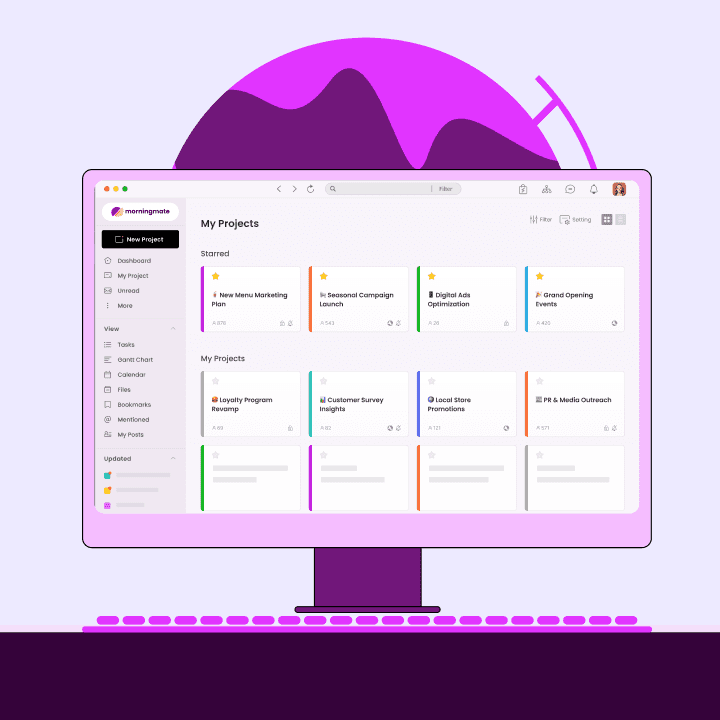
Most small marketing teams don't fail at planning — they fail at keeping everything connected once work starts. That's the specific gap that lightweight work management tools like Morningmate are designed to close.
Morningmate is a work management platform used by over 550,000 teams that combines task management, built-in chat, and file sharing in a single space — without the complexity of tools like Jira or Asana that small teams rarely have time to configure. Its feed-style interface feels familiar from day one, which means your freelancers and founders actually use it instead of defaulting back to WhatsApp.
A Worked Example: The Partner Co-Marketing Deck
Here's how this plays out in practice. You're running a background project: a co-marketing slide deck with a SaaS partner, due in three weeks, no one is chasing you yet.
In Morningmate, you create a dedicated project post for the deck in your team's feed. You break it into four tasks: brief draft (you, Day 1), design brief to freelancer (you, Day 3), partner review (partner contact, Day 10), and founder approval (Day 14). Each task has an assignee, a due date, and the brief attached directly to the task — not in a separate Drive folder no one can find.
When the freelancer finishes the first design pass, they comment directly on the task with the file attached. You get a notification. You leave feedback in the same thread. No email, no separate chat message, no "hey can you resend that file?" The founder gets a task assigned to them on Day 14 with a direct link to the final deck and a one-line context note: "Ready for your approval — needs green light before partner sends to their list." The task management loop is closed. Nothing falls through.
That's the core value of keeping task tracking, chat, and file management in one place: you eliminate the translation layer between where work happens and where it gets approved. For small marketing teams managing multiple workstreams, that's not a nice-to-have — it's how background projects actually ship.
Task Management Step | Scattered Tools (Chat + Email + Sheet) | Morningmate (Unified Task Workflow) |
|---|---|---|
Briefing a freelancer | Email + separate Drive link | Task with brief attached, one place |
Tracking approval status | Manual chasing via WhatsApp | Task assigned to approver, auto-notified |
Finding last feedback | Scroll chat history / search inbox | Comments on the task, always visible |
Weekly status check | Compile from multiple tools manually | One feed view, all task statuses live |
Onboarding a new freelancer | Re-explain context every time | Task history and files already there |
The Impact: Task Tracking That Actually Ships Work
Teams that implement a structured task management approach for background projects — even a simple one — see measurable improvement in on-time completion rates. The difference isn't effort. It's system design.
On-Time Completion Rate for Low-Priority Projects Before vs. After Task System Adoption
31%
No system (baseline)
58%
Basic task list only
83%
Unified task + chat + files
Fig 2: Illustrative improvement in low-priority project completion rates based on task management system type
Your Task Management Checklist: Apply This Week
Task management for background projects doesn't require a system overhaul. Start with these actions this week and you'll notice the difference within a fortnight.
☐ List every active "background" project your team is technically responsible for right now
☐ Assign a single owner to each one — not a team, one person
☐ Break each project into tasks that can be done in two hours or less
☐ Add a soft internal deadline (one week before real deadline) and a hard deadline to every project
☐ Assign every approval as a named task with a due date — including the founder's review
☐ Move all task tracking out of spreadsheets and into one tool where tasks have owners, dates, and attached context
☐ Brief your freelancers with files attached directly to their tasks — not sent separately via email
☐ Block 15 minutes every Monday for your background project pulse check
☐ When a background project ships, call it out publicly in your team space
☐ Review your task workflow monthly — kill projects that are truly dead, don't let them zombie on
Low-priority doesn't have to mean low-momentum. With the right task management habits — clear ownership, small tasks, connected context, and lightweight tooling — your background projects can ship consistently without stealing focus from your urgent work. The teams that pull this off aren't bigger or better resourced. They just stopped letting task coordination happen by accident.