Project Management

Task management is not just about knowing what needs to get done — it is about knowing who is doing it. And in small businesses, that line blurs constantly. A client deliverable slips through. A vendor invoice goes unfollowed. A team member assumes someone else picked up the ball. Then comes the phrase you have probably heard more times than you can count: "I thought you had that." It sounds minor. It is not. Every time those five words get spoken, something already went wrong — a deadline was missed, a client was let down, or money was left on the table.
For a business with 10 or 20 people, there is no safety net. You cannot afford redundant headcount to catch dropped tasks. Your task management system — or lack of one — is either saving you or slowly bleeding you. Most small business owners do not realize the latter is happening until the damage is already done.
This article is about the specific, fixable problem behind that phrase. Not vague communication issues. Not "alignment." The real, operational root cause of ownership gaps — and a practical way to close them without adding tools, complexity, or cost.
The Real Cost of Ownership Gaps in Task Management
When no one clearly owns a task, it does not just stall — it creates a ripple. A client does not get a response on time. A proposal goes out without a key section. A supplier relationship sours because a follow-up never happened. Each incident feels isolated, but they share a common cause: your task coordination has a hole in it.
Research from Harvard Business Review found that knowledge workers lose significant productive time to what researchers call "coordination overhead" — the time spent figuring out who is doing what, chasing updates, and recovering from miscommunication. For lean teams, that overhead is proportionally devastating because there is no slack in the system.
What Ownership Gaps Actually Cost You
The costs are rarely visible on a spreadsheet, but they are very real. Here is what ownership gaps in task tracking look like on a practical level:
Client churn: A single missed follow-up can be enough for a client to take their business elsewhere — especially in competitive markets.
Rework costs: When a task gets done by the wrong person, or done twice, you pay double in labor.
Owner time drain: You end up being the person who catches everything that falls through — which means your strategic time evaporates into firefighting.
Team morale: Repeated dropped balls breed blame culture. Good people leave environments where they feel set up to fail.
Gallup's 2026 workplace data consistently shows that unclear expectations are among the top drivers of employee disengagement. Unclear task ownership is unclear expectations — every single day.
Ownership Gap Scenario | Immediate Impact | Hidden Long-Term Cost |
|---|---|---|
Client follow-up not assigned | Delayed response | Lost contract or damaged trust |
Vendor invoice follow-up missed | Late payment or dispute | Supplier relationship breakdown |
Internal task assumed "handled" | Work done twice or not at all | Wasted labor hours, team friction |
Project milestone unowned | Missed deadline | Penalty clause or reputation hit |
Why "I Thought You Had That" Keeps Happening: The Root Cause
This is not a people problem. It is a systems problem. Most small businesses run their task workflow through a combination of chat messages, email threads, verbal conversations in meetings, and mental notes. None of these create a visible, shared record of who owns what.
Here is what typically happens: A task gets mentioned in a Slack message or a WhatsApp group. Everyone sees it. Nobody explicitly picks it up. The person who mentioned it assumes it was received as an assignment. The person who read it assumes someone else will handle it. Both move on. The task evaporates.
This is what researchers call "diffusion of responsibility" — when a task is visible to multiple people with no single named owner, each person assumes another will act. It is not laziness. It is a predictable human response to ambiguous task management systems. McKinsey research on organizational effectiveness points to ambiguous accountability as one of the most consistent causes of execution failure in small and mid-sized teams.
How Teams First Hear About a Task (% of small business teams)
61%
Chat / Messenger
24%
Email Thread
10%
Verbal in Meeting
5%
Task System
Fig 1: Most task coordination still happens in channels with no ownership record (illustrative, based on SMB workflow patterns)
The number that should alarm you: most small teams are routing the majority of their task workflow through channels that have no built-in concept of ownership, deadline, or completion status. That is the system failure producing the phrase "I thought you had that."
A Practical Task Management Fix for Lean Teams
You do not need to overhaul everything. You need to close the specific gap that creates ownership ambiguity. Here is a simple, sequential approach any team of 5 to 50 people can implement this week.
Step 1: Establish One Place Where Tasks Live
Pick a single tool where every task — from every source — gets recorded with a named owner, a due date, and a status. Right now, tasks are born in three different places and tracked in none of them. That stops here. If a task is not in the system, it does not exist as a commitment.
Step 2: Make "Name an Owner" Non-Negotiable
Every task that enters the system must have exactly one person's name on it. Not a team. Not "marketing." One human being who is accountable for completion. This single rule eliminates the diffusion of responsibility problem. If you cannot name an owner when creating the task, that is a conversation to have immediately — not a task to file away.
Step 3: Convert Conversations Into Tasks in Real Time
Your biggest task management leak is the gap between "this was discussed" and "this was assigned." When something comes up in a meeting, a chat message, or an email — it becomes a task immediately, with an owner and a due date attached. Whoever runs the meeting or initiates the chat is responsible for making that conversion happen before the conversation ends.
Step 4: Run a Weekly 15-Minute Task Review
Once a week, the whole team (or team leads) looks at the task board together. What is overdue? What is blocked? What just got completed? This is not a status meeting — it is a task workflow hygiene check. It takes 15 minutes and prevents the week from ending with surprises.
Step 5: Close the Loop Visibly
When a task is done, mark it complete in the system — not in a chat message, not verbally. The completion record matters because it builds a shared history of what got done, who did it, and when. This removes ambiguity from future task coordination and builds accountability over time.
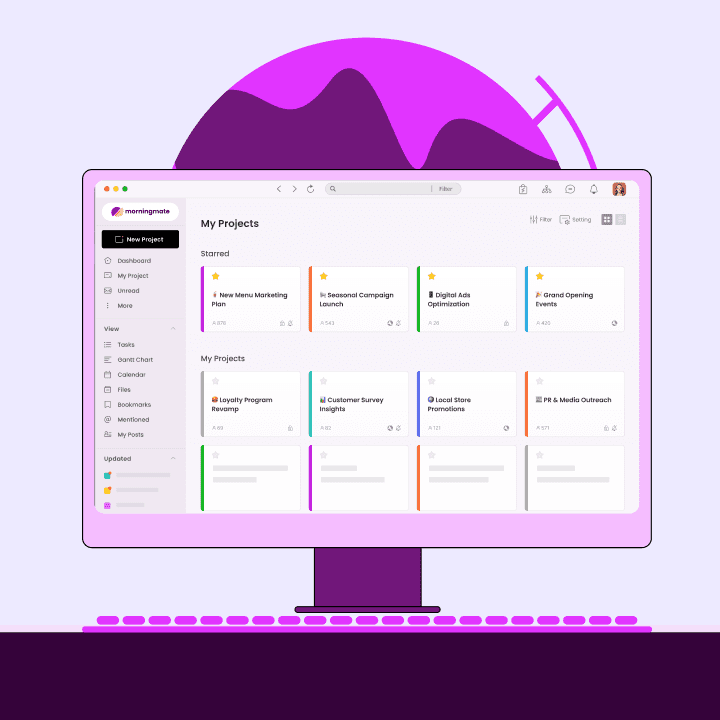
This is where a tool like Morningmate earns its place in a lean team. Morningmate is a lightweight work management platform used by over 550,000 teams that combines task tracking and built-in chat in one place. The interface is intentionally familiar — it works like the social media feed and chat apps your team already uses — so there is virtually no learning curve. You assign a task, set a due date, and the owner gets notified. Everyone can see the board. Nothing disappears into a chat thread.
Choosing the Right Task Management Setup: A Practical Comparison
Not every tool is right for a 15-person team. Heavy project management platforms like Jira or Asana come with a configuration overhead that makes them feel like a part-time job to maintain. On the other end, running task workflow through WhatsApp or email threads means ownership gaps are baked into the system. Here is how the options stack up for a lean team:
Capability | Chat-Only (WhatsApp / Slack) | Heavy PM Tool (Asana / Jira) | Morningmate |
|---|---|---|---|
Named task ownership | No | Yes | Yes |
Due dates and status tracking | No | Yes | Yes |
Built-in chat alongside tasks | Chat only, no tasks | Requires integration | Native, in one workspace |
Setup time for non-tech teams | Immediate | Days to weeks | Under an hour |
Cost for a 15-person team | Low (but hidden cost in errors) | High | Affordable, free to start |
Morningmate's Feed view — which looks and feels like a familiar social media timeline — means your team does not need training sessions or a manual to get started. Tasks, file sharing, and team chat live in the same workspace. When a task gets created in Morningmate, it has an owner, a deadline, and a visible status from the moment it is born. The "I thought you had that" moment simply cannot happen the same way — because ownership is recorded, not assumed.
What Changes When Task Management Actually Works
The shift is not subtle. When task coordination has real structure, three things happen fast. First, your team stops duplicating work and stops dropping it. Second, you stop being the backstop for every dropped ball — which gives you your time back. Third, accountability becomes part of the culture rather than something you have to enforce manually.
Teams that move from chat-based task coordination to a dedicated task workflow system report significant gains in on-time delivery and a reduction in manager time spent chasing updates. The chart below illustrates the pattern across small business teams that made the switch.
Tasks Completed On Time: Before vs. After Structured Task Management
42%
Chat-based only (Before)
58%
Basic task list (3 months)
79%
Structured task workflow (6 months)
Fig 2: On-time task completion rate improves sharply when ownership and deadlines are systematically recorded (illustrative, based on SMB adoption patterns)
Your Next Step: One Task Management Change That Pays Back Fast
Task management is not a nice-to-have for a growing small business — it is the difference between a team that executes and one that spends half its energy recovering from dropped balls. The fix is not complicated, and it does not require a big investment or a new hire.
Here is the one action to take this week: pick one recurring area where ownership gaps happen most — client follow-ups, internal projects, vendor management — and move every task in that area into a single shared system with named owners and due dates. Just that one area. Track it for two weeks. The results will speak for themselves, and you will have the proof you need to expand the habit across the team.
If you want a tool that your whole team will actually use — without a six-week rollout or an IT project — Morningmate is free to start. Its task workflow features, built-in chat, and social-feed-style interface make it one of the fastest tools to get a non-tech team up and running with real task management discipline. The next time something almost slips through, you will have a system to catch it — not a phrase to say afterward.