Project Management

Effective task management does not break down at the finish line — it breaks down at the handoff. The moment a deliverable moves from one person, team, or stage to the next without a defined protocol is the moment your project starts quietly slipping. For operations managers in growing SMBs, this is not a rare edge case. It is a daily reality that compounds into missed deadlines, duplicated effort, and a constant need to chase status updates that should have been automatic.
Research from the Project Management Institute found that organizations waste an average of 11.4% of all investment due to poor project performance — much of it attributable to unclear ownership and process gaps between teams. In a 50-person SMB running a dozen concurrent workstreams, that is a significant operational tax you are paying every single quarter.
The solution is not a heavier tool or a longer checklist. It is a repeatable task management structure that your team actually follows — one built specifically around the handoff moments where work most often falls apart. This article gives you a named framework to build that structure, with concrete examples and a worked implementation you can adapt immediately.
The Compounding Cost of Inconsistent Task Handoffs
Inconsistency in task coordination does not announce itself. It accumulates. One unclear handoff produces a one-day delay. That delay creates a downstream dependency failure. That failure requires a replan meeting, which pulls three people out of productive work, which pushes another deliverable. Harvard Business Review has documented how process fragmentation in mid-size organizations consistently inflates project delivery times by 20–30% — not through any single failure, but through the accumulation of small, preventable friction points.
For ops managers, the practical symptoms are familiar: you spend more time reconstructing what happened than planning what comes next. New hires take longer to become productive because the process lives in someone's head. Cross-team work stalls because each team has its own informal task tracking approach. The cost is not just time — it erodes the kind of operational predictability that lets a business scale.
Handoff Scenario | Without a Defined Process | With a Standardized Task Workflow |
|---|---|---|
New client onboarding | Sales to ops handoff missed; client waits 3 days | Task auto-assigned on deal close; ops notified same hour |
Cross-team deliverable | Ownership unclear; both teams assume the other is handling it | Single owner named; due date and brief attached at creation |
New hire ramp-up | Manager manually walks through every step; takes 2+ weeks | Onboarding task board pre-built; hire self-serves from day one |
Status update requests | Manager sends 5–8 messages per project per week | Status visible in task board; zero chase messages needed |
Introducing the CORD Task Management Framework
Every reliable task handoff process has four properties in common. They can be structured into a repeatable model called the CORD Framework — an acronym built around the four non-negotiable elements of a clean task workflow: Capture, Own, Reference, and Direct. Each component targets a specific failure point in how growing teams currently manage work.
CORD is not a project methodology. It is a lightweight operating standard you apply at the task level — particularly at transition points where work moves between people, teams, or stages. It works whether you are onboarding a new client, launching an internal initiative, or coordinating across departments in a 40-person company that just hired its fifth team lead.
C — Capture: Task Management Starts Before the Work Does
Most task coordination failures begin with tasks that were never formally recorded. A decision made in a meeting becomes a verbal commitment. A verbal commitment becomes a vague memory. Three days later, nothing has moved because no one ever wrote it down in a place the whole team can see.
Capture means every action item gets logged as a structured task — not a chat message, not a sticky note — with a title, a description of the expected output, and a due date. This applies to recurring work, one-off requests, and cross-team dependencies alike. The rule is simple: if it is not captured as a task, it does not officially exist in your workflow.
Ops example: Your marketing team finishes a campaign brief and needs the design team to produce five assets. Under CORD, marketing does not ping the design lead on chat. They create a task titled "Campaign Asset Production — Q3 Launch," attach the brief as a file, set the deadline, and tag the design lead as the owner. The request is now traceable, searchable, and deadline-bound from the moment it is created.
O — Own: Single-Point Accountability in Every Task Workflow
Shared ownership is the enemy of task tracking. When two people are responsible for a deliverable, the default human behavior is for each to assume the other is taking the lead. The result is a task that belongs to everyone and gets done by no one.
Own means every task has exactly one named owner — not a team, not a department, one person. That person is accountable for the outcome, not necessarily for doing all the work themselves. They can delegate sub-tasks, but they are the single point of escalation if something stalls.
Ops example: During a product launch, seven departments have connected workstreams. Under CORD, each workstream has one owner. The ops manager is not managing seven separate task lists — they are checking seven named individuals against a shared project board. If legal's deliverable is late, the ops manager knows exactly who to talk to. No detective work required.
Where Task Handoffs Break Down Most Often
61%
Unclear Ownership
47%
Missing Context
39%
No Status Visibility
Fig 1: Primary causes of task coordination failure in SMBs (illustrative, based on industry research)
R — Reference: Building a Self-Serve Task Knowledge Layer
One of the most expensive hidden costs in ops is the time spent answering questions that have already been answered. When processes live in people's heads — or buried in email threads — every new hire, every handoff, every cross-team collaboration starts from zero. McKinsey research estimates that employees spend nearly 20% of their work week searching for information or tracking down colleagues who have it.
Reference means every task carries the context needed to complete it without asking someone for a briefing. This includes files, SOPs, prior decisions, relevant links, and a brief note on why the task exists — not just what needs to be done. When a team member picks up a task mid-project or a new hire joins a running workstream, they should be able to orient themselves from the task record alone.
Ops example: Your customer success team hands off a client account to a new CSM. Under CORD, the transition task includes: account history summary, open action items, last communication log, and the client's stated priorities. The new CSM does not need a two-hour knowledge transfer call. They read the task record and are operational the same day.
D — Direct: Closing the Loop on Task Coordination
A task management system without a clear completion and escalation protocol is just an organized to-do list. Direct is the component that turns static task tracking into an active workflow. It means every task has a defined next action — either a completion state, a handoff trigger, or an escalation path if it is blocked.
Direct also means you build in the signal, not just the expectation. Rather than assuming people will update their task status, you design the workflow so that moving a task forward requires a status update as part of the action. This is how you stop chasing manually — by making visibility a byproduct of doing the work, not an extra administrative step.
Ops example: Your procurement workflow moves from request to approval to vendor contact to invoice. Under CORD, each stage has a defined owner and completion condition. When procurement marks "vendor contacted," the next task automatically surfaces for the finance lead. No one needs to send a follow-up message. The workflow directs itself.
Applying CORD with Morningmate: A Worked Task Management Example
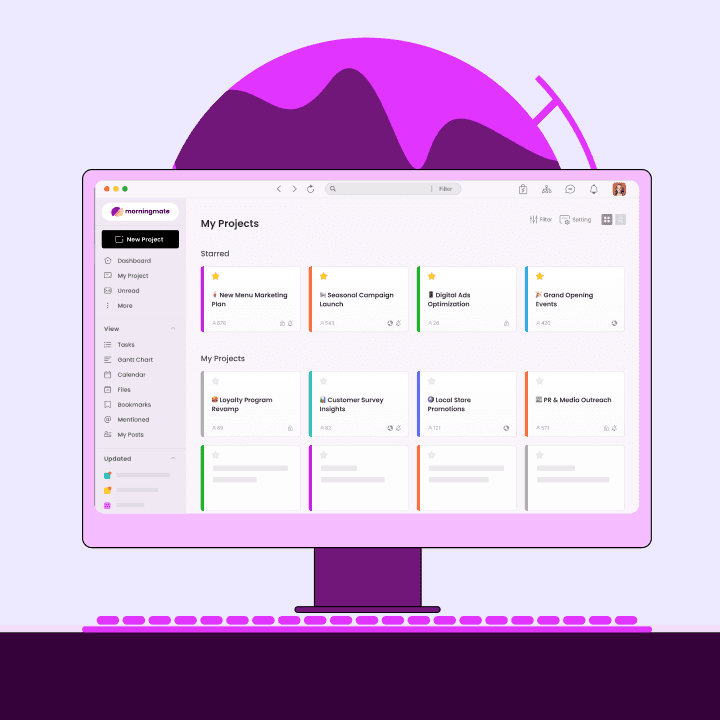
Here is how the CORD framework maps to a real onboarding workflow built inside Morningmate, a lightweight work management platform used by over 550,000 teams globally. Morningmate combines structured task boards with built-in team chat — so the communication and the task coordination live in the same workspace, not in separate apps.
Scenario: A new B2B client signs on. The sales team closes the deal and the account needs to move to the ops and customer success teams within 24 hours.
Capture: Sales creates a Morningmate task titled "Client Onboarding — [Company Name]" in the shared Onboarding project board. They attach the signed contract, the client brief, and the agreed service scope. Due date: 5 business days.
Own: The task is assigned to the ops lead as the single owner. Sub-tasks are created for the CSM, IT setup, and billing — each with their own named owner — but the ops lead holds the parent task accountability.
Reference: The task description includes a direct link to the onboarding SOP stored in Morningmate's file management section, a summary of the client's technical requirements, and a note on any custom terms agreed during the sale. Anyone picking up a sub-task can orient themselves without pinging the sales rep.
Direct: Each sub-task has a defined completion condition. When IT marks their setup task complete, the CSM's task automatically becomes the active item. The ops lead sees progress in the board view without requesting a single update. Morningmate's feed view surfaces the latest activity on the board in a familiar, social-media-style interface — so nothing requires manual checking.
This is what a standardized onboarding workflow actually looks like in practice — not a flowchart in a slide deck, but a live task board that runs itself once you build it the first time.
CORD Component | Manual / Ad-Hoc Approach | Standardized Task Workflow |
|---|---|---|
Capture | Verbal or chat-based; tasks forgotten within hours | Every action item is a structured task with a deadline |
Own | Shared responsibility; accountability diffused | One named owner per task; clear escalation path |
Reference | Context in email or someone's memory; requires chasing | Files, SOPs, and context attached at task level |
Direct | Manager manually follows up for every status change | Status updates are built into workflow completion steps |
Reduction in Status Chase Messages After Standardizing Task Management
8%
Ad-Hoc (No System)
34%
Partial Process
72%
Full CORD System
Fig 2: Estimated reduction in manual follow-up messages when task management is standardized at the handoff level (illustrative)
Your Task Management Implementation Checklist
Standardizing your task handoff process does not require a multi-month rollout. Start with one recurring workflow — client onboarding, vendor requests, or cross-team deliverables — and apply CORD to it this week. Once that workflow runs cleanly for 30 days, extend the model to the next one. According to Gallup's workplace research, teams with clearly defined roles and processes are 2.5 times more likely to consistently meet their targets — and the compounding effect of getting task coordination right early in a company's growth curve is substantial.
Use this checklist to track your progress on implementing reliable task management across your team:
Identify the top three workflows where handoffs currently break down most often
Define the Capture standard: what fields every task must include (title, output description, due date, owner)
Assign single-point ownership to every recurring workflow, not just ad-hoc tasks
Build a Reference layer: attach your SOPs and key documents to the task templates, not in a separate folder no one checks
Define completion conditions for each task stage so status updates are a natural byproduct of progress
Choose one shared platform where all task tracking lives — not email, not chat, not a mix of both
Run a two-week audit: how many status questions did you have to ask manually? That number should drop each cycle
Onboard new hires directly to your task boards rather than walking them through processes verbally
Review the workflow monthly for the first quarter — simplify any step that creates friction
If you are looking for a place to run this system without adding complexity for non-technical team members, Morningmate's task boards, built-in file management, and integrated chat give you everything the CORD framework needs in a single workspace. The task management interface is deliberately simple — it was designed for teams that cannot afford an adoption curve, not just teams with dedicated project managers. You can set up your first standardized task board in under an hour and have a working handoff process running the same day.
Task management done right is not about tracking work after the fact. It is about designing your workflows so that the next person in the chain always knows exactly what they are picking up, why it matters, and what done looks like. That is how you stop projects from slipping before they start.