Project Management

Good task management is supposed to keep campaigns moving — but what happens when the work lives between teams? It's 9 a.m. on launch day. Your product team sent final copy approval through email. Your designer got a different version in a WhatsApp thread. Your founder left feedback as a comment in Google Drive three days ago that nobody saw. And you, the marketing manager, are standing at the center of it all, trying to figure out which version is actually final before the ad goes live in two hours.
This is not a communication failure. It is a task coordination failure — specifically, the kind that happens when no single person owns the handoff space between teams. When cross-functional work touches marketing, design, product, and leadership all at once, task tracking breaks down fast. Everyone assumes someone else is watching the thread. Nobody is.
If you run marketing at a small business with a lean team and rotating freelancers, you already know this pain intimately. This article is a tactical playbook for owning that in-between space before it owns you.
Where Task Management Breaks Down in Cross-Functional Work
Cross-functional campaigns — think product launches, seasonal promotions, event marketing — require input from people who do not share a daily workflow. Product gives you messaging. Legal reviews the claims. Design executes the creative. Founders approve the budget. Each group has its own tools, its own rhythm, and its own definition of "done."
The result? According to Project Management Institute research, poor communication and unclear ownership are among the top reasons projects fail — and cross-functional projects are especially vulnerable because accountability sits in the gap between teams, not inside any one of them.
Here is what that gap looks like in practice for a small marketing team:
Approvals requested by email, acknowledged in chat, and then forgotten entirely
Feedback from the founder scattered across three different channels with no clear resolution
Freelancers starting work on outdated briefs because the updated file never made it to them
Tasks that everyone assumes are "in progress" but no one has actually started
Asana's Anatomy of Work report found that employees switch between apps more than 25 times a day, and that context-switching costs teams nearly a month of productive work per year. For a two- or three-person marketing team running five campaigns at once, that context loss is not just annoying — it is a campaign killer.
The Ownership Vacuum
The core problem is not the number of tools. It is the absence of a shared space that everyone — marketing, product, freelancers, founders — actually checks. When that space does not exist, task workflow collapses into whoever shouts the loudest or follows up the most. That is usually you, the marketing manager, and it is not scalable.
The table below shows how cross-functional task tracking typically looks without a shared workspace versus with one in place.
Scenario | Without shared task space | With shared task space |
|---|---|---|
Founder approval | Email, then Slack DM, then phone call | Single approval task with deadline and status |
Freelancer brief delivery | Email attachment, version confusion | File attached to task, one source of truth |
Design feedback | Scattered across Drive comments and chat | Consolidated in one task thread |
Launch status visibility | Everyone asks "where are we?" separately | Status visible to all stakeholders in real time |
The Scale of the Problem: Why Task Coordination Fails So Often
This is not just a small-team problem. Harvard Business Review reports that 75% of cross-functional teams are dysfunctional, failing on basic metrics like staying on schedule, meeting budget, or delivering on goals. The reasons are consistently the same: unclear ownership, siloed communication, and no single system of record for task tracking.
Top Causes of Cross-Functional Task Breakdown (% of teams affected)
71%
No clear task owner
64%
Approval delays
58%
Scattered context
47%
Version confusion
Fig 1: Common cross-functional task management failure points (illustrative, based on industry research)
A Repeatable Play for Cross-Functional Task Management
Here is a lightweight, six-step workflow that any SMB marketing manager can run without overhauling their entire stack. Think of it as your campaign coordination operating system — simple enough for a founder to follow, structured enough to keep freelancers aligned.
Step 1: Name the campaign space before work starts
Before a single brief is written, create one dedicated project space for the campaign. This is not a group chat. It is the official home for all task tracking, file sharing, and status updates related to that campaign. Every stakeholder — founder, designer, freelancer, product lead — gets access to this space and only this space for campaign work.
Step 2: Assign every task to one human, not a team
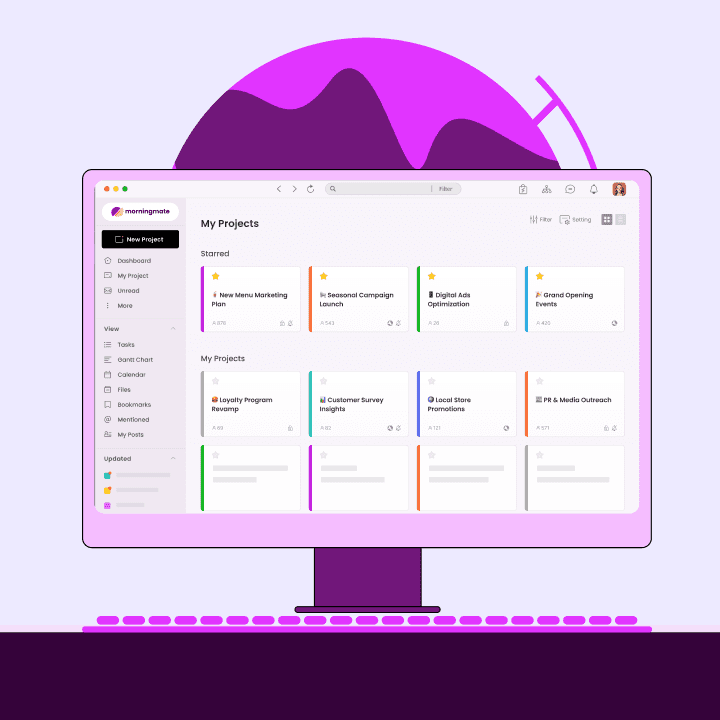
The phrase "marketing team handles it" is where accountability goes to die. Every task in your task workflow needs a single named owner and a due date. If you are using morningmate, the work management platform used by over 550,000 teams, you can create tasks directly inside a project space, assign them to individuals, and attach files in the same action. No separate email required.
Step 3: Build approval tasks, not approval emails
Approvals are where cross-functional task coordination dies most often. Turn every approval into an explicit task with a deadline, assigned to the approver, with the asset attached. When your founder needs to sign off on ad copy, that is not a Slack message — it is a task with a 48-hour window and a clear status: pending, approved, or revision needed.
Step 4: Keep context in the task, not in chat
Every decision, every version note, every piece of feedback should live inside the relevant task as a comment. This way, when your freelance designer picks up the project on Tuesday, they do not need to scroll through 200 WhatsApp messages to find the brief. The context is right there, attached to the work.
Step 5: Run a 10-minute weekly task review
Once a week, block ten minutes to scan all open tasks across the campaign. Flag anything stuck in "pending" for more than 48 hours. Reassign anything without an owner. Update statuses. This is not a meeting — it is a five-second scan per task. The goal is to eliminate the "I thought someone else was doing it" conversation before it happens.
Step 6: Close the loop publicly
When a task is complete, mark it done inside the shared project space — not just in your head or in a side chat. This creates a visible record that the campaign milestone was hit, gives your team a small win to see, and prevents duplicate work from happening two days later when someone assumes the task is still open.
Common Task Management Failure Points (and How to Dodge Them)
Even the best task workflow falls apart if you hit these four traps. Here is what to watch for and exactly what to do instead.
Trap 1: The founder is a bottleneck but not a participant
Founders often hold veto power over campaigns but do not live inside whatever tool you are using for task tracking. Fix this by making the approval task so simple it takes them under 60 seconds to complete — a single link, the asset, and two options: approve or request changes. morningmate's built-in chat and task interface makes this easy because it looks and feels like a messaging app, not a project management dashboard. Founders actually use it.
Trap 2: Freelancers operate in a separate universe
If your freelancers are getting briefs by email and returning work through WeTransfer, you have no task visibility and they have no context. Invite them into the shared project space with guest access. Assign them tasks directly. Attach the brief to the task. Now the task workflow includes them — and you stop losing hours to "did you get my email?" follow-ups.
Trap 3: Status updates happen in chat instead of tasks
When someone posts "copy is done!" in the team chat but does not update the task status, you end up with a mismatch between what people think is true and what is actually recorded. Make it a team habit: if the work is done, the task status is updated. Full stop. This is the single most important behavior change for clean task coordination.
Trap 4: One shared space turns into ten
Discipline matters. It is tempting to start side threads, create a new sheet, or fire off a "quick email" to resolve something fast. Every time you do, you fragment the task workflow again. Keep the rule simple: if it is about the campaign, it goes in the campaign space. No exceptions during active campaign weeks.
How morningmate Solves Cross-Functional Task Tracking in One Place
Here is a real-world example of the workflow in action. Imagine you are running a product launch campaign. You need copy approval from the founder, a landing page built by a freelance developer, creative assets from your in-house designer, and a social schedule reviewed by the product team — all due within the same week.
In morningmate, a lightweight work management tool that combines task management, file sharing, and built-in chat in a single workspace, you would set this up as one project space called "Q2 Product Launch." Inside that space, you create individual tasks: "Founder copy approval — due Thursday," "Landing page dev handoff — due Wednesday," "Social creative assets — due Friday." Each task has an owner, a due date, the relevant files attached, and a comment thread for feedback.
Your founder gets a notification that looks like a chat message — familiar, not intimidating. They open the task, see the copy, and mark it approved directly inside the platform. Your freelance developer sees their task with the full brief attached and posts a question as a comment on the task rather than emailing you at 11 p.m. Your designer updates their task status from "in progress" to "review needed," and you catch it immediately.
No email threads. No lost approvals. No version confusion. The entire cross-functional task workflow lives in one place, visible to everyone who needs it. morningmate's Feed view — which looks like a familiar social media interface — means even non-technical stakeholders check in without needing onboarding. That is the difference between a campaign that launches clean and one that launches late with the wrong version of the copy.
Before vs. After: Task Management Adoption Results
Teams that shift from scattered multi-channel communication to unified task management consistently see measurable improvements in campaign delivery and approval speed. The comparison below reflects patterns reported across small marketing teams that adopted structured task workflow tools.
Campaign Launch Success Rate: Before vs. After Structured Task Management
41%
Launched on time (no system)
63%
Email + spreadsheet system
89%
Unified task workspace
Fig 2: On-time campaign launch rates by coordination method (illustrative)
Task Management Checklist: Apply This Week
You do not need to redesign your entire workflow to start fixing cross-functional task coordination. Pick up this checklist and run it against your next active campaign. Each item takes under five minutes to implement.
Action | Why it matters for task management | Done this week? |
|---|---|---|
Create one campaign project space | Eliminates context scatter across tools | ☐ |
Assign every open task to one person | Kills the "I thought you were doing it" problem | ☐ |
Convert all pending approvals into tasks | Makes approvals visible and time-bound | ☐ |
Invite freelancers into the project space | Stops brief delivery by email attachment | ☐ |
Move feedback from chat into task comments | Keeps context attached to the actual work | ☐ |
Schedule a 10-min weekly task review | Catches stuck tasks before they derail launch | ☐ |
Cross-functional task management does not require a new headcount or an enterprise tool. It requires one shared space, clear ownership, and the discipline to keep context inside tasks rather than scattered across channels. The teams that get this right do not just launch campaigns on time — they build a repeatable task workflow that actually gets easier every cycle. Start with the checklist above, pick one upcoming campaign, and own the space between your teams before it owns you.