Project Management

Good task management is not just about starting work — it is about knowing when work is actually done. If you run a small business, you already know the feeling: a project gets kicked off, everyone is busy, and then somewhere between "we're almost there" and "can someone check on that?" the task quietly disappears into the void. Nobody marked it closed. Nobody confirmed the outcome. And three weeks later, you are not even sure if it was finished or just forgotten.
This is one of the most expensive blind spots in small business operations. Task management conversations usually focus on how to assign and track work — but the closure problem is just as damaging, and far less talked about. When tasks do not have a defined end point, your team keeps carrying them mentally, your reporting is unreliable, and the same problems resurface again and again because there was no clean handoff or documented result.
The good news is that this is fixable without adding a project manager, buying expensive software, or overhauling how your team works. It just requires a small but deliberate shift in how your team coordinates task workflow from start to finish.
The Real Cost: What Unclosed Work Actually Drains From Your Business
Unclosed tasks are not just a minor administrative annoyance. They compound into real financial and operational drag. According to Gallup's workplace research, unclear expectations and lack of accountability are among the top drivers of disengagement — and disengaged employees cost businesses significantly in lost productivity. When task management lacks a formal closure step, the ripple effects are immediate.
Your team carries open loops. Psychologically, unfinished work takes up mental space — this is called the Zeigarnik effect, and it means your people are partially distracted by tasks they are not sure are done. You lose visibility. When you cannot tell what is open versus closed, you cannot make accurate decisions about capacity, priorities, or hiring. Work gets redone. Without a closure record, someone else picks up the same task later because there is no evidence it was completed.
The Hidden Time Tax on Your Lean Team
A five-person team spending just 15 minutes per person per day chasing status on tasks that should already be closed adds up to more than 60 hours of lost time per month. That is nearly two full work weeks across the team — time spent on confusion rather than output. Research from Harvard Business Review consistently shows that unclear work handoffs are a primary driver of unnecessary meetings and redundant communication.
For a business that relies on a tight team to do the work of a much larger one, that kind of drag is not sustainable.
What Gets Lost | Immediate Impact | Longer-Term Cost |
|---|---|---|
No formal task closure | Team unsure if work is done | Duplicate effort, missed handoffs |
No outcome record | No reference for future work | Repeated mistakes, slow onboarding |
No status visibility | Owner chasing updates manually | Bottlenecks, delayed decisions |
No team accountability | Blame diffused, no ownership | Culture of ambiguity, low trust |
Why This Happens: The Root Cause Is Not Laziness
Most small business owners assume that unclosed tasks are a people problem — someone is not following through. But the real root cause is almost always a systems problem. When task management lives across email threads, WhatsApp messages, and verbal check-ins, there is no natural moment where anyone formally closes a piece of work. There is no prompt. There is no record. And there is no one watching the gap.
Your team is not failing to close tasks because they are disorganized. They are failing to close tasks because the tools they use were never designed to track task workflow from open to done. Chat apps archive conversations but do not track completion. Email threads get buried. Spreadsheets go stale. None of these signal to your team that closure is expected — or even possible.
According to McKinsey research on team performance, one of the most consistent differentiators of high-performing teams is clarity around who owns what and when it is done. That clarity cannot exist without a task coordination system that makes closure visible.
Where Task Closure Breaks Down in Small Teams
71%
Teams using email/chat only
54%
Teams using spreadsheets
28%
Teams with structured task management
Fig 1: Estimated % of tasks left unclosed per month by tool type (illustrative, based on industry benchmarks)
A Practical Task Management Fix: Six Steps Your Team Can Start This Week
You do not need to hire an operations manager or roll out a complex system. The following task coordination process is built for a lean team that needs outcomes, not overhead.
Step 1 — Define "Done" Before the Task Starts
Every task needs a completion condition written at the moment it is assigned. Not "update the website" — but "new pricing page is live and reviewed by the owner." This one sentence prevents ambiguity and gives your team a clear target for task closure.
Step 2 — Assign One Owner Per Task
Tasks assigned to a group are tasks owned by nobody. Assign a single person who is responsible for both completing and formally closing the task. They do not have to do all the work — they just have to own the outcome.
Step 3 — Use a Tool That Has a "Closed" State
This is where task management tools earn their keep. A task needs more than a checkbox — it needs a status that is visible to the whole team: Open, In Progress, Done, and Closed. If your current tool does not make this visible at a glance, your team will always default to assuming tasks are still open.
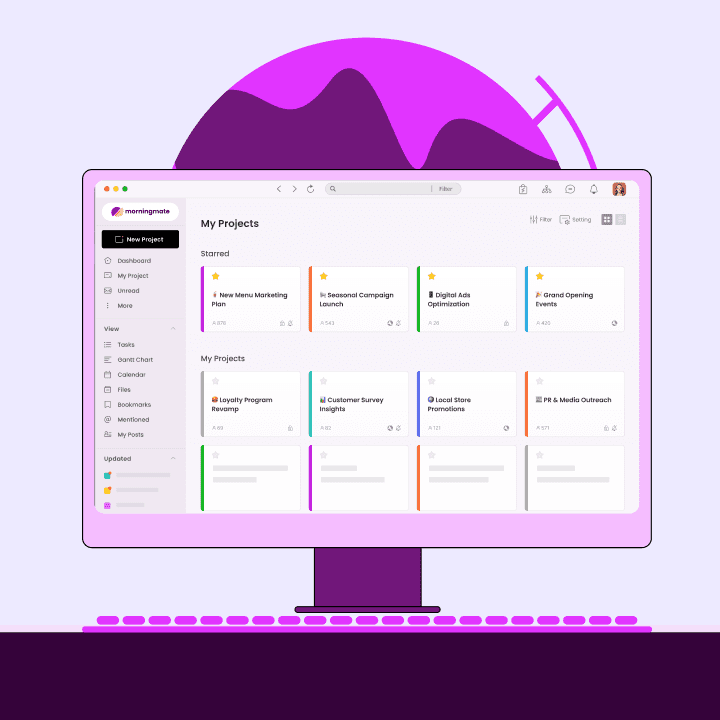
Morningmate, a lightweight work management platform used by over 550,000 teams, gives every task a clear status visible directly in a shared workspace. When a team member marks a task done, it does not disappear into a chat thread — it stays visible and logged, so you always know what is closed and what is not. The interface feels familiar, like a social media feed, so even non-technical team members adopt it quickly without training overhead.
Step 4 — Require a One-Line Closure Note
When a task is marked closed, the owner adds a single sentence: what was done, what the outcome was, or where the file lives. This takes 30 seconds and saves hours of re-investigation later. It also creates a searchable record that helps you onboard new team members without starting from scratch.
Step 5 — Review Open Tasks Weekly, Not Monthly
Build a 10-minute weekly habit where someone — even you — scans for tasks that have been open more than five business days. Flag them. Ask one question: is this still active, or should it be closed? This single habit eliminates most of the zombie tasks that drag on indefinitely.
Step 6 — Celebrate Closures, Not Just Starts
Most small business cultures celebrate kicking off new projects. Deliberately recognizing when work gets properly closed — with a documented outcome — shifts the team's attention toward completion. It sounds soft, but it directly changes behavior around task workflow.
Task Management Comparison: Before and After a Closure System
Here is what changes when a lean team installs even a basic task closure process. These are not hypothetical — they are the operational differences that show up within 30 days of adopting structured task tracking.
Operational Area | Without Closure Process | With Structured Task Management |
|---|---|---|
Status visibility | Owner must ask team individually | Dashboard view shows live status |
Duplicate work | Common — no record of completion | Rare — closure note prevents repeat |
Team accountability | Diffuse — no named owner at close | Clear — one owner logs the outcome |
Knowledge retention | Lost in chat or email threads | Stored in task record, searchable |
Owner's weekly time on updates | 3–5 hours chasing status | Under 30 minutes of review |
How Morningmate Closes the Task Management Gap Without Adding Complexity
The reason most small teams never fix their task management closure problem is not lack of intention — it is tool friction. If the system is complicated, nobody uses it consistently. And if task coordination happens across five different tools, the closure record never lands anywhere useful.
Morningmate is built specifically to avoid that trap. It combines task management, file sharing, and team chat in one workspace that looks and feels like something your team already uses every day. The task view lets you set statuses, assign owners, attach files, and leave closure notes — all in the same place where the conversation happened. There is no switching between a project tool and a chat app and an email thread. Everything is connected.
For a small business owner who is already wearing six hats, that matters. You can check task status without asking anyone. You can see what is open, what is in progress, and what is closed — in one scroll. And your team does not need a training day to figure it out. That is the right foundation for a small team that needs to run like a larger one without the overhead.
Morningmate's built-in chat works just like the messaging apps your team already loves, so adoption is fast. But unlike WhatsApp or Slack, every task tracked inside Morningmate carries its full history — who assigned it, what the completion condition was, when it was closed, and what the outcome was. That is the difference between a record and a rumor.
Reduction in Unclosed Tasks After 60 Days: By Tool Type
12%
Email & chat only
41%
Generic PM tools
78%
Structured task management
Fig 2: Estimated improvement in task closure rates by tool approach after 60 days (illustrative)
Your Next Step: Turn Task Management Into a Competitive Advantage
Every unclosed task in your business is a small leak. On its own, it barely registers. But across a week, a month, and a team of 10 people, those leaks add up to real money: hours of duplicated effort, decisions made on incomplete information, and an owner who spends their best energy chasing status instead of growing the business.
The fix is not complicated. Start with the six steps above — pick one task your team is currently working on and apply the full closure process to it this week. Define what done looks like. Name one owner. Use a tool that can show you a closed state. Add one line when it is complete. That one task will show you the difference immediately.
When you are ready to apply that to everything your team does, a simple task management system like Morningmate gives you the structure without the sprawl. One place for tasks, chat, and files. No steep learning curve. No seat fees that scale out of control. Just a clear view of what your team is working on — and what is actually done.
The businesses that grow without adding headcount are not the ones with the most ambitious task tracking. They are the ones where work gets started, completed, and formally closed — every time. That discipline is worth more than any new hire you are delaying.