Project Management

Good task management starts the moment a piece of work is identified — not when someone finally sits down to do it. Yet for most small business owners, there is a frustrating and costly gap between the two. A task gets discussed in a meeting, mentioned in a message, or scribbled in a notebook — and then it quietly stalls before anyone actually starts. That gap is not laziness. It is a structural problem, and it is draining more from your business than you probably realize.
If you run a team of 5 to 50 people, you already know the feeling. You planned the work. You even told people what needs to happen. But a week later, nothing has moved. You are back to chasing the same update you thought you had sorted out. The task is still sitting exactly where you left it — unassigned, unstarted, and slowly becoming urgent.
This article is about that specific moment — the gap between planning a task and starting it — and how to close it without hiring more people or buying more software you will never fully use.
Why the Planning-to-Start Gap Costs Real Money
Task management is not just about organizing work. It is about making sure the work you plan actually gets done on time. When there is a gap between planning and starting, the hidden costs pile up fast. Deadlines slip. Clients get frustrated. You spend time re-explaining things you already explained. And your team spends mental energy tracking what they are supposed to be doing instead of actually doing it.
Asana's Anatomy of Work report found that workers spend 60% of their time on work about work — status updates, searching for information, chasing approvals — rather than on the skilled work they were hired to do. For a lean team, that is an enormous amount of wasted capacity. And most of it stems from poor task coordination at the point where a plan should turn into action.
The Real Dollar Cost for a Small Team
Say your team averages $30 an hour per person. If five people each waste 45 minutes a day on task-related confusion — who owns what, what the brief actually said, where the latest file lives — that is roughly $3,375 lost every single week. Over a year, that is more than $175,000 in wages spent on friction, not output. That is not a rounding error. That is a hire.
The table below compares what task workflow typically looks like when this gap is ignored versus when it is deliberately closed.
Aspect | Gap Left Open (No System) | Gap Closed (Clear Task Workflow) |
|---|---|---|
Task ownership | Assumed or verbally agreed | Named and visible to everyone |
Start date / due date | Often missing or vague | Set at the point of planning |
Context and brief | Buried in chat or email | Attached directly to the task |
Status visibility | Requires chasing | Updated in one shared place |
Time to first action | Days or never | Within hours of planning |
Why This Gap Keeps Opening — The Root Cause
The planning-to-start gap is not a motivation problem. Your team is not refusing to work. The gap exists because the information needed to start a task rarely travels with the task itself. Someone describes what needs to happen in a meeting. The notes go into a personal notebook or a shared doc nobody reads. The actual assignment gets sent via WhatsApp or email — with no deadline, no attached brief, and no clear owner. The person receiving it has three other things going on and no way to see where this task fits among their priorities.
Research from Harvard Business Review consistently shows that unclear expectations at the point of assignment are one of the leading causes of low team performance. When people do not know exactly what "done" looks like, when it needs to happen, or what resources they have available, they stall — not out of choice, but out of confusion.
For small business owners, this is compounded by tool sprawl. You might plan a task in a meeting, assign it on WhatsApp, attach a file in Google Drive, and follow up via email. By the time the task reaches the person doing it, the context is scattered across four different tools. No wonder they do not start immediately.
Where Tasks Get Stuck Before They Start (% of Teams Affected)
71%
No clear owner assigned
64%
Missing deadline or priority
58%
Context scattered across tools
49%
No visibility on workload
Fig 1: Common reasons tasks stall between planning and execution (illustrative, based on industry research)
A Practical Task Management Fix Your Team Can Start This Week
The good news is that closing this gap does not require a major process overhaul. It requires one habit change at the planning stage, and a place to make it stick. Here is a straightforward approach that works for lean teams.
Step 1: Never Let a Task Leave a Meeting Without Four Things
Every task that gets discussed — in a meeting, a call, or a chat — must have four pieces of information attached before anyone moves on: a named owner, a due date, a one-sentence description of what "done" looks like, and any files or links needed to start. That is it. No four-paragraph briefs. Just those four things, captured at the moment the task is created.
Step 2: Move Task Tracking Out of Chat
Chat tools are great for quick questions. They are terrible for task coordination. A task assigned in a WhatsApp message is a task that will be buried by tomorrow morning. Move every task into a shared, searchable space where the owner can see it, update it, and find everything attached to it in one click. This single change reduces follow-up messages by a significant margin because everyone can check the status themselves instead of asking you.
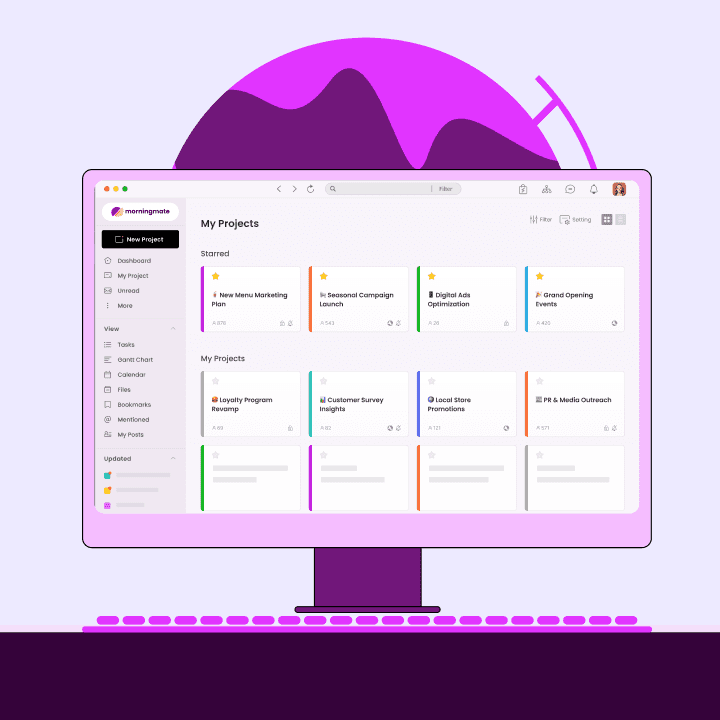
This is where a tool like Morningmate fits naturally into a small team's workflow. It is a lightweight work management platform used by over 550,000 teams that combines task tracking with built-in chat — so you are not switching between five different apps. Tasks are created with owners, deadlines, and attachments in one place, and the team's chat sits right alongside it. There is no complex setup, no learning curve that takes weeks, and no per-seat pricing that makes you hesitate before adding a new hire.
Step 3: Set a Start Date, Not Just a Due Date
Most task management habits focus entirely on deadlines. But if someone does not know when they are supposed to begin, the deadline arrives before the work does. When you create a task, always set a start date alongside the due date. This tells your team member: "This is when you need to pick this up." It removes the ambiguity that causes stalling, and it makes it easy for you to see whether someone has too much landing in the same week.
Step 4: Build a Weekly Five-Minute Task Review
Once a week — Monday morning works well — spend five minutes as a team looking at the tasks scheduled to start that week. Confirm ownership. Flag any that are blocked or missing context. This is not a status meeting. It is a brief alignment check that dramatically improves task coordination without adding meeting overhead. McKinsey research on team performance has repeatedly shown that short, structured check-ins outperform long status meetings for keeping work moving.
What Better Task Management Actually Looks Like in Practice
Picture this: your operations person finishes a client call and identifies three follow-up actions. Instead of firing off three WhatsApp messages that disappear into a thread, she opens Morningmate and creates three tasks directly from the feed — each with an owner, a start date, a due date, and a brief note about what is needed. The assignees get notified instantly. The files are attached. The context lives with the task, not buried in a scroll of messages.
The feed view in Morningmate works like a familiar social media timeline, which means even non-technical team members pick it up in minutes. There is no resistance, no training days, and no one reverting back to WhatsApp because the tool feels too complicated. The built-in chat means the team can still message each other — they just do it next to the work, not instead of managing it.
That is the practical difference between task coordination that works and task coordination that looks good on paper but collapses in real life. Simplicity is not a nice-to-have. For a time-poor team, it is the only thing that actually gets adopted.
Task Management Checklist | Do You Have This Now? | How to Fix It |
|---|---|---|
Named owner on every task | Often missing | Assign at the moment of planning |
Start date set alongside due date | Rarely done | Make start date a required field |
Files and context attached to task | In a separate tool | Use a tool that links files to tasks |
Weekly task start review | Not happening | Block 5 minutes every Monday |
All tasks in one visible shared space | Scattered across apps | Consolidate into a single work hub |
The Before and After: Task Management Adoption Results
Small teams that move from informal, chat-based task tracking to a structured task management workflow consistently report the same outcomes: fewer follow-up messages, shorter time-to-start on new tasks, and more work completed without the owner having to chase. The chart below shows the improvement across key task tracking metrics that teams typically report after closing the planning-to-start gap.
Team Performance Improvement After Closing the Planning-to-Start Gap (%)
45%
Fewer status follow-ups needed
62%
Tasks started on planned date
38%
Reduction in missed deadlines
55%
Improvement in task visibility
Fig 2: Reported improvements after structured task management adoption (illustrative, based on team productivity research)
Your Next Step: Turn One Planned Task Into a Started One Today
Good task management is not about having a perfect system. It is about having a consistent enough system that work moves from planned to started without anyone needing to ask twice. For a small business, that single improvement compounds quickly. Fewer dropped balls. Less time spent as the human reminder service. More headspace to actually lead.
The ROI case is simple: if your team loses even two hours a week per person to task confusion, and you have ten people, you are losing 20 hours of productive capacity every week. Fix the planning-to-start gap and you get most of that back — without adding headcount, without a complex new tool, and without a week-long rollout.
If you want to see what structured task coordination looks like in practice without a steep learning curve, Morningmate's free plan gives your team a shared workspace where tasks, files, and conversations live together — in an interface that feels as familiar as a social media feed. You can be up and running in under an hour, and your team will not need a manual to figure it out.
Pick one task that has been sitting in a chat thread this week. Assign it properly — named owner, start date, due date, context attached. That is the habit. Build it once, and the gap starts closing itself. Consistent task management is what separates the teams that grow smoothly from the ones that stay stuck firefighting the same problems every quarter.