Project Management

Effective task management is the backbone of any operation that wants to scale without breaking — and yet most growing SMBs are running it through a tool that was never designed for work at all. WhatsApp sits on nearly every employee's phone, it's instant, familiar, and free. So teams adopt it organically for task coordination, status updates, and cross-team handoffs. Then headcount doubles. Then it doubles again. And what once felt like a convenient workaround quietly becomes the most expensive process failure in your organization.
The problem isn't that WhatsApp is a bad product. It's that task management requires structure, accountability, and retrievability — three things a chat thread fundamentally cannot provide. When your team hits 15, 25, or 50 people, every message that contains a deliverable, a deadline, or a decision is a liability buried in scroll. According to McKinsey's research on workplace communication, employees spend an average of 19% of their working week searching for information — and in chat-heavy environments, that number climbs higher.
This article lays out a named framework for diagnosing exactly where chat-based task tracking fails, quantifies what it costs, and walks through a concrete standardized flow you can implement immediately. If you're an ops manager trying to bring order to a growing team, this is the blueprint.
The Compounding Cost of Running Task Management Through Chat
Inconsistent process doesn't produce a single point of failure — it produces dozens of small ones, and they compound. A missed update in a WhatsApp thread means a team member proceeds on outdated information. That triggers a rework cycle. The rework requires a new approval. The approval request gets buried in chat. Three days lost on a two-hour task.
Asana's Anatomy of Work report found that 58% of workers' time is spent on "work about work" — status updates, chasing confirmations, and duplicating effort — rather than skilled, productive output. In teams using chat apps as their primary task tracking system, that figure is consistently worse. The hidden tax on every task management failure is time: time re-explaining context, time locating files, time figuring out who owns what.
For a 30-person team, if each person loses just 45 minutes per day to chat-driven task confusion, that's 337.5 hours of productivity lost every week. Annualized, that's the equivalent of over 4 full-time employees doing nothing but cleaning up process failures.
Failure Point | WhatsApp / Chat-Based | Structured Task Management |
|---|---|---|
Task ownership | Verbal, implied, easily missed | Assigned, visible, logged |
Status visibility | Requires manual chasing | Real-time, always current |
File and context retrieval | Scroll-hunt, often lost | Attached to the task, searchable |
Deadline tracking | Memory-dependent | System-enforced with reminders |
Cross-team handoffs | No handoff record exists | Documented, timestamped |
Onboarding new hires | Context lives in old chats | Process is visible from day one |
The SCALE Framework: Where Chat-Based Task Management Breaks Down
To diagnose the failure modes precisely, use the SCALE framework — five structural dimensions that any task management system must support as a team grows. Chat tools fail on every one of them, but not all at once. They erode gradually, which is why most ops managers don't see the rot until it's systemic.
S — Searchability of Work Records
WhatsApp message history is linear and unsortable. When a task was discussed six weeks ago in a group of 40 people, finding that context means scrolling hundreds of messages. Structured task management attaches all conversation, files, and decisions directly to the task record — searchable, permanent, and accessible to anyone with permission.
Ops example: Your logistics coordinator needs to reference the delivery spec agreed with a supplier in March. In WhatsApp, that's a 20-minute search. In a structured task management tool, it's a two-second filter.
C — Clear Ownership and Accountability
Chat messages don't assign tasks — they suggest them. "Can someone handle the vendor invoice this week?" is not a task assignment. Without a named owner, a due date, and a visible status, the task management process relies entirely on individual memory and goodwill. Both are unreliable at scale.
Ops example: A supplier payment reminder was sent in a WhatsApp group. Three people assumed one of the others was handling it. The invoice went overdue. With formal task management, the assignment, deadline, and owner are explicit and non-negotiable.
A — Auditability of Decisions
Growing businesses face audits, compliance reviews, and internal retrospectives. When task coordination lives in personal messaging apps, there is no audit trail. Harvard Business Review notes that the inability to retrieve past decisions is one of the leading causes of repeated organizational mistakes. Structured task tracking creates a permanent, timestamped record of who decided what, and when.
L — Legibility Across Teams
When each team runs its own WhatsApp group, cross-team task visibility is zero. Operations doesn't know where marketing stands. Sales doesn't know what product has shipped. This is the silo problem in its most common form — not malicious, just structural. Task management tools with shared workspaces give every stakeholder a single view of what's in progress.
E — Efficiency of Onboarding
When a new ops coordinator joins and asks "how does X get done here?", the honest answer in a WhatsApp-run team is "ask around." Process knowledge lives in individuals, not systems. Standardized task management creates living documentation — new hires see how tasks flow, what templates exist, and what the expected steps are, without a week of knowledge-transfer calls.
Time Spent Searching for Task-Related Information (Hours/Week per Employee)
7.5 hrs
Email-based teams
9.2 hrs
Chat app-led teams
2.1 hrs
Structured task mgmt
Fig 1: Estimated weekly hours lost to information search by team workflow type (illustrative, based on McKinsey and Asana benchmarks)
How Each SCALE Failure Manifests in Day-to-Day Task Management
These aren't abstract risks. Here's what each failure looks like on a real ops floor.
Searchability failure looks like: "Did we already do this?" being a legitimate question that takes 30 minutes to answer. Teams duplicate work because there's no accessible task history.
Ownership failure looks like: the status meeting where three people report "I thought you were handling that." No task management record means no accountability loop.
Auditability failure looks like: a client dispute over what was promised, and your only evidence is a WhatsApp screenshot that may or may not still exist on someone's phone.
Legibility failure looks like: operations prepping for a product launch without knowing that the marketing team pushed the go-live date two weeks back — because the update was in a different chat group.
Onboarding failure looks like: a new hire spending their first two weeks asking basic process questions because every procedure is stored in someone else's memory, not in a system.
Applying SCALE with Morningmate: A Worked Task Management Example
Let's take a concrete, high-frequency ops scenario: onboarding a new vendor. In most growing SMBs, this process lives across WhatsApp threads, email chains, and verbal handoffs. Here's how standardizing it through a structured task management tool changes every dimension.
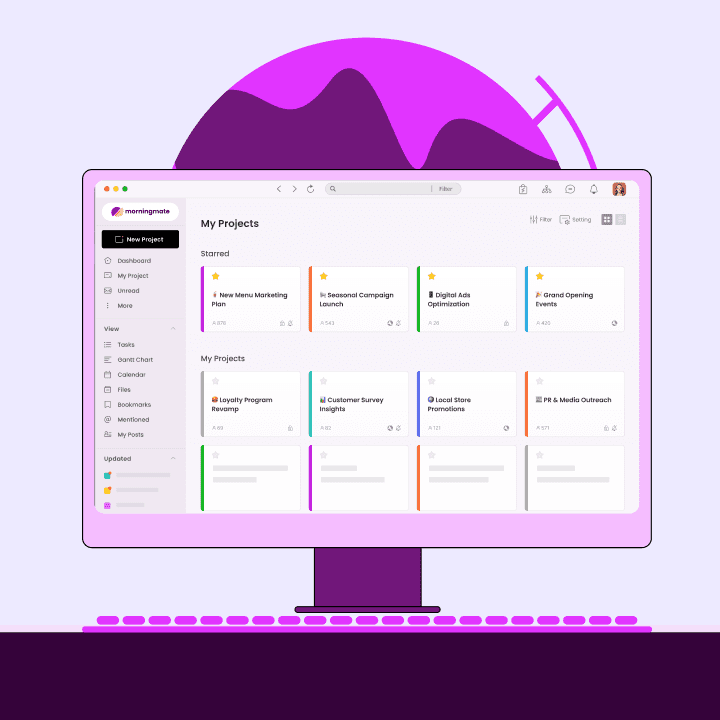
Morningmate is a lightweight work management tool used by over 550,000 teams worldwide. It combines structured task tracking with built-in chat — so teams don't have to choose between organized workflows and fast communication. Its interface mirrors the familiarity of social media feeds and messaging apps, which means even non-technical teams adopt it without a learning curve.
The standardized vendor onboarding flow in Morningmate:
Template task created: A reusable vendor onboarding task template is set up once, with all standard subtasks: NDA collection, supplier code registration, payment terms confirmation, system access provisioning. Every new vendor onboarding starts from this template — zero reinvention, zero missed steps.
Ownership assigned at creation: Each subtask is assigned to a named owner with a deadline. The procurement lead owns the NDA. Finance owns payment terms. IT owns access. Everyone knows their piece. Task management accountability is baked in from the start.
Context stays attached to the task: Documents, links, and communication threads live inside the task card — not in someone's WhatsApp or email inbox. When the ops manager checks status, everything is in one place.
Cross-team visibility via the Feed: Morningmate's Feed view displays project and task updates in a structured, social-media-style stream. The finance team sees when IT has completed access provisioning. Operations sees when procurement has cleared the NDA. No one needs to send a "just checking in" message.
New hire access: When a new procurement coordinator joins, they open the vendor onboarding project and immediately understand the full process — who does what, what the standard timeline is, and where previous vendors are in the pipeline. Task management becomes institutional knowledge, not individual memory.
The result: a process that previously took two to three weeks of fragmented chasing now completes in under a week, with no status meetings required.
Process Step | WhatsApp Approach | Morningmate Standardized Flow |
|---|---|---|
Task initiation | Message in group, easily missed | Template task created, all steps pre-loaded |
Owner assignment | Verbal, assumed, ambiguous | Named assignee per subtask, notified immediately |
Status check | Manual message, await reply | Real-time in Feed — no chasing |
Document location | Search individual chats or emails | Attached to task card, always findable |
Process repeat (next vendor) | Start from scratch, rely on memory | Duplicate template, update details, done |
The Performance Impact of Standardized Task Management
Standardizing task management workflows doesn't just feel better — it produces measurable output improvements. Teams that move from chat-based coordination to structured task tracking consistently report faster cycle times, fewer errors, and significantly reduced management overhead. The data below reflects the operational improvement patterns seen across SMBs making this transition.
Process Cycle Time Reduction After Adopting Structured Task Management (%)
18%
Email → structured
31%
Mixed tools → structured
44%
Chat-only → structured
Fig 2: Average cycle time improvement by prior tool type after transitioning to structured task management (illustrative, based on published productivity research)
Your Implementation Checklist: Moving Task Management Off WhatsApp
Standardizing task management across a growing team doesn't require a big-bang migration. A phased, process-first approach delivers results within weeks. Use this checklist to execute it.
Audit your current task management flow: Identify the five to ten recurring workflows your team runs most often — approvals, onboarding, vendor management, reporting cycles. These are your standardization targets.
Map who owns what: For each workflow, define the accountable role per step. Not the person — the role. This survives turnover and scales with hiring.
Build one template first: Don't try to migrate everything at once. Pick your highest-frequency, highest-pain workflow and build a structured task template for it in your chosen tool.
Choose a tool your whole team will actually use: Complex PM software creates its own adoption barrier. A tool like Morningmate — which keeps task tracking simple with a familiar interface and built-in chat — removes the "I don't know how to use this" excuse from day one.
Set a hard date for the WhatsApp cutoff: No structured task management transition succeeds while the old channel is still active. Announce a cutoff date for work-related task coordination in WhatsApp, and enforce it.
Train on the behavior, not just the tool: Teach your team what a proper task assignment looks like: named owner, due date, context attached, status visible. The tool is just the vehicle.
Review at 30 days: Check task completion rates, status update frequency, and how often people are still asking "what's the status?" If the answer is still "often," a process step is missing — not a feature.
Sustainable task management doesn't come from finding the perfect app. It comes from building the habit of structured accountability and choosing a tool that makes that habit effortless. The SCALE framework gives you the diagnostic lens. The checklist gives you the execution path. The only thing left is the decision to stop letting a messaging app run your operations.