Project Management

Task management is the backbone of any functioning operation — and when it lives inside WhatsApp, it starts breaking down faster than most ops managers realize. What begins as a convenient workaround quickly becomes a liability: missed deadlines buried in group chats, onboarding instructions scattered across DMs, and cross-team coordination that depends entirely on whoever happens to be online. If you're running a growing SMB and you're still relying on a messaging app to manage work, you're not just dealing with inconvenience — you're absorbing a compounding operational cost that quietly drains your team's capacity every single day.
The numbers are stark. McKinsey research found that employees spend an average of 28% of their workweek managing email and messaging — and that figure climbs when those tools are doing double duty as task tracking systems. For a team of 20, that's roughly 11 hours per person per week swallowed by communication overhead, not actual work. Scale that across departments and the cost becomes staggering.
This article introduces a structured framework for diagnosing exactly where WhatsApp-based task management fails, what standardized task coordination looks like instead, and how to implement a process that actually holds as your team grows.
The Compounding Cost of Informal Task Management
Every time a task gets assigned in a WhatsApp message, three things happen: it gets seen by the recipient, it gets buried within hours by unrelated messages, and it disappears from any kind of system of record. No due date. No owner accountability. No audit trail. Multiply that by dozens of tasks per day across multiple teams and you have a task workflow that is structurally designed to fail at scale.
Asana's Anatomy of Work report found that 58% of workers miss important information because it gets lost in communication tools not built for task tracking. That's not a people problem — it's a systems problem. And it's one that ops managers inherit and are expected to solve, usually without additional headcount.
The failure isn't sudden. It's gradual and compounding. A team of five can survive WhatsApp-based task coordination. A team of fifteen starts showing cracks — duplicated work, missed handoffs, onboarding that relies on tribal knowledge. By thirty people, the system has collapsed under its own weight and someone is spending half their day manually chasing status updates.
Operational Area | WhatsApp-Based Task Management | Standardized Task Workflow |
|---|---|---|
Task assignment | Buried in group chat messages | Structured, with owner and due date |
Status visibility | Requires manual chasing | Real-time, visible to all stakeholders |
Onboarding new staff | Relies on tribal knowledge, DMs | Templated, repeatable process |
Cross-team coordination | Ad-hoc, easily dropped | Structured handoffs with accountability |
Decision audit trail | Essentially non-existent | Logged, searchable, timestamped |
Introducing the SCALE Framework for Task Management Standardization
To systematically fix the breakdown caused by informal task management, use the SCALE Framework — a five-component model built specifically for ops managers in growing SMBs. Each component addresses a distinct failure point that emerges when teams try to run task coordination through a messaging app. The framework is designed to be sequential: fix each layer before moving to the next, and you build a task workflow that holds under growth pressure.
SCALE stands for: Structure, Clarity, Accountability, Legibility, and Escalation. Together, these five pillars replace the informal, memory-dependent systems that WhatsApp encourages with a repeatable, visible, and scalable approach to task tracking.
S — Structure: Give Task Management a Physical Home
The first failure of WhatsApp-based task management is that it has no dedicated home. Tasks live inside conversations, mixed with memes, voice notes, and unrelated updates. The moment a task is assigned in a chat, its clock is ticking — within hours, it will be displaced by newer messages.
Structured task management means tasks exist in a dedicated space, separate from conversation. In practice, this means creating project workspaces where each task has a title, an owner, a due date, and a status field. This isn't bureaucracy — it's the minimum viable structure for task coordination at any scale above ten people. When every task lives in the same structured environment, managers stop asking "did you see my message?" and start asking "what's the status on the task?"
C — Clarity: Standardize How Tasks Are Created and Assigned
Inconsistent task creation is one of the most invisible productivity drains in a growing team. One person assigns tasks with full context and a deadline. Another drops a single line in a group chat and assumes it's understood. A third sends a voice note. The result is a task workflow where interpretation becomes part of the job.
Clarity means establishing a consistent task creation standard across your team. Every task should include: a clear action verb in the title, an assigned owner (singular, not a group), a due date, and any relevant context or file attached directly to the task. This sounds basic — and it is. But enforcing it consistently across teams is what separates ops managers who chase status from those who simply check a dashboard.
Where Tasks Get Lost: Primary Breakdown Points in Informal Task Management
61%
Tasks lost in chat
47%
No clear owner assigned
53%
Missing deadlines
39%
Duplicated work
Fig 1: Common failure points when task coordination runs through messaging apps (illustrative, based on industry patterns)
A — Accountability: Make Task Ownership Visible Across Teams
In WhatsApp groups, accountability diffuses instantly. When a task is dropped into a group of eight people, all eight see it and none of them feel solely responsible for it. This is a known psychological phenomenon — diffusion of responsibility — and it is actively reinforced by the group chat format.
Accountability in a standardized task workflow means every task has exactly one named owner. That owner is notified when the task is created, can see their full task load in one place, and is the person whose name appears when the task is overdue. This single change — moving from group assignment to named ownership — has a measurable impact on completion rates. It's not about pressure; it's about clarity over who is responsible for moving something forward.
L — Legibility: Build a Task Tracking System Anyone Can Read at a Glance
One of the most time-consuming ops rituals is the status update meeting — a recurring gathering whose sole purpose is to answer the question "where does everything stand?" That meeting exists because the task tracking environment is not legible. If you have to schedule a conversation to understand work status, your system is failing.
Legibility means building a task management environment where any manager or team lead can open a workspace and immediately see: what's in progress, what's overdue, what's blocked, and what's done — without asking anyone. This is where tools matter. A task board or list view with status fields, filters, and clear visual hierarchy does in seconds what a status meeting does in forty-five minutes. Better task tracking visibility directly reduces the number of synchronous meetings your team needs to run.
E — Escalation: Create a Standard Path for Blocked Tasks
Blocked tasks are the silent killers of project timelines. In a WhatsApp-based system, a blocked task has no formal resolution path. The person who's stuck sends a message, hopes the right person sees it, and then the task sits in limbo. Meanwhile, downstream dependencies pile up and deadlines shift.
Standardized escalation means building a defined process for when a task is blocked: a status field to mark it, a clear escalation owner (usually the ops manager or team lead), and a response SLA — say, 24 hours before the block is formally addressed. This turns an invisible problem into a visible, managed one. It also removes the anxiety of "I don't want to bother anyone" that causes people to sit on blocked tasks silently for days.
Applying the SCALE Framework in Morningmate: A Worked Example
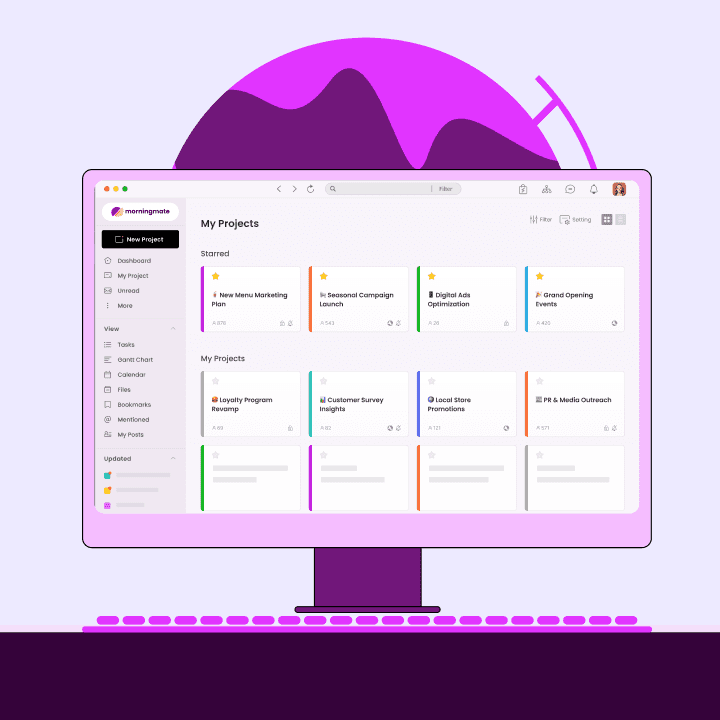
Here's what the SCALE framework looks like in practice, using Morningmate — a lightweight work management tool used by over 550,000 teams — as the operational environment. The scenario: onboarding a new hire across three departments (HR, IT, and Operations) in a 40-person company that previously ran all coordination through WhatsApp.
Structure: Create a dedicated "New Hire Onboarding" workspace in Morningmate. All onboarding tasks — equipment setup, system access, policy review, first-week schedule — live here, not in a chat thread. Every team sees the same workspace.
Clarity: Use a repeatable task template for every new hire. Tasks are pre-named ("Set up laptop and VPN access — [Name]"), pre-assigned to the relevant department owner, and pre-dated based on the start date. No one needs to recreate the process from memory each time.
Accountability: IT owns the equipment tasks. HR owns the documentation tasks. Operations owns the workspace access tasks. Each owner sees their onboarding responsibilities in their personal task tracking view. No group assignment, no ambiguity.
Legibility: The ops manager opens the onboarding workspace on day one of the new hire's start and sees at a glance: three tasks complete, one in progress, one overdue (IT hasn't set up the VPN). No meeting required. One message to IT, task resolved.
Escalation: The VPN setup task is marked "Blocked" with a note explaining the access request is pending vendor approval. The ops manager is notified automatically, sets a follow-up within 24 hours, and the new hire isn't left waiting without explanation. Morningmate's built-in chat — which operates with the same familiar interface as a messaging app, so non-technical teams adopt it immediately — keeps the conversation attached to the task itself rather than floating in a separate group chat.
SCALE Component | WhatsApp Approach | Morningmate Standardized Flow |
|---|---|---|
Structure | Tasks buried in chat threads | Dedicated project workspace per process |
Clarity | Recreated from memory each time | Repeatable task templates with pre-set fields |
Accountability | Group assignment, diffused ownership | Single named owner per task, visible to all |
Legibility | Status requires manual chase or meeting | Dashboard view: at-a-glance task tracking |
Escalation | Blocked tasks go silent | Blocked status flags manager with 24hr SLA |
The Measurable Impact of Standardized Task Tracking
The shift from informal to standardized task management is not just qualitative. Gallup research consistently shows that role clarity — knowing exactly what you're responsible for — is one of the strongest predictors of employee engagement and output. Standardized task workflows deliver that clarity at scale, without requiring managers to individually clarify expectations with every team member every week.
Teams that migrate from chat-based task management to a structured task tracking system typically report faster task completion cycles, fewer missed handoffs, and a significant reduction in the time managers spend chasing status. The ops manager stops being a human routing system and starts being a strategic resource — which is what the role is supposed to be.
Time Saved Per Manager Per Week After Standardizing Task Management
1.2 hrs
Email-only workflow
2.4 hrs
Basic task tool
4.8 hrs
Standardized SCALE system
Fig 2: Estimated weekly time recovered by ops managers at each maturity level of task management standardization (illustrative)
Task Management Implementation Checklist
If you're ready to move your team from WhatsApp-based task coordination to a standardized task workflow, start here. This checklist is sequenced to match the SCALE framework — work through it in order, one layer at a time, and you'll have a functioning system within two weeks.
Structure: Identify your three most repeated operational processes (onboarding, approvals, cross-team handoffs) and create a dedicated workspace for each.
Structure: Formally retire those processes from WhatsApp — announce the switch, don't just add a new tool alongside the old one.
Clarity: Define a task creation standard: action verb title, single owner, due date, context/file attached. Write it down and share it with all team leads.
Clarity: Build at least one reusable task template for your highest-frequency process (e.g., new hire onboarding, weekly reporting cycle).
Accountability: Audit your existing task management backlog — any task assigned to a group or role rather than a named person needs a single owner assigned today.
Legibility: Set up a weekly ops dashboard review — five minutes, no meeting, just open the task board and check status across all active workspaces.
Escalation: Define what "blocked" means for your team, who the escalation owner is, and what the response SLA is. Communicate it to all task owners.
Review: After 30 days, measure the number of status update messages sent per week compared to your baseline. That delta is your ROI on standardization.
Standardized task management is not a software purchase — it's a commitment to process. The tool enables the process, but the process has to be designed first. Start with the SCALE framework, apply it to one workflow, and prove the model before rolling it out team-wide. That's how you build an operation that doesn't break every time someone new joins or a project gets complex. And it's how you stop being the person whose job is to remember everything that would otherwise fall through the cracks.