Project Management

Task management does not begin the moment someone opens a project board — it begins in the meeting room, or the video call, when someone says "what if we tried this?" Good ideas surface constantly in team meetings. The problem is that most of them vanish before anyone has a chance to act on them. Someone scribbles a note on a sticky pad, another person makes a mental reminder, and by the time the next meeting rolls around, that potentially brilliant idea is gone. If your team is serious about doing better work, protecting those moments of clarity has to become part of how you operate.
This is not a small problem. Research published by Harvard Business Review found that executives consider more than 67% of meetings to be failures — and one of the most cited reasons is that decisions and ideas discussed rarely translate into clear next steps. When your task management system does not connect to where ideas are born, you end up with a permanent gap between thinking and doing.
The good news is that closing this gap does not require a complete overhaul of how your team runs meetings. It requires a smarter approach to capturing, organizing, and converting ideas into trackable work — and a few intentional habits that any team can build. Here is exactly how to do that.
Why Good Ideas Keep Slipping Through the Cracks
Before fixing the problem, it helps to understand why it keeps happening. Most teams do not have a dedicated system that connects meeting conversations to task tracking. Ideas get mentioned verbally, maybe written in someone's personal notes, and then discussed again in a separate chat thread — usually a WhatsApp group or an email chain that nobody can search later.
The result is what you might call "idea scatter." The thought exists somewhere, but nobody knows exactly where, who owns it, or what the next step is. This is especially common in hybrid and remote teams, where meetings happen across different time zones and not everyone can attend live. Without a structured task coordination system, asynchronous attendees are completely left out of the idea loop.
There is also a psychological dimension at play. Gallup's workplace engagement research consistently shows that employees who feel their input is ignored become less likely to speak up. When ideas shared in meetings routinely go nowhere, your team learns to stop contributing them. The long-term cost goes far beyond a missed to-do item.
Here is a breakdown of the most common failure points in capturing meeting ideas:
Failure Point | What Typically Happens | Impact on Task Management |
|---|---|---|
No designated note-taker | Ideas are mentioned but not recorded | Ideas disappear after the call ends |
Notes stored in personal docs | Only one person can access them | Team-wide task coordination breaks down |
Ideas discussed in chat apps | Buried under subsequent messages | Cannot be linked to tasks or projects |
No owner assigned to ideas | Everyone assumes someone else will follow up | Ideas stall with no accountability |
The Real Scale of the Problem: How Many Ideas Actually Get Acted On
The failure to convert meeting ideas into task workflows is not just an inconvenience — it is a significant drag on productivity and team morale. Studies suggest that the average knowledge worker spends nearly 12 hours per week in meetings, yet the number of actionable outcomes that make it into any formal task management system is surprisingly low. Industry estimates suggest that fewer than 30% of ideas discussed in meetings get formally recorded, and only around half of those ever become assigned tasks.
% of Meeting Ideas That Become Tracked Tasks
18%
Email + Personal Notes
34%
Chat-Only Tools
61%
Structured Task Workflow Tools
Fig 1: Estimated conversion rate of meeting ideas to tracked tasks by tool type (illustrative)
The gap between chat-based capturing and structured task coordination is striking. When ideas live in the same place as assignable tasks, ownership, and deadlines, the follow-through rate jumps dramatically. This is the core argument for building a deliberate system around your meetings.
Build a Meeting-to-Task Management System in Five Steps
Getting your team from scattered sticky notes to a reliable task workflow does not have to be complicated. These five steps give you a practical framework to implement immediately.
Step 1: Assign a Rotating Idea Catcher
Every meeting needs one person whose explicit job is to capture ideas — not just action items. Rotate this role across team members so it does not always fall on the same person. The idea catcher is not there to evaluate ideas on the spot. Their job is simply to document them in a shared, searchable location that everyone can access after the meeting.
Step 2: Write Ideas Directly Into Your Task Management Tool
This is the step most teams skip, and it is the most important one. Instead of capturing ideas in a separate doc or chat thread, write them directly into your task management or task tracking platform as draft tasks or idea cards. Even if the idea is half-formed, creating a placeholder with a title and a note is enough to anchor it. You can refine it later — the goal right now is that it exists in a trackable system.
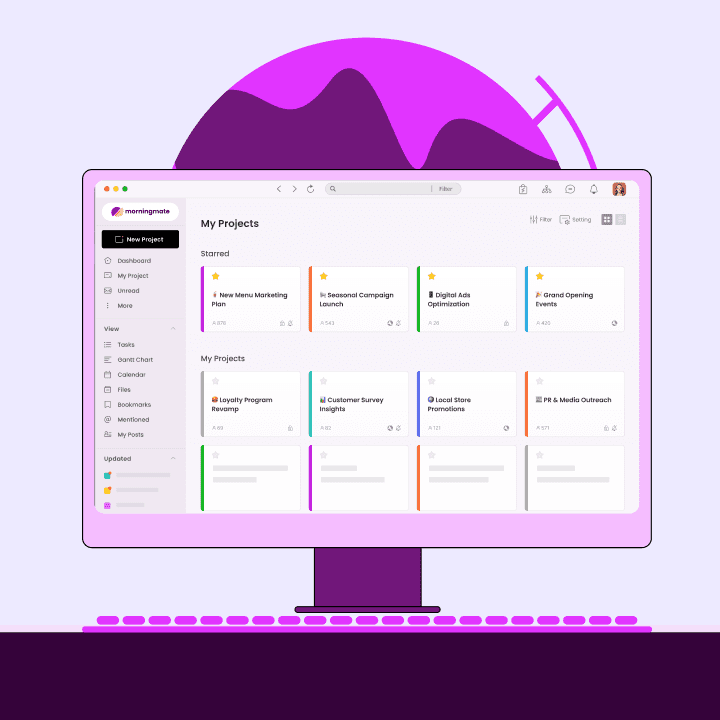
This is where a tool like Morningmate helps significantly. Morningmate is a lightweight work management platform designed to keep task coordination simple — even for non-technical teams. During or right after a meeting, you can post ideas directly to a project Feed (think of it like a social media-style update board), create tasks with assignees and due dates, and attach any relevant files. Nothing leaves the meeting without a home.
Step 3: Tag Ideas by Status
Not every meeting idea is ready to become a task. Create a simple status system: "raw idea," "to be evaluated," and "approved for action." This prevents good ideas from getting buried alongside immediate priorities, while also keeping them visible enough to revisit. A quick tag or label inside your task workflow is all you need.
Step 4: Schedule a Weekly Idea Review
Set aside fifteen minutes once a week — it does not need to be a full meeting — to review the ideas tagged as "to be evaluated." Decide as a team which ones to move forward with, which to park, and which to discard. This rhythm ensures that ideas do not sit in limbo for months. It also signals to your team that their contributions are being taken seriously, which feeds directly into a healthier team collaboration culture.
Step 5: Close the Loop Publicly
When an idea moves from "raw" to an actual assigned task, let your team know. A quick update in your shared workspace — "We're moving forward with [idea] from last Tuesday's meeting, now assigned to [name] with a deadline of [date]" — takes thirty seconds and does two powerful things. It shows that meetings produce real outcomes, and it reinforces that your task management system is the source of truth for what gets done.
Choosing the Right Tools for Idea-to-Task Tracking
The tool you use for task management matters more than most teams realize. Many teams default to email threads or WhatsApp groups for post-meeting follow-up — which feels fast in the moment, but creates a chaotic, unsearchable mess over time. On the other end of the spectrum, tools like Jira are powerful but carry a steep learning curve that discourages non-technical team members from engaging.
Asana's Anatomy of Work report has consistently flagged that teams using dedicated work management tools report significantly higher rates of goal clarity and follow-through compared to those relying on email and chat apps alone. The key is finding a tool that sits in the middle — structured enough to support real task tracking, but simple enough that everyone actually uses it.
Morningmate is built for exactly this space. Its Feed view gives every project a visible, scrollable update stream that feels familiar — similar to how most people already use social media — so adoption is fast even for teams that are not tech-savvy. The built-in chat keeps conversations linked to specific tasks rather than floating in a separate app, and file attachments are organized within each project rather than scattered across email inboxes. Over 550,000 teams use Morningmate globally to replace the chaos of scattered tools with one organized workspace.
Here is a comparison of how different approaches handle the idea-to-task pipeline:
Capability | Email / WhatsApp | Complex PM Tools | Morningmate |
|---|---|---|---|
Idea capture during meetings | Manual, unstructured | Possible but steep setup | Quick, via Feed or task creation |
Task assignment and ownership | Not supported | Yes, but complex | Yes, simple and fast |
Searchable idea archive | Difficult, scattered | Yes, with configuration | Built-in, centralized |
Adoption by non-tech teams | High (but chaotic) | Low | High — familiar interface |
Idea-to-task conversion | Manual, often missed | Supported but clunky | Seamless, in one workspace |
Practical Task Management Habits That Make Ideas Stick
Systems matter, but so does daily behavior. Even the best task tracking setup will fail if your team does not build a few supporting habits around it. These are small, low-effort practices that compound quickly.
Start meetings with a two-minute recap of ideas captured in the previous session. This reinforces the idea that your task management system is a living document, not a graveyard. It also helps team members who were absent catch up without needing a separate briefing.
End every meeting with a three-minute "parking lot" review. Before anyone closes the call, go through ideas that were mentioned but not fully discussed. Decide on the spot whether to log them as draft tasks or schedule a focused discussion. This single habit can dramatically reduce the number of ideas that disappear between meetings. For more on making async and live meetings work together, your team might find a structured format helpful.
Also consider giving every project or team a shared "Ideas" post within your task workflow tool — a pinned note or card where anyone can drop thoughts between meetings. This creates a low-friction channel that sits alongside your formal task coordination without disrupting it.
What Changes When Task Management and Idea Capture Work Together
Teams that close the gap between meeting conversations and formal task tracking report real, measurable improvements — not just in productivity, but in how people feel about their work. When contributors see their ideas move from a meeting comment to an assigned task with a real outcome, participation in meetings improves. Decision-making becomes faster because the relevant context is already documented. And managers spend less time chasing updates because the task workflow itself tells the story.
Team Outcomes After Implementing Structured Idea-to-Task Workflows
+63%
Idea Follow-Through
+47%
Meeting Satisfaction
+55%
Task Completion Rate
-40%
Status Update Requests
Fig 2: Reported improvements after adopting structured idea-to-task management practices (illustrative)
These numbers reflect what better task management habits actually look like in practice. The goal is not perfection — it is consistency. When your team knows that every meeting produces a clear, documented set of ideas and next steps inside one shared system, the default behavior shifts from "someone will remember that" to "it's already in the system."
Make Task Management the Bridge Between Thinking and Doing
Great ideas deserve more than a nod in a meeting and a fading sticky note. Structured task management is what transforms those sparks into outcomes your team can actually point to. The five-step system outlined here — designating an idea catcher, logging ideas directly into your task tracking tool, tagging them by status, reviewing weekly, and closing the loop publicly — gives your meetings a real output for every conversation that matters.
If your team currently relies on email threads or personal messenger apps to track what came out of a meeting, that is the single most important thing to change. A tool like Morningmate, which combines task management, built-in chat, and a Feed view that everyone finds intuitive, makes it easy to bridge the gap between the meeting room and the work itself — without adding complexity. You can explore how it works for teams of any size at morningmate.com.
Your next meeting is going to produce ideas worth keeping. The only question is whether your task management system is ready to catch them.