Project Management

Task management in hybrid teams is only as strong as the conversations that actually get recorded — and right now, a significant chunk of those conversations aren't. When half your team works remotely and the other half shares an office, critical decisions, status updates, and project context regularly slip into WhatsApp threads, hallway chats, and one-off emails that nobody else can see. By the time work surfaces in a shared space, the full picture is already missing.
This isn't a discipline problem or a people problem. It's a structural one. Hybrid teams operate across different environments, different time zones, and different communication habits. Without a deliberate system for task tracking and information capture, context loss becomes the default — not the exception. Harvard Business Review has noted that the shift to hybrid models fundamentally changes how information flows through organizations, often leaving remote workers especially disconnected from in-office decisions.
The good news is that losing context isn't inevitable. But fixing it requires understanding exactly where and why it happens — and then building task coordination habits that close those gaps before they turn into missed deadlines, duplicated work, or broken trust between team members.
Where Context Actually Goes Missing in Hybrid Teams
The most dangerous communication gaps aren't the obvious ones. Nobody overlooks a formal meeting invite or a project kickoff. The gaps that quietly derail task management are the informal ones — the quick desk conversation that changes a deliverable's scope, the voice note someone sends over WhatsApp with a revised deadline, or the email thread between two managers that never makes it into the shared workspace.
In hybrid environments, these off-record moments happen constantly. Office-based team members build shared context through proximity — body language, overheard conversations, spontaneous check-ins. Remote workers don't get any of that. They receive only what is explicitly communicated, and in most teams, explicit communication is the minority of what actually drives work forward.
According to McKinsey's research on hybrid work models, employees in hybrid arrangements frequently cite information asymmetry as one of their top frustrations — knowing that decisions are being made, but not having access to the reasoning or the context behind them. Task workflow breaks down not because tasks aren't assigned, but because the "why" and "what changed" never gets captured.
Here are the most common off-record moments that erode task management quality in hybrid teams:
In-person whiteboard sessions that never get documented or shared
Instant messages in personal apps (WhatsApp, iMessage) that contain real task updates
Verbal approvals or scope changes during hallway conversations
Email chains between two people that affect a broader team's work
Video calls where action items aren't formally recorded anywhere
Verbal feedback given in the office that remote workers never receive
Each of these moments is low-stakes in isolation. Compounded across a week, they create a version of reality for office workers and a different, incomplete version for everyone else.
Context Loss Source | Who It Affects Most | Impact on Task Management |
|---|---|---|
Hallway / desk conversations | Remote workers | Scope changes go unnoticed; duplicated effort |
Personal messenger apps (WhatsApp) | Entire team | Updates buried, deadlines missed |
Unrecorded video call decisions | Async team members | Action items fall through the cracks |
Email threads between two people | Everyone not CC'd | Decisions made without team visibility |
Undocumented whiteboard sessions | Remote and async workers | Planning context lost immediately |
The Real Cost of Off-Record Task Coordination
When task management relies on informal, untracked communication, the cost isn't always immediately visible. Teams feel it in subtler ways first — a slight hesitation before starting work because someone isn't sure if the brief has changed, a redundant Slack message asking "wait, did we already decide this?", or a deliverable that misses the mark because the feedback was never formally logged.
Over time, these micro-frictions compound into something much more damaging. Gallup's State of the Global Workplace report consistently finds that lack of clear direction and communication is one of the strongest drivers of employee disengagement — and disengaged employees cost organizations through lost productivity, higher turnover, and lower output quality.
For hybrid teams specifically, the stakes are higher. The information gap between office and remote workers doesn't just affect individual tasks — it shapes career trajectories. If in-office employees consistently have more context, they make better decisions, appear more competent, and get more visibility with leadership. Task tracking gaps quietly create a two-tier team dynamic that erodes trust and morale over time.
How Hybrid Teams Experience Context Loss Weekly
71%
Miss a key decision
63%
Redo completed work
58%
Unclear on task status
44%
Delayed by missing info
Fig 1: Common weekly experiences reported by hybrid remote workers (illustrative, based on industry research)
Why Email and WhatsApp Make Task Management Worse
Most teams that struggle with context loss aren't struggling because they communicate too little — they're communicating in the wrong places. Email and personal messenger apps like WhatsApp feel convenient in the moment, but they're fundamentally incompatible with reliable task coordination.
Email is siloed by design. When two people exchange information over email, that context lives only in their inboxes. Nobody else can reference it, search it, or connect it to the relevant task. When one of those people leaves the team or changes roles, the context disappears with them.
WhatsApp and similar apps create a different problem. They're fast and familiar, which makes them attractive for quick task updates. But messages scroll out of view, there's no way to assign or track action items, and mixing personal and professional communication creates constant distraction. What feels like a quick status update becomes an unsearchable, unaccountable communication black hole.
This is exactly the problem that choosing the right workplace communication tool is designed to solve. Tools built for task tracking keep communication attached to the work itself — so context never drifts away from the task it belongs to.
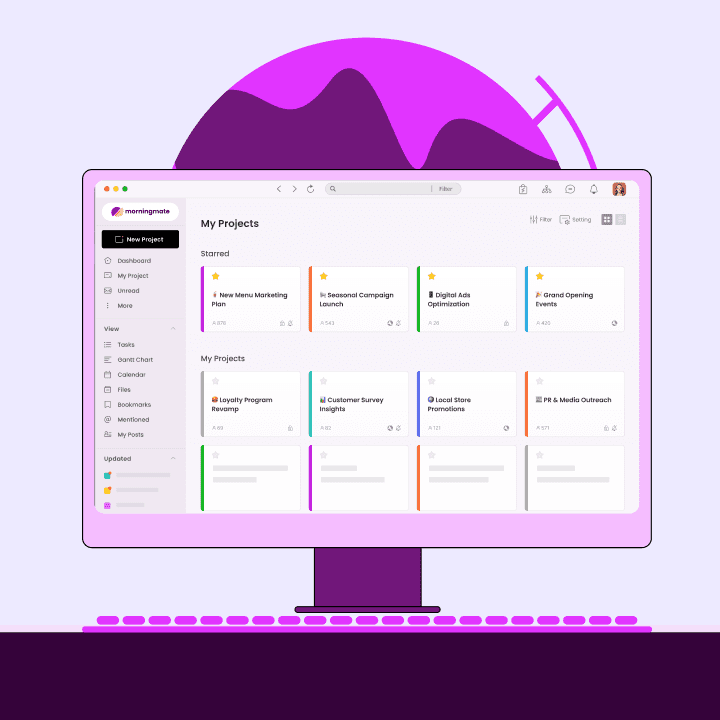
Morningmate was built specifically to replace this fragmented communication pattern. It brings together task management, team chat, and file sharing into a single lightweight workspace — with a familiar interface that feels more like a social feed than a complex project management tool. Teams that have been managing work through email and WhatsApp can switch without a steep learning curve, because the experience is designed to feel intuitive from day one.
Building a Task Management System That Captures Context by Default
The goal isn't to add more documentation work to your team's plate. It's to design a task workflow where capturing context is the path of least resistance — not an extra step that competes with actually getting work done.
Here's a practical framework for reducing off-record task coordination in hybrid teams:
1. Anchor Every Decision to a Task
Whenever a decision is made — in a meeting, over chat, or in a hallway — it should be linked to the relevant task within your task management system, not stored in someone's memory or a private message thread. This sounds simple, but it requires a deliberate norm: if it's not in the system, it didn't happen.
2. Replace Personal Messenger Threads with Work-Specific Chat
Move team communication off WhatsApp and into a workspace where messages are organized by project or task. Morningmate's built-in chat works exactly like a messaging app your team already knows, but conversations live alongside the work they relate to — making task tracking seamless rather than retroactive.
3. Require a Written Summary After Every Meeting
Even a three-line summary posted to your shared workspace is infinitely better than nothing. Decisions made, tasks assigned, next steps — that's all you need. The habit of writing it forces clarity and gives remote workers the context they missed by not being in the room.
4. Create a Single Source of Truth for Task Status
Your team should be able to look at one place and know exactly where any given task stands. Not email, not WhatsApp, not a mix of both — one place. This is where a dedicated task management platform proves its value: everyone, regardless of location, sees the same live picture of work in progress.
5. Make Async Updates a Team Norm, Not an Exception
Hybrid task coordination works best when updates don't depend on real-time presence. Encourage your team to post brief task updates at the start or end of their workday — visible to everyone, requiring no live meeting to stay current. This is especially powerful for teams working across time zones.
Choosing the Right Task Tracking Tool for Hybrid Teams
Not every task management tool is suited to hybrid environments. Some are too complex for non-technical teams and require dedicated training. Others focus purely on task tracking but leave communication fragmented across separate apps. The right tool for hybrid task coordination needs to do three things well: make task status visible to everyone, keep communication attached to work, and be simple enough that your whole team actually uses it.
Feature Need | Email + WhatsApp | Complex PM Tools (Jira/Asana) | Morningmate |
|---|---|---|---|
Task visibility for all team members | ❌ Siloed | ✅ Yes, but complex | ✅ Simple and clear |
Built-in team chat | ⚠️ Personal apps only | ❌ Requires integrations | ✅ Native, WhatsApp-style UX |
Easy adoption for non-tech teams | ✅ Familiar but messy | ❌ Steep learning curve | ✅ Designed for all teams |
Context attached to tasks | ❌ Disconnected | ✅ Yes, but requires setup | ✅ Built-in by design |
File management in one place | ❌ Scattered | ⚠️ Varies by tool | ✅ Integrated |
Morningmate sits in a deliberately simple middle ground. It gives you robust task management — with deadlines, assignments, status tracking, and file attachments — without requiring your team to attend training sessions or hire an administrator to set it up. Over 550,000 teams use it because it removes friction rather than adding it. The Feed view, in particular, gives everyone a real-time, social-style update stream of what's happening across projects — so context travels with the work, not through someone's personal inbox.
What Improved Task Management Actually Looks Like in Practice
Teams that move from scattered communication to structured task coordination don't just feel more organized — they measure real improvements in speed, output quality, and team satisfaction. The shift shows up in fewer "quick sync" meetings (because context is already visible), fewer missed deadlines (because task status is tracked), and less friction between office and remote workers (because everyone works from the same information).
Team Performance Improvements After Adopting Structured Task Management
67%
Fewer missed deadlines
54%
Reduced status meetings
48%
Less duplicated work
72%
Better remote-office alignment
Fig 2: Reported improvements after switching to centralized task coordination (illustrative, based on industry benchmarks)
The pattern is consistent: when task tracking moves from scattered personal apps into a shared system, teams stop wasting energy on coordination overhead and redirect it toward actual work. Remote workers stop feeling like second-class team members because they have equal access to the same information. Managers spend less time chasing updates and more time acting on them.
Task Management Is the Foundation Your Hybrid Team Is Missing
Hybrid work isn't going away. If anything, the 2026 workplace looks more distributed, more asynchronous, and more dependent on digital systems than ever before. That means the off-record communication habits your team has been tolerating — the WhatsApp threads, the email sidebars, the hallway decisions — are going to create more context loss, not less, as your team grows.
Effective task management isn't about adding bureaucracy or forcing everyone into rigid processes. It's about making sure that the work your team is doing — and the decisions that shape it — live somewhere everyone can see. That single shift, from scattered to centralized task coordination, is what separates hybrid teams that thrive from ones that constantly feel like they're catching up.
Start by auditing where your team's real task workflow happens right now. Count how many decisions this week were made over WhatsApp, in hallway conversations, or in email threads that half your team never saw. That number is your context loss gap — and closing it starts with giving task management the central, visible home it deserves.