Project Management

Task management falls apart long before a new hire touches their first real project — it breaks down the moment they realize no one can tell them where anything lives. If your processes exist only in someone's head, buried in an email thread, or scattered across three different chat apps, onboarding will take twice as long as it should. Every hour a new team member spends hunting for context instead of doing actual work is an hour your team pays for twice: once in lost productivity, and again in the frustration that quietly erodes confidence and morale.
This isn't just an onboarding problem. It's a task management problem. When there's no central place where work lives — no clear record of who owns what, why decisions were made, or how tasks move from start to finish — every new hire has to reconstruct the operating system of your team from scratch. And most of them never fully do.
The good news is this is fixable. But fixing it requires understanding exactly why undocumented processes make onboarding so expensive, and what a structured approach to task coordination actually looks like in practice.
The Hidden Cost of "We Just Know How It Works"
Most teams don't realize their processes are undocumented until someone new joins and asks a question nobody can answer cleanly. "How do we handle client revisions?" gets answered differently by three different people. "Where do I find the latest version of the proposal template?" leads to a five-message chain that ends with someone digging through their Downloads folder.
This is what researchers call tacit knowledge — the kind of institutional know-how that lives in people's habits rather than in any shared system. Harvard Business Review has long noted that tacit knowledge is one of the most difficult assets for organizations to transfer, and it's exactly what makes onboarding drag on for weeks longer than necessary.
Without solid task tracking in place, new hires can't see how work actually flows. They can't tell what's urgent, what's blocked, or what's already been decided. They rely entirely on whoever has time to answer questions — which is rarely the right person at the right moment.
Onboarding Challenge | Without Structured Task Management | With Structured Task Management |
|---|---|---|
Finding process documentation | Ask multiple people, get inconsistent answers | Access shared workspace immediately |
Understanding task ownership | Unclear, inferred from memory | Assigned and visible in task workflow |
Tracking project progress | Status meetings or constant check-ins | Real-time visibility at a glance |
Accessing past decisions | Buried in email threads or lost entirely | Logged in task comments and posts |
How Long Onboarding Really Takes When Task Coordination Is Missing
The numbers here are hard to ignore. Gallup research estimates that replacing a single employee costs between one-half to two times their annual salary — and a significant driver of that cost is slow, inefficient onboarding that leaves new hires disengaged before they ever reach full productivity. When task management is absent or fragmented, that ramp-up period stretches considerably.
Consider what a new operations hire actually does in their first two weeks when there's no structured task tracking: they spend the majority of their time in ad-hoc conversations, watching for context clues in Slack, reading old email threads, and making educated guesses about priorities. Very little of that time produces real output.
Average Onboarding Ramp-Up Time by Process Documentation Level (Weeks)
12 wks
No documentation
9 wks
Partial docs (scattered)
5 wks
Centralized task management
Fig 1: Estimated onboarding ramp-up duration by documentation and task tracking maturity (illustrative)
The pattern is consistent: the more scattered your task workflow, the longer it takes for a new hire to contribute meaningfully. And in growing companies — where onboarding is happening more frequently — this compounds fast.
Where Processes Actually Live in Most Teams (And Why That's a Problem)
Ask your team where your processes live right now. You'll likely hear answers like: "In the shared drive, I think," "I usually just ask Priya," or "There's a Notion page but I'm not sure it's up to date." That fragmentation is the root of the onboarding problem.
Processes tend to scatter across four places simultaneously: email threads, personal messenger apps like WhatsApp, informal verbal handoffs, and the occasional document that nobody updates. Each of these stores a fragment of how work actually gets done — but none of them gives a new team member a complete, trustworthy picture.
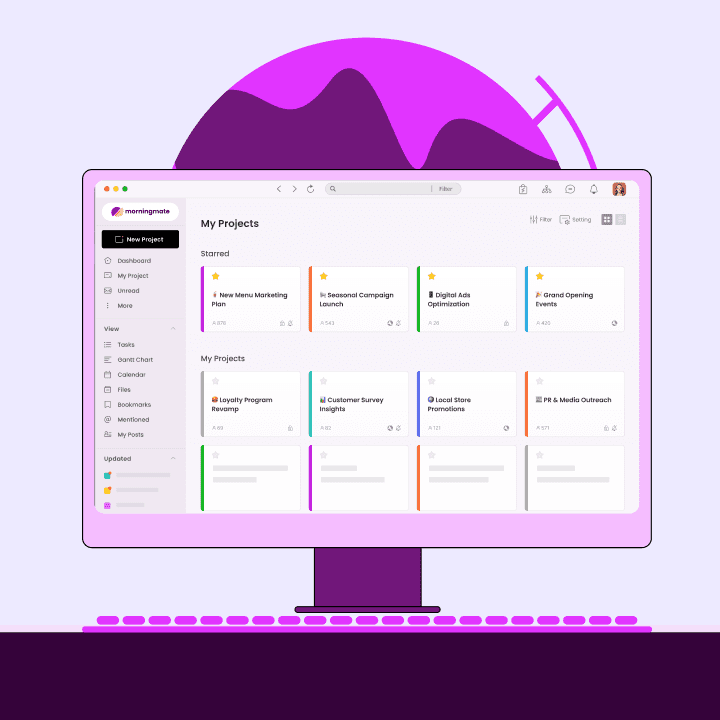
This is exactly the problem that tools like Morningmate are designed to solve. Rather than forcing teams to maintain separate wikis, document libraries, and chat threads, Morningmate brings task management, communication, and file sharing into one unified workspace. New hires can scroll through a project's Feed — which looks and feels like a familiar social media timeline — and immediately see what's been happening, what decisions were made, and what's currently in progress. The context is already there. They don't have to chase it down.
Building a Task Management System That Supports Onboarding
The fix isn't about writing a massive process manual that nobody reads. It's about building task coordination habits that naturally document work as it happens. Here's a practical framework to get there.
Step 1: Make Every Task a Record, Not Just a Reminder
Every task your team works on should carry enough context to be understood by someone seeing it for the first time. That means a clear title, an owner, a due date, and a short description of why it matters — not just what needs to be done. When task tracking is this intentional, your task list becomes an onboarding document automatically.
Step 2: Log Decisions Where the Work Lives
One of the biggest gaps in most teams is that decisions get made in meetings or over chat, but never get attached to the actual task they affect. When a new hire picks up a task and wonders why it's structured a certain way, there's no trail to follow. Fix this by making it a habit to post a quick update on the relevant task whenever a meaningful decision is made. Thirty seconds of documentation saves hours of confusion later.
Step 3: Create a Standard Onboarding Task Workflow
Build an onboarding checklist as an actual set of tasks in your task management system — not a PDF that lives in HR's folder. Assign each task to the right person (the new hire, their manager, IT, etc.), set due dates, and let the system handle follow-up. This way, onboarding itself becomes a managed process, not a wing-and-a-prayer exercise.
Step 4: Centralize Communication Around Work, Not Around People
When conversations about a project happen in a general Slack channel or a WhatsApp group, they're essentially invisible to anyone who wasn't part of them at the time. Shift communication to happen inside — or directly alongside — the relevant task or project. This is where Morningmate's built-in chat becomes genuinely useful: conversations are tied to workspaces and projects, so a new hire can read the thread history and understand exactly what was discussed without having to ask anyone to recap.
What Good Task Management Looks Like vs. What Most Teams Are Doing
Practice | Most Teams Today | High-Performing Task Coordination |
|---|---|---|
Task assignment | Verbal or message-based, easy to lose | Formally assigned with owner and deadline |
Process documentation | One-off docs, quickly outdated | Living records updated as work progresses |
Decision logging | Rarely captured, lives in memory | Posted in task comments or feed updates |
Onboarding structure | Ad-hoc, manager-dependent | Templated task workflow, repeatable each time |
Status visibility | Requires asking around | Visible to the whole team in real time |
McKinsey research on organizational performance consistently shows that teams with clear role clarity and documented workflows outperform those that rely on informal coordination — particularly during transitions like onboarding or team restructuring. The insight is straightforward: when work is visible and structured, people spend less time figuring out what to do and more time actually doing it.
The Compounding Effect: What Happens When Task Management Improves
Teams that invest in structured task tracking don't just onboard faster — they create a flywheel effect. Every task completed becomes a record. Every project finished adds to a growing body of institutional knowledge that future team members can actually access. Over time, your task management system becomes the memory of your organization.
This is especially valuable for growing companies. When you scale from 15 people to 50, you can't rely on the founding team to remember everything. You need a system that scales with you. Morningmate is built with exactly this in mind — it's intentionally lightweight enough that non-technical teams can adopt it without a steep learning curve, but robust enough to handle task coordination across an entire organization. Over 550,000 teams globally use it as their central work hub precisely because it doesn't require a consultant to set up or a training week to learn.
New Hire Productivity at 30 Days by Task Coordination Approach (%)
28%
Email + WhatsApp only
47%
Partial task tracking
79%
Centralized task workflow
Fig 2: Estimated new hire productivity at day 30 by task coordination method (illustrative)
Task Management Is the Infrastructure Your Onboarding Is Missing
Onboarding doesn't take twice as long because your new hires aren't capable — it takes twice as long because your processes aren't findable. The fix isn't a longer orientation week or a bigger handbook. It's a task management system that makes the way your team works visible, searchable, and self-explanatory from day one.
Start by auditing where your current processes actually live. If the honest answer is "mostly in people's heads," that's your starting point. Build task tracking habits that capture decisions, assign clear ownership, and keep communication tied to work rather than scattered across apps. And if your team is still relying on email threads and personal messenger apps to manage work, it's worth exploring a tool that was built to replace exactly that chaos — without making the switch feel like a technical project.
When task management is done well, new hires hit the ground running. They spend their first week understanding the work, not decoding how your team communicates. That's the difference between onboarding that costs you time and onboarding that actually builds your team.