Project Management

If your team is still managing work in a spreadsheet, you already know the cracks are starting to show — and finding a reliable project tracking spreadsheet alternative has probably crossed your mind more than once. What starts as a clean tab with color-coded rows slowly becomes a shared document nobody trusts, filled with outdated statuses and missing context. For small teams especially, that friction compounds fast.
The good news is that migrating away from spreadsheets doesn't have to mean adopting a bloated enterprise tool your team won't actually use. Many small teams land somewhere in the middle — they outgrow their spreadsheets but don't need the complexity of platforms built for hundred-person engineering departments. What they need is a project tracking spreadsheet alternative that keeps things simple while giving everyone real visibility.
This guide walks you through why the switch matters, what to look for, and exactly how to move your team from spreadsheet chaos to a system that actually works — without losing a week of productivity in the process.
Why Spreadsheets Stop Working for Small Teams
Spreadsheets are genuinely great tools — for data analysis, financial modeling, and one-person workflows. But project tracking is a team sport, and spreadsheets weren't designed for real-time collaboration. They're static by nature. They don't send reminders, they don't link tasks to conversations, and they have no concept of accountability beyond whatever column someone added for "Owner."
Research from the Project Management Institute consistently shows that poor communication and a lack of visibility are among the top reasons projects fail — both problems that spreadsheet-based tracking makes significantly worse. When your status updates live in a file that someone last edited three days ago, you're not managing work. You're managing a history of work.
Here are the specific pain points that push small teams toward a project tracking spreadsheet alternative:
Version confusion — multiple people saving different copies
No task-level comments or threaded discussions
Manual status updates that nobody remembers to do
Zero notification system for deadlines or changes
No audit trail for decisions or task history
Updates scattered across email, WhatsApp, and the spreadsheet itself
If three or more of those sound familiar, you're well past the point where a better spreadsheet template will solve the problem. You need a different kind of tool.
Pain Point | Spreadsheet Reality | Project Tracking Alternative |
|---|---|---|
Task ownership | A name in a cell | Assigned tasks with notifications |
Status updates | Manual, often stale | Real-time, team-visible |
Communication | Happens elsewhere (email, chat) | Tied directly to tasks |
Deadline tracking | No automatic reminders | Alerts and due date views |
File management | Attached externally or lost | Stored with relevant tasks |
The Real Cost of Staying on Spreadsheets
The cost of not adopting a project tracking spreadsheet alternative isn't always obvious until you start adding it up. It's not one big failure — it's a slow accumulation of small inefficiencies. Twenty minutes lost searching for the latest version of a file. A task that slipped through because nobody updated the sheet. A new team member who spent their first week confused about where to find anything.
McKinsey research found that knowledge workers spend roughly 19% of their week searching for information and tracking down colleagues. For a five-person team, that's nearly a full person-day of lost productivity every single week — driven largely by fragmented tools and no central system of record.
What to Look for in a Project Tracking Spreadsheet Alternative
Not every team needs the same solution. But when evaluating a project tracking spreadsheet alternative, small teams should prioritize ease of adoption over feature count. A tool that your whole team actually uses is infinitely more valuable than one packed with functionality that only one person understands.
Here's a practical checklist of what to look for:
Task assignment and ownership — Every task should have a clear owner and due date, visible to the whole team.
Status tracking without manual effort — Statuses should update and be visible in real time, not require someone to edit a cell.
Communication tied to work — Discussions about a task should live next to the task, not in a separate email thread.
File attachment at the task level — No more hunting through email attachments or shared drives for the right version.
Simple enough for non-technical users — If it takes a week of onboarding, your team won't stick with it.
Visibility for managers — Leaders need a way to see overall project health without interrupting the team for updates.
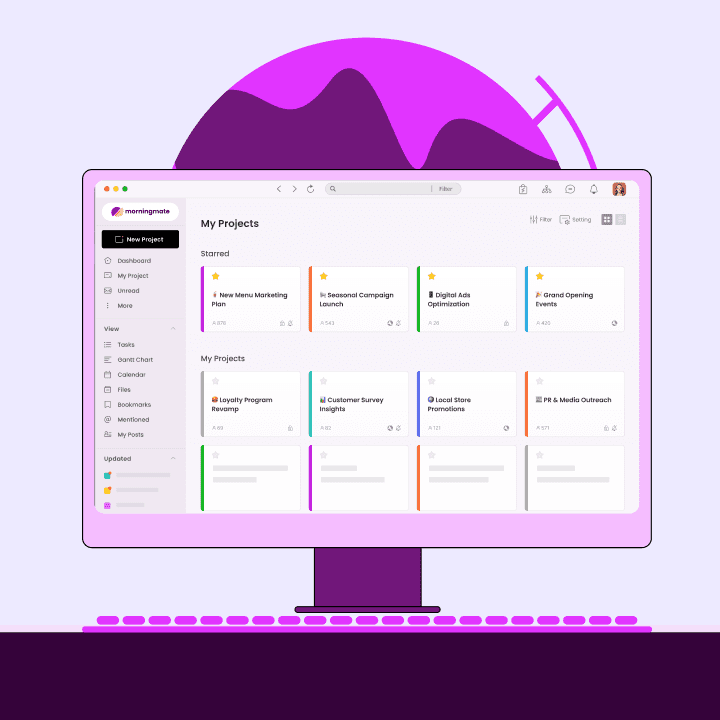
One tool worth considering is Morningmate, a lightweight work management platform used by over 550,000 teams worldwide. Its feed-based interface feels familiar — similar to a social media timeline or WhatsApp — which means even non-technical teams get comfortable quickly. Tasks, file sharing, and built-in chat all live in one place, so nothing gets scattered across tools.
How to Migrate from Spreadsheets to a Project Tracking Tool (Step by Step)
The actual migration process is simpler than most teams expect — especially for small teams where there's no legacy IT infrastructure to navigate. The key is doing it in phases rather than flipping a switch overnight.
Step 1: Audit What You're Actually Tracking
Before you move anything, spend 30 minutes reviewing your current spreadsheet. Identify every column — what does each one represent? Common ones include task name, assignee, due date, status, and notes. This becomes your data map for the new system. Anything you can't find a field for in your new tool is a signal to either adapt or simplify.
Step 2: Choose Your Project Tracking Spreadsheet Alternative
Pick one tool and commit to a 30-day pilot with a single project or team. Don't try to migrate everything at once. The goal is to prove the new system works before you abandon the old one entirely. Look for a project tracking spreadsheet alternative that lets you get started in under an hour — setup friction at this stage kills adoption.
Step 3: Recreate Your Active Tasks (Not Your Archive)
Import or manually enter only your active, in-progress tasks. There's no benefit to migrating six months of completed work. Keep your old spreadsheet read-only as an archive if you need historical reference, and focus your new tool on what's happening right now.
Step 4: Set Clear Team Norms
The biggest risk during migration isn't technical — it's behavioral. People default back to what they know. Set explicit norms: all task updates happen in the new tool, not via email or WhatsApp. All project files get attached to the relevant task. Status is updated before end of day on Fridays. Simple rules, written down and agreed upon, make all the difference.
Step 5: Run a Two-Week Check-in
After two weeks, ask the team honestly: Is this making work easier or harder? What's still being tracked in the spreadsheet out of habit? Use that feedback to adjust. Most teams find that by week three, the new system feels more natural than the old one.
Comparing Your Project Tracking Spreadsheet Alternative Options
There are dozens of tools positioning themselves as the ideal project tracking spreadsheet alternative. The challenge is that many of them are built for enterprise teams with complex workflows — and for a 10-person operations team or a growing startup, they're overkill. Here's how the landscape breaks down for small teams specifically.
Morningmate sits in the lightweight PM category, and it's specifically designed as a project tracking spreadsheet alternative for teams that need structure without complexity. Its built-in chat works like WhatsApp — familiar and fast — while its task management features give managers the visibility they need.
Harvard Business Review has noted that the best workflow tools are ones that reduce cognitive load, not add to it — meaning the right project tracking spreadsheet alternative should feel like an obvious improvement within the first week, not a burden your team has to push through.
Tool Type | Best For | Watch Out For |
|---|---|---|
Spreadsheet (current) | Solo or static data tracking | No real-time collab, no notifications |
Heavy PM tools (Jira, Asana) | Large engineering or enterprise teams | High complexity, steep learning curve |
Lightweight PM tools (Morningmate) | Small to mid-size teams, hybrid or remote | May lack advanced reporting for some use cases |
Chat-only tools (Slack, WhatsApp) | Quick communication | Tasks and decisions get buried and lost |
After the Switch: What Improvement Actually Looks Like
Teams that successfully adopt a project tracking spreadsheet alternative consistently report the same kinds of improvements: fewer status-check meetings, faster onboarding for new hires, and less anxiety around whether anything is slipping through the cracks. The shift isn't just operational — it changes how the team communicates.
When tasks, conversations, and files live in one place, there's less duplicate work and far less "did you see my message?" follow-up. Managers get visibility without micromanaging. Team members get clarity without constant check-ins. That combination — visibility plus autonomy — is what a good project tracking spreadsheet alternative actually delivers.
The transition to a project tracking spreadsheet alternative is one of the highest-leverage changes a small team can make in 2026. You're not just upgrading a tool — you're upgrading how your team works together. And unlike most process changes, this one tends to pay for itself within the first month in saved time alone.
If you're looking for a starting point, Morningmate is worth a look. It's built specifically for teams that want the structure of project management without the overhead of enterprise software. The feed view gives everyone a clear picture of what's happening across projects, the built-in chat keeps conversations contextual, and the task management system gives managers the cross-team visibility they've been missing.
Your spreadsheet served you well — but as a project tracking spreadsheet alternative becomes more accessible and more intuitive than ever, there's no reason to keep wrestling with a tool that was never built for team coordination. The switch is simpler than you think, and the upside is immediate.