Project Management

If you run a professional services firm — whether it's a consulting agency, law practice, marketing shop, or IT services company — you already know that time is your product. Billable hours are how you generate revenue, and project progress is how you keep clients happy. Yet most firms still track both using a patchwork of spreadsheets, email threads, and gut instinct. That gap between how work actually happens and how it gets recorded costs real money.
The challenge is not just about logging hours. It's about connecting the work your team does every day to the outcomes clients are paying for. When those two things fall out of sync, you end up with scope creep, under-billed projects, and teams that feel like they're always behind even when they're working hard.
This guide walks through how professional services firms can build a more reliable system for tracking billable work and project progress — one that gives you visibility without burying your team in administrative overhead.
Why Tracking Billable Work Is Harder Than It Looks
The mechanics of tracking time seem simple enough. Log hours, attach them to a project, send an invoice. But in practice, professional services work is messy. Tasks shift mid-project, multiple team members contribute to a single deliverable, and client requests often arrive through informal channels like a WhatsApp message or a quick email chain that never makes it into your project management system.
Research published by Harvard Business Review found that workers are surprisingly poor at reconstructing how they spent their time when logging it retroactively — a common practice in service firms. The result is systematic under-billing, inaccurate project cost data, and a distorted picture of where your team's capacity is actually going.
Add to that the growing complexity of hybrid and distributed teams. According to McKinsey's research on organizational performance, teams that lack shared visibility into work status spend a disproportionate amount of time just figuring out where things stand — time that in a billable context is often absorbed silently as overhead.
The Foundation: Defining Billable vs. Non-Billable Work
Before you can track billable work accurately, your entire team needs to agree on what counts as billable. This sounds obvious, but most firms leave it ambiguous — and ambiguity always resolves in favor of under-billing.
Categories to Define Up Front
A simple but effective categorization framework separates all work into four buckets. Once your team internalizes this, time-logging becomes faster and more consistent.
Directly billable: Work explicitly covered in the client contract — deliverables, strategy sessions, implementation tasks, client calls
Conditionally billable: Revision rounds, additional research, or scope extensions that may require a change order
Non-billable client work: Relationship-building activities, status updates beyond the agreed cadence, goodwill extras
Internal overhead: Admin, team meetings, training, business development
Document these definitions somewhere your whole team can access — not just in someone's inbox. This is one of the reasons many professional services firms use a centralized work management tool rather than relying on scattered documents. Tools like lightweight work management platforms let you keep these guidelines alongside the actual project tasks, so context is never more than a click away.
How to Track Project Progress Without Micromanaging
Project progress tracking in professional services is different from tracking a product roadmap. Your deliverables are often qualitative, timelines shift based on client feedback, and the "done" state of a task can be subjective. The goal is visibility, not surveillance.
Use Milestones, Not Just Task Lists
Breaking a project into milestones — discrete, client-meaningful checkpoints — gives you a much clearer picture of progress than a flat list of tasks. A milestone might be "first draft delivered," "client feedback incorporated," or "final sign-off received." These are the moments that actually matter for billing and relationship management.
Each milestone should have an owner, a target date, and a small set of tasks required to reach it. This structure makes it easy to answer the question your client will eventually ask: "Where are we?"
Build Status Updates Into the Workflow
One of the most common failure modes in professional services firms is the status-update bottleneck. A project manager has to chase down three different people across two tools just to write a weekly client update. That's non-billable time being burned on coordination overhead.
The fix is making status updates a natural by-product of how work gets done, rather than a separate administrative task. When your team logs progress directly on tasks — adding a comment, updating a status field, attaching a deliverable — that information becomes immediately visible to everyone who needs it.
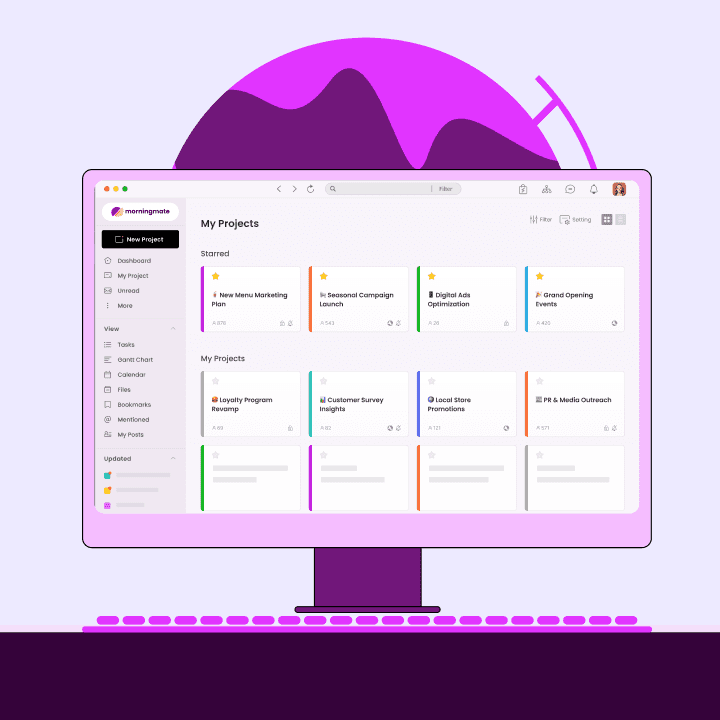
This is where tools with a feed-based interface show their value. Morningmate, a work management platform built for teams who want simplicity without sacrificing structure, uses a social-media-style feed so that updates, file attachments, and task changes surface naturally as they happen. Instead of digging through email chains to find where a deliverable was approved, your team sees it in the feed in real time. For project managers juggling multiple client accounts, that kind of ambient awareness is genuinely useful.
Practical Systems for Logging Billable Hours Accurately
The closer time-logging is to the actual work, the more accurate it will be. Every layer of separation — switching apps, reconstructing memory, batch-entering hours at the end of the week — introduces error and under-billing.
Log Time at the Task Level
Rather than asking team members to log hours against a project as a whole, connect time entries to individual tasks. This gives you two things at once: accurate billing data and a real record of where effort is going inside each project. Over time, that data tells you which types of tasks consistently blow their estimates — critical information for pricing future work.
Set a Daily Logging Habit
Encourage your team to log time at the end of each working day rather than at the end of the week. The difference in accuracy is significant. A simple team norm — fifteen minutes at the end of the day to close out tasks and log time — pays for itself many times over in billing accuracy.
For teams that communicate through a shared workspace, this habit becomes easier to maintain. When your task list and your team chat live in the same place, there's no context-switching cost to updating a task before you sign off. Morningmate's built-in chat works alongside the task and project view, so team members can quickly note what got done, flag blockers, and keep the project record current — all in one place rather than bouncing between a project tool and a separate messaging app.
A Simple Weekly Billing Audit Checklist
Before closing out each week, run through this quick audit at the project level:
Are all completed tasks marked as done and tied to a billable or non-billable category?
Has every team member logged their hours for the week against specific tasks?
Are there any scope-change conversations that need to be documented before they get billed?
Do actual hours align with the project budget estimate, or is there a variance that needs a client conversation?
Are deliverables attached to the relevant tasks so the project record is complete?
Running this audit takes under thirty minutes when your work management system is organized well. It prevents the end-of-month scramble that most service firms know too well.
Giving Leadership Visibility Without Adding Meetings
One of the biggest frustrations for operations leads and business owners at professional services firms is that getting an honest picture of where all projects stand requires either a lot of meetings or a lot of chasing. Neither scales as the firm grows.
The answer is building visibility into the system rather than trying to extract it through conversation. When tasks have clear owners, due dates, and status fields, and when those fields are kept current as a matter of team habit, leadership can see project health at a glance without asking anyone for a report.
Gallup's ongoing research on employee engagement consistently shows that workers perform better when they have clarity on their role and how their work connects to broader outcomes. In a professional services context, that clarity goes both ways: your team needs to know what's expected, and leadership needs to be able to see progress without interrupting the work to check on it.
Morningmate was built with this kind of lightweight visibility in mind. Business owners and team leads can see what's happening across projects through a shared feed and organized task boards — without needing to hold a status meeting or ping everyone individually for updates. For growing firms where the principal can no longer be in every conversation, that structural visibility is what lets the business scale without losing control.
Connecting Tracked Work to Client Conversations
All of this tracking only matters if it actually improves your client relationships and your bottom line. The data you collect on billable hours and project progress should feed directly into how you communicate with clients — not just how you invoice them.
Use Progress Data to Get Ahead of Scope Creep
When you can see in real time that a project is running twenty percent over its estimated hours before you've hit the halfway milestone, you have a choice: absorb the cost silently or have a proactive conversation with the client. Firms that track work well almost always choose the conversation — because they have the data to back it up. That transparency tends to build client trust rather than erode it.
Turn Project Records Into Reusable Templates
Every completed project is a dataset. How long did each phase actually take? Which deliverables generated the most revision rounds? Where did your original estimate diverge from reality? Capturing this at the task level means you can build more accurate proposals for similar future work — which is one of the most direct ways good tracking practice translates into revenue.
If your team works on similar project types repeatedly — a common pattern in agencies and consulting firms — consider building out project templates in your work management tool. That way, the structure that worked on the last project becomes the starting point for the next one.
The Tools Question: What You Actually Need
Professional services firms often overcomplicate their tooling. They invest in enterprise platforms that require dedicated administrators to maintain, or they bolt together five different tools that don't talk to each other. Neither extreme serves you well.
What you actually need is something that covers three things: a clear place to manage tasks and projects, a way for the team to communicate around that work without switching to a personal messaging app, and enough structure to give leadership visibility without creating an administrative burden for the people doing the work.
That's a simpler requirement than most firms realize. The firms that track billable work and project progress most effectively are rarely using the most sophisticated tools — they're using the right tools consistently. If your team currently runs on email threads and WhatsApp group chats, moving to a centralized workspace like Morningmate is the single highest-leverage change you can make. Its familiar interface — a feed that works like social media and a chat that feels like WhatsApp — means even non-technical team members adopt it quickly, which is the only way any system actually works.
What Good Tracking Actually Looks Like in Practice
Consider a small marketing consultancy with twelve people running eight client accounts simultaneously. Before implementing any system, the managing director spent every Monday morning chasing status updates via email. Invoicing was done at the end of the month based on memory and calendar reviews — clearly imprecise. Scope creep was a recurring problem because there was no record of informal client requests.
After moving to a centralized task-based system with daily logging habits and milestone-based project structures, the same team saw two immediate improvements: billing accuracy went up because time was being logged at the task level in real time, and scope creep conversations became easier because there was a documented record of what had been requested and when.
The operational overhead didn't increase. If anything, it went down — because the managing director no longer had to manually compile status information before client calls. It was simply there.
That's the outcome good tracking practice should produce: less administrative noise, more accurate billing, and a clearer picture of where your firm's capacity is going — without adding complexity to the work itself.