Project Management

Missing a client deadline at a marketing agency is not just an inconvenience — it can cost you the account. Clients in the agency world have little tolerance for late deliverables, and with multiple campaigns, brands, and stakeholders running in parallel, even one dropped ball can damage trust that took months to build. The challenge is rarely about effort. It is almost always about systems.
Most agencies start out managing client deliverables through email threads, shared spreadsheets, and group chats. That approach works when you have two clients. It completely falls apart when you have twelve. Work gets siloed across inboxes, feedback gets buried in WhatsApp threads, and nobody has a clear picture of what is due, who owns it, or where it stands.
The good news is that fixing this does not require an expensive project management overhaul or weeks of onboarding. What it requires is a clear structure for how your team captures, tracks, and communicates client work — and the discipline to follow it. This guide walks you through exactly how to build that structure.
Why Marketing Agencies Struggle with Client Deliverables
Marketing agencies operate in a uniquely chaotic environment. Unlike internal product teams, agencies juggle deliverables across multiple clients simultaneously, each with different timelines, brand guidelines, approval processes, and communication styles. A single account manager might be tracking deliverables for five clients on any given Tuesday.
Research from Harvard Business Review has consistently shown that unclear ownership and poor visibility into project status are among the leading causes of missed deadlines in knowledge work environments. In an agency context, this problem is amplified because the consequences are external — the client sees every failure in real time.
The Most Common Breakdown Points
Before you can fix the problem, it helps to name exactly where things go wrong. In most agencies, deadline failures trace back to a handful of recurring issues:
No single source of truth for what is due and when
Feedback and approvals stuck in email or personal messaging apps
Tasks without clear owners — everyone assumes someone else is handling it
Scope changes that never get reflected in the original timeline
Handoffs between team members that happen verbally and leave no trail
Each of these is a process problem, not a people problem. The fix is structural.
Build a Deliverable Tracking System Your Whole Team Will Actually Use
The best system is the one your team sticks to. Overly complex tools tend to get abandoned within weeks, especially in creative teams where people did not sign up to do project management. Simplicity and clarity matter more than features.
Step 1 — Create a Master Deliverable List Per Client
Every client account should have one living document or workspace that captures every deliverable, its due date, its current status, and who owns it. This is not the same as a project brief or a scope document. It is an operational tracker that your team references daily.
For each deliverable, capture at minimum: the deliverable name, the internal deadline (always set this a day or two before the client deadline), the assigned team member, the current status, and any dependencies. If a social media graphic cannot be designed until the copy is approved, that dependency needs to be visible.
Step 2 — Assign Clear Ownership, Not Shared Responsibility
Every deliverable needs one person whose name is attached to it. Shared ownership sounds collaborative, but in practice it means everyone assumes someone else is watching the deadline. One owner does not mean one person does all the work — it means one person is accountable for making sure the work gets done and escalates early if there is a problem.
This principle also applies to client feedback rounds. Assign someone to chase approvals. Do not let review cycles stall because nobody is explicitly responsible for pushing them forward.
Step 3 — Set Internal Deadlines, Not Just Client Deadlines
Client deadlines are non-negotiable. Internal deadlines give you buffer. A good rule of thumb is to set the internal deadline at least 24 to 48 hours before the client-facing date. This gives you time to handle last-minute revisions, quality checks, or unexpected blockers without missing the actual delivery window.
Make sure these internal deadlines live in the same place as the rest of the deliverable information — not in someone's personal calendar that only they can see.
Centralize Communication Around the Work, Not Away from It
One of the most damaging habits in agency life is conducting work conversations in tools that are disconnected from the work itself. When feedback on a deliverable lives in a WhatsApp thread and the deliverable lives in a shared drive and the task lives in a spreadsheet, your team is spending energy just connecting the dots — energy that should go toward doing the actual work.
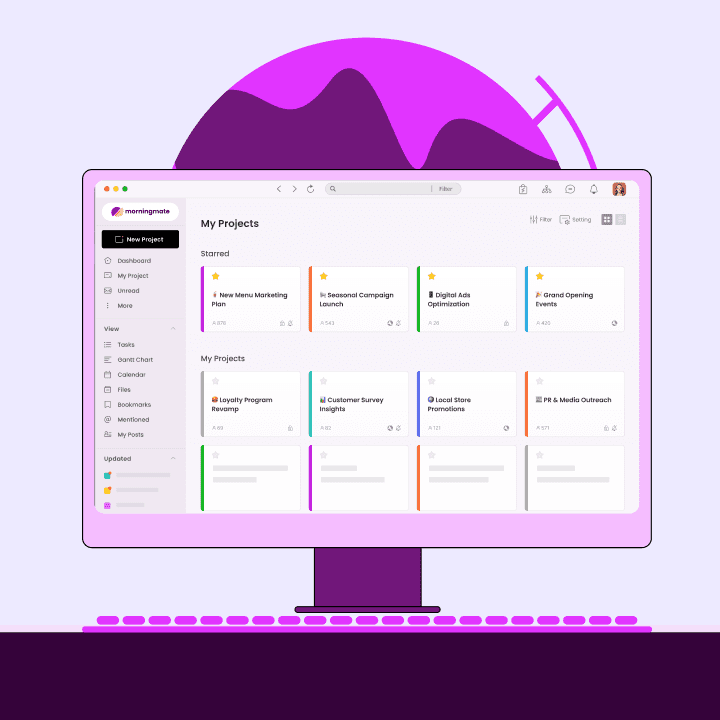
This is where a tool like Morningmate makes a real difference for agency teams. Morningmate is a lightweight work management platform that combines task management with a built-in team chat, so conversations about a deliverable happen right alongside the task itself. Instead of chasing context across five different apps, your team has everything in one place — updates, files, and discussions all connected to the work they belong to.
Stop Using Personal Messenger Apps for Client Work
WhatsApp and similar tools are designed for personal communication. They lack threading, search history often disappears, and there is no way to link a conversation to a task or deadline. When a client revision request arrives at 9pm in a WhatsApp group, there is a real chance it gets missed or forgotten by Monday morning.
Moving your internal work communication to a dedicated workspace — even a simple one — immediately reduces the noise and creates a searchable record of every decision, feedback, and status update related to each client account. That record becomes invaluable when a client disputes a timeline or asks why something was changed.
Create a Consistent Check-In Rhythm
Beyond the tools, your team needs a rhythm. A brief weekly sync — 20 to 30 minutes — where each account lead walks through the upcoming deliverables for the week ahead catches problems before they become missed deadlines. Keep it structured: what is due this week, what is at risk, what needs a decision.
You can also do a lighter daily async check-in. Each team member posts a quick update at the start of their day: what they are working on and if anything is blocked. This does not require a meeting — it just requires a shared space where everyone is expected to contribute. Morningmate's feed-style interface makes this feel natural rather than like a chore, since updates appear in a social-style stream that is easy to scan and respond to without formal meetings.
Handle Scope Creep Before It Kills Your Timeline
Scope creep is the silent deadline killer in most agencies. A client adds one more round of revisions. Then asks for an extra asset. Then wants the campaign extended to a new platform. Each request feels small in isolation, but together they quietly push your team past capacity while the original deadlines stay fixed.
According to the Project Management Institute, scope creep affects nearly half of all projects and is one of the primary reasons projects run over time and budget. In an agency setting where margins are already thin, this matters enormously.
Build a Lightweight Change Request Process
You do not need a formal contract amendment every time a client asks for something extra. You do need a habit of flagging it. When a new request comes in that falls outside the original scope, the account lead should respond with a brief note: "Happy to add this — I will update the timeline and let you know if this affects the delivery date." That simple act creates a record and sets the right expectation.
Internally, any scope change should trigger an update to the deliverable tracker. New tasks get added, ownership gets assigned, and the timeline gets adjusted before the work begins — not after the deadline is missed.
Use a Deliverable Status Framework Your Whole Team Shares
When everyone defines "in progress" differently, status updates become meaningless. One team member's "almost done" is another's "just started." A simple shared framework removes ambiguity and makes it easy to see the real state of any deliverable at a glance.
Here is a straightforward five-stage framework that works well for most marketing agency deliverables:
Not started — task exists, no work begun
In progress — actively being worked on
In review — ready for internal review before client submission
Awaiting client approval — submitted, waiting on client feedback
Complete — approved and delivered
Everyone on the team uses these exact labels — nothing else. When a manager or operations lead checks the tracker, they can see in seconds which deliverables are stuck in review, which ones are waiting on a client, and which ones have not been started yet with two days to go. That visibility is what prevents surprises.
This is also where a tool like Morningmate earns its place. Morningmate's task management features let you assign statuses, set due dates, and attach files directly to tasks — so your tracker is not a separate spreadsheet someone has to remember to update, but the actual workspace where the work happens. Teams using Morningmate report that having tasks, files, and chat in one place reduces the back-and-forth that typically delays client deliverables. You can explore how task management works for creative teams to see how this applies in practice.
Client Communication That Protects Your Deadlines
Your internal process is only half the equation. The other half is how you communicate with clients. Poor client communication creates the conditions for missed deadlines even when your internal team is executing well — because approvals stall, feedback arrives too late, or expectations get misaligned.
Set Clear Feedback Windows
Every time you submit a deliverable for client review, include a specific feedback deadline. Do not say "let us know your thoughts." Say "please share your feedback by Thursday at noon so we can incorporate revisions and deliver the final version on Friday." This is not pushy — it is professional, and most clients appreciate the clarity.
If feedback does not arrive by the agreed window, follow up the same day — not two days later. A quick message that says "Just checking in on the feedback for the campaign brief — we want to make sure we stay on track for Friday delivery" is all it takes. The key is following up promptly rather than hoping the client will remember on their own.
Proactively Flag Risks Before They Become Problems
If you can see three days out that a deadline is at risk — because a designer is sick, a tool is not cooperating, or a dependency has not been resolved — tell the client before the deadline passes, not after. A heads-up three days early gives you options. An apology after a missed deadline gives you nothing.
Most clients are far more forgiving of proactive communication than they are of being surprised. A simple message that says "We want to flag that the campaign assets are tracking slightly behind — we are managing it internally and expect to deliver by end of day Friday rather than Thursday" keeps the relationship intact. Silence followed by a miss does not.
A Practical Weekly Workflow for Agency Deliverable Management
Putting it all together, here is a weekly workflow structure that agencies of all sizes can adapt. This does not require sophisticated tools to implement — it requires consistency.
Monday — Set the Week
At the start of the week, each account lead reviews their client deliverable tracker and confirms what is due in the next five to seven days. Any deliverable without a clear owner or status gets flagged immediately. The team has a short sync — in person, on a call, or async — to surface any risks before the week is in motion.
Wednesday — Mid-Week Check
By Wednesday, you should be able to tell whether this week's deliverables are on track. If something looks at risk, Wednesday is the last comfortable moment to communicate proactively with a client or reallocate resources internally. Waiting until Thursday or Friday removes all your options.
Friday — Wrap and Preview
Close out the week by confirming all deliverables have been submitted or are on track. Update statuses in your tracker so Monday's review starts from an accurate picture. Do a quick preview of next week's due dates so nothing catches you off guard on Monday morning.
This rhythm is simple on paper and genuinely powerful in practice. Teams that follow it consistently report fewer last-minute scrambles and better client satisfaction — not because they work harder, but because they work with more visibility.
When to Invest in Dedicated Work Management Tools
Spreadsheets can take you surprisingly far if your team is disciplined. But as your client roster grows past five or six accounts, the manual upkeep of a spreadsheet tracker starts to create its own overhead. Updates get missed, versions diverge, and the tracker itself becomes a source of confusion rather than clarity.
That is the point at which a lightweight work management tool pays for itself quickly. The key word is lightweight. Many agencies make the mistake of adopting tools like Jira or complex Asana configurations that are built for software development teams — and then spend weeks trying to customize them for creative workflows, only to find the team has reverted to WhatsApp within a month.
Morningmate is built for exactly this use case — teams that need real structure without the steep learning curve. Its interface is familiar enough that non-technical team members adopt it quickly, and its combination of task tracking and built-in chat means your team does not need to context-switch between five tools just to manage one client deliverable. With over 550,000 teams using the platform globally, it is particularly well-suited to agencies that need to move fast without sacrificing visibility.
The Bottom Line on Managing Client Deliverables
Managing client deliverables without missing deadlines is not about working longer hours or hiring more people. It is about building the right habits and systems so that nothing falls through the cracks — and problems surface early enough to be solved before they become client-facing failures.
Start with clear ownership. Add a shared status framework. Centralize your communication around the work. Set internal deadlines that give you breathing room. And communicate proactively with clients, especially when something is at risk. These are not complicated changes, but they compound quickly into the kind of operational discipline that earns long-term client trust.
Your clients are not just paying for the work — they are paying for the reliability. Build the systems that make you reliably excellent, and the deadlines take care of themselves.