Project Management

Most project status dashboards get built once and abandoned fast. The team checks it for a week, then reverts to asking for updates in chat, replying "any news?" in email threads, and pulling someone out of deep work just to find out where things stand. Sound familiar?
The problem usually isn't the dashboard itself — it's that it was designed for the person who built it, not the people who need to use it every day. A great project status dashboard solves a communication problem first, and a visibility problem second. When you get that order right, your team actually opens it.
This guide walks you through how to build a project status dashboard your whole team will genuinely rely on — from deciding what to track, to keeping it alive past the first two weeks.
Why Most Status Dashboards Fail Before They Start
Before you build anything, it helps to understand why most dashboards quietly die. Several studies have consistently shown that tool adoption fails when the tool adds work for the people expected to use it, rather than removing it. A dashboard that requires manual updates, duplicate data entry, or a learning curve becomes a chore — and chores get skipped.
There's also the problem of building for the wrong audience. Many dashboards are designed top-down — built to satisfy an executive's need for a weekly overview, but loaded with enough detail to confuse everyone else. The result: leadership doesn't trust it because it's too granular, and the team ignores it because it doesn't reflect how they actually work.
The Three Most Common Dashboard Mistakes
Tracking too many metrics that nobody uses to make decisions
Requiring manual updates that create a second job for team leads
Designing for reporting instead of for action
A useful dashboard is one that answers the questions your team asks most often — and ideally answers them before anyone has to ask.
Step 1: Define What "Status" Actually Means for Your Team
Before you open any tool, get clear on what your team needs to know at a glance. This sounds obvious, but most teams skip it and end up with a dashboard that shows everything and communicates nothing.
Start by asking three questions across your team — not just management:
What's the one thing you always want to know about a project without having to ask anyone?
What update do you currently have to chase down most often?
What information do you look at and immediately know whether to take action?
The answers will tell you exactly which data points belong on your dashboard — and which ones are just noise. For most teams, the core elements come down to: current task status, upcoming deadlines, blockers, and ownership. Everything else is detail that belongs one click deeper.
Status Labels That Actually Work
Generic labels like "In Progress" or "Pending" are almost useless without context. Instead, use status labels that imply action. Something like "Waiting on Approval," "Blocked — Needs Input," or "On Track for Friday" tells anyone reading the dashboard exactly what the situation is and whether they need to do something about it.
Keep your label system to five or fewer options. More than that, and people start to guess which one fits, which defeats the purpose entirely.
Step 2: Choose the Right Level of Detail for Each Audience
One of the fastest ways to kill dashboard adoption is trying to serve every stakeholder with the same view. A founder checking in on three active projects needs a completely different snapshot than the designer managing individual deliverables inside one of those projects.
Think in layers:
Executive layer: Is the project on track? Any blockers leadership needs to resolve? What's the delivery timeline?
Team lead layer: What tasks are overdue? Who's overloaded? What decisions are pending?
Contributor layer: What do I need to do today? What's blocked? What did I just complete?
If your tool supports it, build separate views for each layer rather than forcing everyone to filter through the same wall of information. This is where a task management tool with flexible views makes a real difference in whether people come back to the dashboard voluntarily.
How Morningmate Handles Multi-Level Visibility
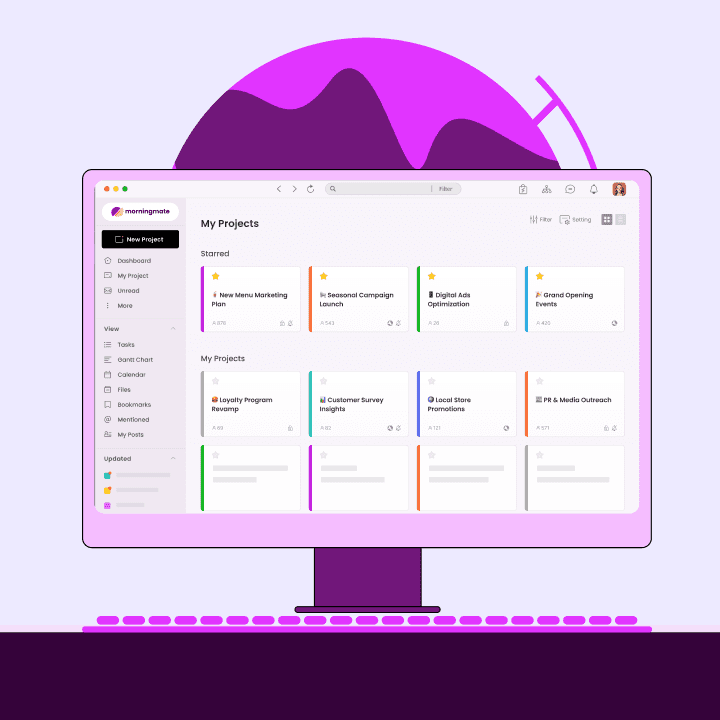
Morningmate — a lightweight work management platform used by over 550,000 teams — uses a Feed view designed to feel like a social media timeline. This means team members can scroll through updates, tasks, and project activity the same way they'd check Instagram or LinkedIn, without learning a new interface. For non-technical teams especially, this dramatically reduces the resistance that kills most tool rollouts.
Managers get a consolidated view of what's happening across projects, while individual contributors see what's relevant to their work. No one has to dig through nested menus or decode complicated filters just to find out what's happening.
Step 3: Make Updates Effortless or They Won't Happen
Here's the hard truth: if updating the dashboard takes more than 30 seconds, it won't get done consistently. And an outdated dashboard is worse than no dashboard — it creates false confidence and bad decisions.
McKinsey research has found that employees spend a significant portion of their week searching for information and waiting for updates — time that a well-maintained dashboard could eliminate entirely. But only if it's kept current without becoming a burden.
Tactics That Keep Dashboards Updated
Tie status updates to existing workflows — when a task moves to "Done," the dashboard updates automatically
Make Friday afternoon status reviews a five-minute team ritual, not an hour-long report
Use inline comments and task threads so context lives where the work lives
Assign one person per project as the "dashboard owner" — not to do all the updates, but to flag when data goes stale
The goal is to make updating the dashboard a natural byproduct of doing the work — not a separate task piled on top of it.
Step 4: Design for a Weekly Rhythm, Not a One-Time Setup
A project status dashboard isn't a document you create and file away. It's a living communication tool that needs a rhythm around it to stay useful. The teams that actually use their dashboards week over week tend to have a simple, repeatable cadence.
A basic weekly structure that works well for most teams:
Monday: Team lead reviews dashboard, confirms priorities are current
Wednesday: Mid-week check for blockers or shifted timelines
Friday: Each contributor updates their task statuses before logging off
This cadence doesn't require additional meetings. It simply builds dashboard maintenance into the workweek as a lightweight habit rather than a reporting obligation.
Replacing Status Meetings With Async Updates
One of the biggest wins a good dashboard delivers is reducing the number of status meetings your team has to sit through. Gallup's workplace research points to unnecessary meetings as one of the primary drivers of disengagement, particularly in remote and hybrid teams.
When your dashboard is accurate and accessible, the answer to "where does this project stand?" is always available without scheduling a call. This is especially valuable for remote teams managing async communication across time zones, where a quick status meeting can mean pulling someone in at 7am or 10pm just to share information that could have lived in a shared view.
Morningmate's built-in chat — which mirrors the familiar interface of WhatsApp — lets teams pair their dashboard with quick, contextual messaging without switching between tools. Instead of emailing for an update or texting in a personal messenger app, your team can ask, answer, and attach files all in the same workspace where the project tasks live.
Step 5: Keep It Simple Enough to Survive Busy Weeks
The real test of any dashboard is whether it gets used when things get hectic — not just when there's time to be organized. A dashboard that requires careful maintenance to stay useful will always lose to the chaos of a busy quarter.
That means resisting the urge to add more over time. Every time you feel tempted to add a new column, metric, or field, ask: would someone on my team check this every week without being asked to? If the answer is no, it doesn't belong on the main view.
A Simple Dashboard Checklist Before You Launch
Can anyone on the team understand the dashboard in under 60 seconds without a tutorial?
Does it show who owns each project or task?
Are blockers visible at a glance — not buried inside tasks?
Is it connected to where the actual work happens, or does it require separate updates?
Have you tested it with someone outside of management?
If you can check every item on that list, you've built something your team will actually come back to.
What Good Looks Like: A Real-World Example
Imagine a hybrid team of 25 people managing three simultaneous product launches. Before building a shared dashboard, the operations lead spent the first hour of every Monday compiling updates from email, Slack, and WhatsApp into a single spreadsheet — which was already outdated by the time she sent it.
After restructuring around a centralized project status dashboard — with one view per project, clear ownership, and a Friday update ritual — the Monday morning summary became a two-minute skim. The team knew exactly where each launch stood, who was blocked, and what needed a decision before the week got moving.
That shift didn't come from a fancier tool. It came from being deliberate about what the dashboard needed to do and making it easy enough that keeping it current wasn't optional — it was just part of how the team worked.
Tools like Morningmate are built around exactly this kind of workflow — giving growing teams a single place where tasks, updates, files, and conversations connect, without the complexity of enterprise project management software that requires a dedicated admin to maintain. If your team is still coordinating across email and personal messenger apps, it's worth seeing how teams are moving away from scattered communication into one organized workspace.
The Dashboard Is Only as Good as the Culture Around It
No dashboard — no matter how well designed — fixes a culture where people aren't expected to communicate proactively. If your team sees status updates as extra work rather than as part of the job, the dashboard will collect dust regardless of how intuitive it is.
The most effective teams treat the dashboard as the source of truth — not a backup. When a question gets asked in a meeting, the answer points back to the dashboard. When a project gets delayed, the dashboard is where that gets recorded first. Over time, this builds a habit of transparency that makes the whole team more aligned and a lot less reactive.
Start small, keep it visible, and resist adding complexity until you've earned it with consistent usage. That's how you build a project status dashboard your whole team actually uses — and keeps using, long past the initial rollout enthusiasm.