Project Management

Every tool your team adds to its stack comes with a price tag you can see — and several you cannot. Subscription fees show up on invoices. The other costs? They hide in onboarding hours, support tickets, duplicated data, and the slow frustration of asking your team to log into yet another platform. Niche tools like YunoJuno and Clearfeed are built to solve specific problems, and they often do that job well. But the hidden cost of niche tools is rarely discussed honestly before the contract is signed.
The pattern is familiar. A team identifies a pain point — freelancer management, support ticket routing, contractor invoicing — and finds a specialized tool that fits perfectly. Six months later, that tool is one of eight platforms the team switches between daily. Nobody planned for the integration overhead, the per-seat pricing that compounds as you grow, or the fact that critical work information now lives in four different places.
This is not an argument against specialized software. It is an argument for going in with open eyes. Before you commit to another niche platform, here is what you are actually signing up for.
What Makes a Tool "Niche" — and Why That Matters
A niche tool is purpose-built for one workflow or one type of user. YunoJuno, for example, focuses on freelancer and contractor management — sourcing, contracts, and payments. Clearfeed is designed to turn Slack channels into structured support queues. Both solve real problems. But their narrow focus is also the source of their hidden costs.
When a tool does one thing, everything adjacent to that thing still needs to happen somewhere else. Contracts get signed in YunoJuno, but the actual work gets coordinated in email. Tickets get logged in Clearfeed, but the context behind those tickets lives in a Notion doc nobody updates. The tool fills a gap — and creates two new ones on either side.
The Real Hidden Costs You Are Paying Right Now
1. Context Switching Tax
Every time your team moves between tools, there is a cognitive cost. Research published in Harvard Business Review has consistently shown that switching tasks and environments degrades focus and increases error rates. In practical terms, an employee juggling five platforms in a workday is not working at full capacity on any of them.
With niche tools, this tax is structural. You are not switching because of bad habits — you are switching because the tool only covers one slice of the workflow. Your team finishes a task in YunoJuno and immediately has to go somewhere else to communicate about it.
2. Integration Costs That Compound Over Time
Most niche tools offer integrations — Zapier connections, API hooks, native syncs with Slack or Google Workspace. These sound reassuring during demos. In practice, integrations require maintenance. APIs change. Zaps break. Someone on your team eventually becomes the unofficial owner of making sure data flows correctly between systems, and that someone has a real job to do that is not plumbing your tool stack.
McKinsey's research on technology adoption highlights that integration complexity is one of the top reasons digital tools fail to deliver expected ROI. The integration cost is rarely included in the vendor's pricing page.
3. Per-Seat Pricing That Sneaks Up on You
Niche tools tend to price per seat. At five users, the monthly fee looks manageable. At thirty users — which happens faster than expected at growing companies — you are suddenly paying for thirty seats in a tool that only ten people use regularly. The others were added for visibility or occasional access, and they are costing you full price.
Multiply that pattern across three or four niche tools in your stack and you have a significant monthly spend on platforms that overlap in purpose, fragment your data, and each require their own onboarding every time someone new joins the team.
4. Onboarding and Training Overhead
Every new tool requires a learning curve — not just for you, but for every person you hire. The more specialized the tool, the steeper that curve tends to be. YunoJuno has its own taxonomy for projects, contracts, and rates. Clearfeed has its own workflow logic for triaging requests. Neither is intuitive to someone who has never used it.
For non-technical teams — operations, HR, sales, creative — this friction is particularly painful. Tools built by engineers, for engineers, rarely account for the person on your team who just wants to know what is happening with a project. Gartner has flagged tool complexity and poor adoption rates as a persistent challenge for organizations investing in workplace technology.
5. Fragmented Information and Knowledge Loss
When work happens across many tools, institutional knowledge scatters. The decision about why a freelancer was dropped from a project lives in a YunoJuno comment nobody exports. The context behind a support escalation is buried in a Clearfeed thread that gets archived automatically. When someone leaves the team, that knowledge often goes with them — because it was never in a place the whole team could see.
This is one of the quietest and most expensive costs. It does not show up in a line item. It shows up when a new hire spends two weeks reconstructing decisions that were already made, or when your team makes the same mistake twice because nobody could find the record of the first time.
A Practical Framework for Auditing Your Tool Stack
Before adding any new niche tool — and especially before renewing existing ones — run your current stack through this five-question audit:
Overlap check: Does this tool do something that another tool in the stack already does, even partially? Overlapping tools mean duplicated data and split attention.
Integration dependency: Does this tool require a third-party integration to function within your workflow? If yes, who owns that integration when it breaks?
Adoption reality: How many people on your team actually use this tool weekly? Not who has a seat — who actively logs in.
Information portability: If you cancelled this tool tomorrow, what data would you lose and could you export it cleanly?
Onboarding cost: How long does it take a new team member to get up to speed on this tool? Multiply that by your average annual hiring rate.
If a tool fails more than two of these checks, it is worth exploring whether a more consolidated alternative could handle the same need with less overhead.
When Consolidation Makes More Sense Than Specialization
There is a category of work — task coordination, team communication, file sharing, project visibility — where niche tools create the most fragmentation for the least gain. These are not exotic needs. They are the basic mechanics of how work gets done every day. And yet many teams address them with four or five separate tools instead of one platform that handles all of them together.
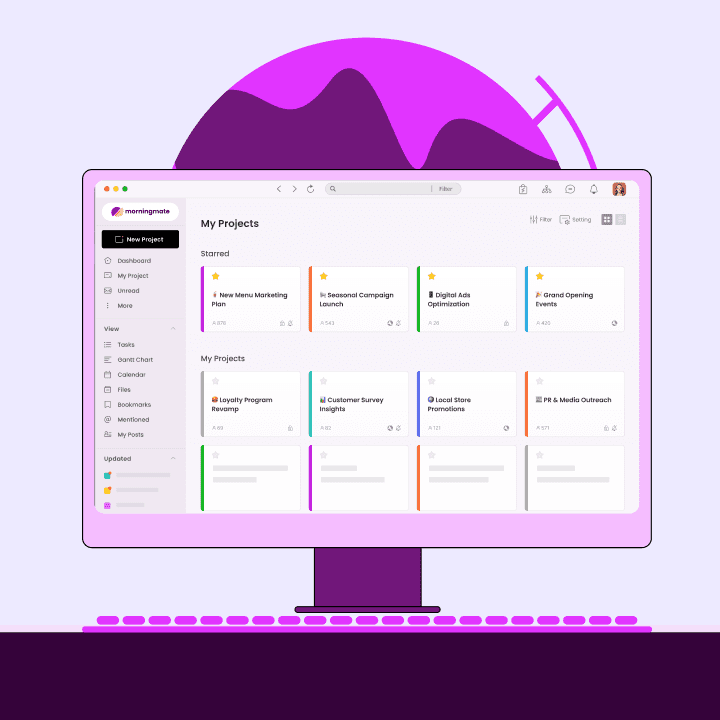
This is exactly the gap that tools like Morningmate are designed to fill. Morningmate is a lightweight work management platform that combines task management, built-in team chat, and file sharing in a single workspace. The interface is deliberately familiar — the feed view works like a social media timeline, and the chat works like WhatsApp — so your team does not need a training program to start using it effectively. For teams that are tired of switching between a project tool, a chat app, and an email thread just to move one piece of work forward, that consolidation is worth a lot.
Where Niche Tools Still Win
To be fair, there are situations where a niche tool is genuinely the right call. If your entire business model depends on managing hundreds of freelancers with complex contract and payment workflows, YunoJuno's depth is hard to replicate with a general platform. If your support team handles a high volume of structured requests that need SLA tracking and escalation logic, Clearfeed earns its place in the stack.
The question is not whether niche tools have value. It is whether your team's use case is specific enough to justify the hidden costs. Most teams running a niche tool for a moderate-volume, non-critical workflow would be better served by a platform that handles the broader job — and keeps everything in one place.
Signs Your Stack Has Too Many Niche Tools
If any of these describe your team, the hidden costs of niche tools are likely already affecting you:
New hires regularly ask which tool to use for a given task, and the answer is always "it depends"
You have had a conversation about consolidating tools for at least six months but nothing has changed
Important updates or decisions are regularly missed because they were in a tool not everyone checks
You have integrations between tools that nobody fully understands and everyone is afraid to touch
Your monthly SaaS spend has grown faster than your headcount
Work gets started in one tool and finished in another, with no clean record of the full picture
How to Make a Smarter Tool Decision Going Forward
When evaluating any new platform — niche or otherwise — go beyond the feature checklist. Ask the vendor what happens to your data if you leave. Ask your team how they would actually use it day-to-day, not how they would use it in the ideal scenario the demo shows. And honestly account for the time cost of managing the tool itself, not just using it.
For teams that are managing async communication or trying to give leadership better visibility across projects, the answer is rarely a more specialized tool. It is usually a simpler, more unified one. Morningmate's approach — combining tasks, chat, and file management in one feed-based workspace used by over 550,000 teams — is built around that idea. Less switching, less scattered context, more actual work getting done.
The hidden cost of niche tools is not a reason to avoid building a thoughtful stack. It is a reason to build one honestly, with a clear accounting of what each tool actually costs — in money, in time, and in the attention of the people doing the work.