Project Management

Google Jamboard was a staple for teams who needed a quick digital whiteboard to brainstorm, map out ideas, or run visual workshops. Then Google announced it would shut Jamboard down — and suddenly thousands of teams were left searching for a reliable replacement. If you're in that position right now, you're not alone.
The good news is that the market for collaborative visual tools has grown significantly. There are now more Google Jamboard alternatives than ever, ranging from feature-rich whiteboarding platforms to lightweight tools that focus purely on getting teams aligned quickly. The challenge is knowing which one actually fits how your team works.
This guide breaks down the best alternatives to Google Jamboard, what to look for when choosing one, and how to build a collaboration setup that doesn't just replace Jamboard — but genuinely improves on it.
Why Teams Are Moving Away From Jamboard (And What They Actually Need)
Jamboard's appeal was its simplicity. It mimicked a physical whiteboard closely enough that even non-technical teams could use it without a learning curve. But simplicity alone isn't enough when your team's collaboration needs grow more complex.
According to Harvard Business Review, hybrid and remote teams consistently struggle not with a lack of tools, but with too many disconnected ones. Replacing Jamboard isn't just about finding another whiteboard — it's about finding something that fits into your existing workflow without creating yet another silo.
When evaluating a Google Jamboard alternative, look for these core qualities:
Real-time collaboration with low latency
Ease of use for non-technical team members
Ability to export or save sessions easily
Integration with tools your team already uses
Mobile accessibility for hybrid and remote teams
The Best Google Jamboard Alternatives in 2026
There is no single best tool for every team. The right choice depends on your team size, technical comfort level, and how central visual collaboration is to your day-to-day work. Here are the top options worth considering.
Miro
Miro is one of the most popular whiteboarding tools available today, and for good reason. It offers an enormous canvas, hundreds of templates, and deep integrations with tools like Slack, Notion, and Jira. Teams use it for everything from sprint planning to customer journey mapping.
The trade-off is complexity. Miro's full feature set can feel overwhelming for teams who just want a simple digital sticky-note board. It's best suited for product, design, and engineering teams that run structured workshops regularly.
FigJam
FigJam is Figma's answer to collaborative whiteboarding. It's clean, fast, and remarkably intuitive — especially if your team already uses Figma. The interface feels playful but purposeful, with built-in voting, timer tools, and reactions that make workshops more engaging.
For teams outside of design, FigJam can feel slightly disconnected from their everyday tools. But as a standalone brainstorming space, it's one of the most enjoyable to use.
Microsoft Whiteboard
If your organization runs on Microsoft 365, Microsoft Whiteboard is the most frictionless Jamboard replacement available. It integrates directly into Teams, which means your team doesn't need to switch contexts during meetings. It's straightforward, well-maintained, and free within the Microsoft ecosystem.
It doesn't have the template depth of Miro or the design polish of FigJam, but for teams that need something reliable and already familiar, it gets the job done.
Mural
Mural positions itself as a visual collaboration tool built for structured facilitation. It comes with guided templates for design thinking, agile workflows, and team retrospectives. Facilitators especially love the "facilitation superpowers" mode, which lets a host guide participants through a session step by step.
It's a strong choice for operations leads or managers who regularly run workshops and need more structure than a blank canvas provides.
Canva Whiteboards
Canva extended its design platform to include an infinite whiteboard feature. If your team already uses Canva for visual content, the whiteboard tool is a natural extension. It's not as feature-rich as Miro for facilitation purposes, but it's visually polished and very easy to pick up.
Non-technical teams — think marketing, HR, or operations — often gravitate toward Canva because the interface feels familiar and non-intimidating.
What Most Jamboard Alternatives Don't Solve
Here's something worth naming directly: whiteboarding tools solve the brainstorming problem, but they don't solve the follow-through problem. How many times has your team run a great workshop, filled a board with ideas, and then watched nothing happen with those insights afterward?
A McKinsey report on team performance found that one of the most common gaps in collaborative work is the transition from idea generation to structured action. Teams capture ideas visually but fail to convert them into assigned tasks with clear ownership and deadlines.
This is where having the right work management layer matters just as much as the whiteboarding tool itself. Visual collaboration and task execution need to connect — otherwise you're just creating beautiful boards that gather digital dust.
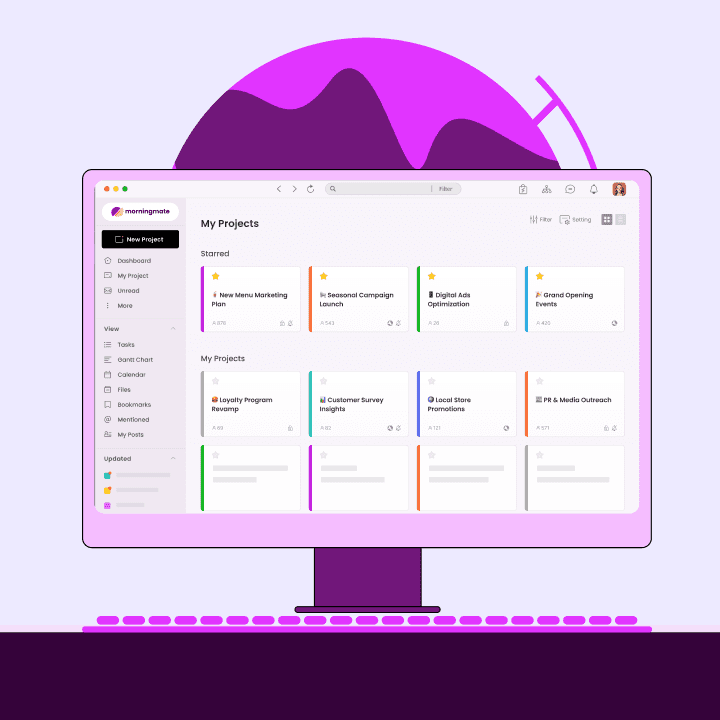
That's a gap that tools like Morningmate are built to address. Morningmate is a lightweight work management and team communication tool that keeps tasks, updates, and conversations in one organized workspace. After a brainstorming session on Miro or FigJam, your team can move action items directly into Morningmate's task management system — with owners, due dates, and status tracking — instead of losing them in a chat thread or email chain.
How to Choose the Right Google Jamboard Alternative for Your Team
Rather than defaulting to the most popular option, walk through these questions before making a decision.
Step 1: Identify how often you actually use a whiteboard
If your team runs visual workshops daily or weekly, a full-featured tool like Miro or Mural is worth the investment. If you only need a whiteboard a few times a month, a simpler free option like Microsoft Whiteboard or Canva Whiteboards will do the job without adding unnecessary overhead.
Step 2: Consider your team's technical comfort level
Not every team is full of tech-savvy users. If you manage an operations, logistics, or field-based team, you need a tool people will actually open and use — not one that requires a tutorial every time. This is a principle that Morningmate is built around too: the platform is intentionally simple, with a feed-style interface that feels familiar to anyone who uses social media or WhatsApp, so even non-technical team members can get up and running without training.
Step 3: Map it to your existing tool stack
The best tool is the one that fits cleanly into how your team already works. If you're deep in the Microsoft ecosystem, start with Microsoft Whiteboard. If you're a design-led team, FigJam is an obvious fit. The goal is reducing friction, not adding new apps that your team has to learn and maintain.
Step 4: Think beyond the whiteboard session itself
Ask yourself: what happens after the session ends? If the answer is "we export a screenshot and move on," that's a process problem worth fixing. Build a habit of converting whiteboard outputs into structured tasks and follow-up actions using a dedicated work management tool. That single habit change will do more for your team's productivity than any whiteboard feature ever will.
Building a Collaboration Stack That Actually Works
The teams that get the most out of collaborative tools aren't necessarily using the most sophisticated ones — they're using a small, well-integrated set of tools consistently. A practical stack for most teams looks something like this:
Visual collaboration: Miro, FigJam, or Microsoft Whiteboard for brainstorming and workshops
Task management and communication: A central hub like Morningmate to manage work, track progress, and keep team conversations in one place — rather than scattered across email and personal messaging apps
Documentation: Notion or Confluence for longer-form knowledge and process documentation
The key is keeping the number of tools small and making sure each one has a clear job. When tools overlap or serve unclear purposes, teams stop using them — and you're back to coordinating everything through WhatsApp threads and reply-all email chains.
According to Gallup's State of the Global Workplace report, employee engagement is directly tied to how clearly teams understand their work and responsibilities. A fragmented tool stack creates confusion about where work lives and who owns what — which quietly erodes engagement over time.
Quick Comparison: Google Jamboard Alternatives at a Glance
Here's a simple breakdown to help you decide faster:
Miro — Best for product and engineering teams running regular workshops. Feature-rich but has a learning curve.
FigJam — Best for design-adjacent teams. Intuitive, fast, and enjoyable to use.
Microsoft Whiteboard — Best for Microsoft 365 organizations. Free, integrated, and no-fuss.
Mural — Best for facilitators and structured workshop formats. Strong template library.
Canva Whiteboards — Best for non-technical teams already using Canva. Visually polished and easy to adopt.
Switching away from Google Jamboard is genuinely an opportunity to build a better collaboration habit — not just a like-for-like swap. The teams that thrive after this transition are the ones who use it as a moment to ask bigger questions: Where does our work actually live? Who owns what? How do we turn ideas into outcomes? Getting those answers right matters far more than which whiteboard tool ends up on your screen.